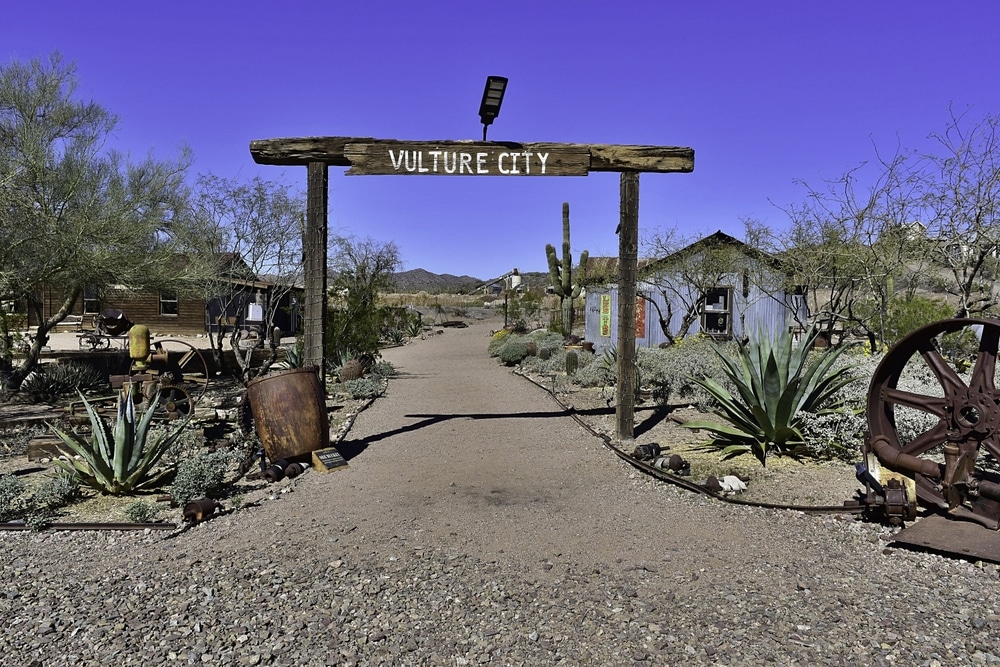
The scent of creosote mingles with leather and hay in Wickenburg, where Western heritage isn’t manufactured for tourists but lived daily by ranchers who still drive cattle across the high desert. This town of 8,300 residents sprawls across 18.8 square miles where the Sonoran Desert meets Arizona’s central highlands, creating a landscape that shifts from saguaro-studded valleys to juniper-dotted hills within a single horseback ride. As dawn breaks over the Bradshaw Mountains, you’ll hear roosters crow from backyard coops while pickup trucks rumble toward the feed store, reminding you that Wickenburg remains genuinely Western despite sitting just 54 miles northwest of Phoenix’s glass towers.
Founded in 1863 when Henry Wickenburg discovered the Vulture Mine—once Arizona’s most productive gold mine—the town evolved from mining camp to territorial capital contender to “Dude Ranch Capital of the World.” Today’s Wickenburg bridges multiple identities: working ranch town, artist colony, retirement haven, and increasingly, refuge for those seeking authentic desert living within reach of metropolitan amenities. The historic downtown along Wickenburg Way preserves frontier-era buildings now housing galleries, antique shops, and restaurants where spurs still jingle on worn wooden floors, while newer developments on the town’s edges accommodate those drawn to this unique blend of Western authenticity and desert beauty.

The Wickenburg housing market reflects dramatic shifts, with current median home prices around $338,000—down 22.3% from recent peaks, creating unexpected opportunities for buyers who understand the town’s long-term value proposition. This correction from previous highs positions Wickenburg as increasingly accessible, particularly for those seeking acreage and elbow room impossible to find at these prices closer to Phoenix. Properties typically spend 75 days on market, providing negotiation leverage rarely available in Arizona’s hotter submarkets, though desirable ranch properties and historic homes still command premiums and move quickly.
Housing diversity distinguishes Wickenburg from cookie-cutter suburbs, with options ranging from historic adobes near downtown to contemporary custom homes on multi-acre parcels in the surrounding hills. The Wickenburg Ranch Golf & Social Club offers luxury homes with golf course views, while areas like Rancho de los Caballeros provide estate lots for those dreaming of their own piece of the desert. Many properties include horse facilities, workshops, and guest houses—remnants of the dude ranch era now serving modern needs for home offices and multi-generational living. The recent market softening has made these unique properties more attainable, though inventory remains limited for truly special homes that capture Wickenburg’s Western character.

Wickenburg’s economy balances traditional sectors with emerging opportunities, creating a diverse if modest job market where 46.4% of residents participate in the labor force—reflecting the town’s significant retiree population alongside working families. Tourism remains vital, with guest ranches, restaurants, and Western-themed businesses providing steady employment, particularly during the October-through-April high season when snowbirds and tourists flood the area. The remarkably low 1.9% unemployment rate suggests those seeking work find opportunities, though many residents commute to Northwest Phoenix for higher-paying positions.
Healthcare has emerged as a significant employer, with Wickenburg Community Hospital and associated medical practices serving both local residents and the broader rural region. Government positions, accounting for 12.6% of employment, provide stable careers through the school district, town services, and various state and federal agencies managing the vast public lands surrounding Wickenburg. The median household income of $65,253 supports comfortable living given the area’s reasonable costs, while 15.78% of workers identify as entrepreneurs, reflecting a strong independent spirit manifested in everything from custom saddle shops to digital consulting firms run from home offices overlooking the desert. Agricultural operations, though diminished from historic levels, still employ ranch hands and support businesses serving the remaining cattle operations.

Education in Wickenburg centers on the Wickenburg Unified School District, serving students from prekindergarten through twelfth grade across a vast geographic area that extends far beyond town limits. The district operates two elementary schools, a middle school, and Wickenburg High School, home of the Wranglers, where Friday night football games remain community events drawing crowds to Alumni Field. Small class sizes allow personalized attention often lost in larger districts, while the rural setting provides unique learning opportunities through agricultural programs and partnerships with local ranches.
Wickenburg High School offers surprising academic depth for its size, with Advanced Placement courses, dual enrollment through Yavapai College, and career technical education programs including Western Maricopa Education Center (West-MEC) offerings. The school’s FFA and rodeo programs connect students to agricultural traditions while building practical skills and scholarship opportunities. For families seeking alternatives, Wickenburg Christian Academy provides faith-based education, while some families choose online options or homeschooling, supported by the library’s resources and community co-ops. Higher education requires travel, with Yavapai College’s nearest campus in nearby Congress and Arizona State University’s West campus about an hour away in Glendale, though many residents appreciate this separation between small-town life and urban institutions.

Healthcare in Wickenburg exceeds expectations for a town its size, anchored by Wickenburg Community Hospital, a critical access facility providing emergency services, inpatient care, and numerous specialties. The hospital’s affiliation with Abrazo Community Health Network ensures access to advanced care when needed, while maintaining the personal attention of a community facility where staff know patients by name. Recent expansions have added services including orthopedics, cardiology, and women’s health, reducing the need for trips to Phoenix for routine specialist visits.
The Del E. Webb Outpatient Center complements the hospital with diagnostic imaging, laboratory services, and rehabilitation programs designed for the active senior population. Several medical practices along Tegner Street offer primary care, with physicians who chose Wickenburg for the same quality-of-life reasons drawing new residents. For complex procedures or specialized pediatric care, Banner Del E. Webb Medical Center in Sun City West sits 30 miles away, while the full resources of Phoenix’s medical centers remain accessible for tertiary care. The concentration of healthcare services reflects Wickenburg’s demographics, with 40.7% of residents over 65, creating demand that supports medical infrastructure benefiting the entire community.

Living costs in Wickenburg remain refreshingly reasonable despite its destination appeal, with overall expenses aligning closely with national averages while delivering a lifestyle unavailable at any price in urban areas. Housing costs, particularly given recent market corrections, provide exceptional value for those seeking space and Western character. Grocery shopping at Safeway or local markets costs slightly more than Phoenix due to transportation, but farmers’ markets and local producers offer fresh options while supporting the community economy.
Utility expenses vary significantly based on property size and features, with Arizona Public Service electricity bills ranging from $150 monthly for efficient homes to $500+ for large properties with pools and extensive cooling needs during summer. Propane remains common for properties beyond natural gas lines, requiring bulk delivery but offering independence from utility connections. Water comes from the town system or private wells, with costs varying by source and usage—critical considerations given ongoing drought concerns. Internet service through Sparklight or satellite providers costs $70-150 monthly, with speeds adequate for remote work though not matching urban fiber options. The rural setting means longer drives for some services, but many residents consider the trade-off worthwhile for Wickenburg’s authentic Western lifestyle.

Transportation in Wickenburg centers entirely on personal vehicles, with the town’s spread-out nature and rural setting making cars essential for all but the most local errands. US Route 60 (Grand Avenue) serves as the main corridor, connecting Wickenburg to Phoenix in about an hour during off-peak times, though rush hour can extend this considerably. US Route 93 heads northwest toward Las Vegas and southeast toward Phoenix, providing alternate routes and serving as Arizona’s CANAMEX corridor for international trade, bringing steady truck traffic through town.
Within Wickenburg, navigation remains simple with the historic downtown grid giving way to winding roads that follow topography rather than planners’ straight lines. Parking is plentiful and free throughout town, with diagonal spaces along Wickenburg Way preserving the Old West feel. For those without vehicles, options remain extremely limited—no public transit serves the area, and ride-sharing services are sporadic at best. The Wickenburg Municipal Airport accommodates general aviation, popular with pilots flying in for breakfast at the airport café or accessing second homes. Many residents maintain “town cars” for local trips and more capable vehicles for exploring the extensive network of unpaved roads leading to ghost towns, hiking trails, and hidden desert treasures throughout the surrounding wilderness.

Wickenburg’s climate offers a gentler version of the Sonoran Desert experience, with elevations around 2,000 feet moderating the extreme heat that punishes lower desert cities. Summer temperatures still reach 105°F regularly from June through August, but evenings cool more quickly than in Phoenix, often dropping 30 degrees from afternoon peaks. Winter delivers near-perfect weather with daytime highs in the 60s and 70s, though overnight freezes occur occasionally from December through February, requiring attention to pipes and plants.
Annual rainfall averages 11 inches, slightly more than Phoenix, with monsoon thunderstorms from July through September bringing dramatic skies and flash flood risks in washes. The surrounding desert blooms spectacularly following wet winters, with wildflowers carpeting the hills in brilliant displays that draw photographers worldwide. Air quality generally remains excellent given the distance from urban pollution sources, though wind can stir dust and summer wildfires in the surrounding mountains occasionally affect visibility. The varied topography creates microclimates where elevation changes of just a few hundred feet alter vegetation from saguaro forests to juniper woodlands, providing diverse landscapes for exploration within minutes of town.

Tax advantages contribute to Wickenburg’s appeal, particularly for retirees managing fixed incomes. Arizona taxes income at 2.59% to 4.5%, with Social Security benefits exempt and generous deductions for seniors. The combined state, county, and town sales tax totals 8.3%, applied to most goods except groceries, keeping daily expenses manageable. Property taxes average around 0.6% of assessed value, though Wickenburg’s lower home prices mean actual tax bills remain modest compared to similar properties in metropolitan areas.
Vehicle registration through ADOT follows Arizona’s value-based system, with newer vehicles costing several hundred dollars annually while older trucks and cars drop below $100. The nearest MVD office in nearby Surprise handles in-person transactions, though many services complete online. Business licensing through the Town of Wickenburg remains straightforward and affordable, encouraging the entrepreneurship visible in downtown’s unique shops and services. The Arizona Department of Revenue’s online systems simplify compliance for the many residents managing rental properties, online businesses, or consulting practices from their Wickenburg bases. Agricultural exemptions benefit those maintaining livestock or growing crops, preserving the town’s ranching heritage while reducing tax burdens for working agricultural lands.

Community life in Wickenburg revolves around Western traditions and desert appreciation, with events like February’s Gold Rush Days celebrating the town’s mining heritage through rodeos, parades, and mucking and drilling contests. The Desert Caballeros Western Museum anchors cultural life with exceptional collections of Western art and regional history, while First Friday Art Walks bring locals and visitors to downtown galleries. The rhythm of small-town life means running errands involves conversations with neighbors, and community support appears immediately when families face challenges.
Recreation opportunities reflect the surrounding landscape’s gifts, with hiking trails leading to hidden petroglyphs and abandoned mines, while the Hassayampa River Preserve protects rare riparian habitat where over 280 bird species have been recorded. Wickenburg Ranch and Los Caballeros golf courses offer championship play with desert vistas, though many residents prefer exploring the extensive network of jeep trails and horseback routes throughout the surrounding public lands. The Vulture Peak Trail climbs to the historic mine that started it all, while the Constellation Park provides accessible stargazing in some of Arizona’s darkest skies. Social life centers on organizations like the Desert Caballeros Trail Riders, Wickenburg Gem & Mineral Society, and numerous service clubs where newcomers quickly find their tribes.

Your Wickenburg journey begins with understanding this isn’t suburban Phoenix with a Western theme, but a genuine small town where independence and self-reliance remain valued traits. The Wickenburg Chamber of Commerce, housed in the historic train depot, provides newcomer packets and connects you with everything from reliable contractors to the best farrier in town. Their website offers practical guidance about utilities, services, and the realities of desert living that glossy real estate brochures might overlook.
Local real estate professionals, particularly those with West USA Realty who understand ranch properties and water rights, can guide you through Wickenburg’s unique market where property descriptions include details about wells, easements, and carrying capacity for horses. Join Facebook groups like “Wickenburg Community” and “Wickenburg Buy, Sell, Trade” to tap into local knowledge about everything from hay suppliers to which restaurants serve authentic chuck wagon breakfast. The Wickenburg Public Library offers more than books, serving as a community hub where newcomers learn about local customs, from flash flood safety to why you always wave when passing on dirt roads.
Schedule your exploration during spring or fall when weather allows comfortable property viewing and you can experience signature events like the Bluegrass Festival or Art Walk. Spend time in local establishments like Anita’s Cocina or the Chaparral Homemade Ice Cream Parlor where conversations reveal whether Wickenburg’s blend of Western authenticity, desert beauty, and small-town dynamics matches your vision. Understanding that Wickenburg offers something increasingly rare—genuine community in an authentic Western setting—helps frame expectations appropriately.
Your story in Wickenburg begins with embracing a pace where horses have right-of-way downtown, where neighbors still help neighbors, and where the desert’s rhythms gradually replace urban urgency with something deeper and more enduring. Here, success isn’t measured in commute times or property values but in sunsets watched from your porch and the satisfaction of living where the West remains real.
We use cookies to improve your experience on our site. By using our site, you consent to cookies.
Manage your cookie preferences below:
Essential cookies enable basic functions and are necessary for the proper function of the website.
Statistics cookies collect information anonymously. This information helps us understand how visitors use our website.
Marketing cookies are used to follow visitors to websites. The intention is to show ads that are relevant and engaging to the individual user.