Nestled in the verdant valley of the Gila River in southeastern Arizona, Duncan stands as a testament to the enduring spirit of rural America. This small agricultural community of about 700 residents sits at an elevation of 3,600 feet along the Arizona-New Mexico border, surrounded by the dramatic volcanic formations of the Peloncillo Mountains to the south and the Blue Range to the north. The demographic makeup reflects deep roots, with many residents able to trace their lineage back four or five generations to the original Mormon pioneers and ranching families who settled the area in the late 1800s. More recent additions include retirees drawn to the peaceful rural setting and Hispanic families connected to both agricultural work and centuries-old cultural ties to the region. What makes Duncan truly distinctive is its remarkable continuity—while many small rural communities have experienced dramatic population decline and economic disruption, Duncan has maintained its essential character as a working agricultural community where irrigation ditches dating to territorial days still water fields, multigenerational family ranches operate on original homesteads, and community celebrations established a century ago continue to bring residents together around shared values of self-sufficiency, cooperation, and deep connection to the land.
Long before Europeans arrived in the Gila Valley, this fertile riverine corridor was home to indigenous peoples who recognized its exceptional agricultural potential. Archaeological evidence indicates that Mogollon cultures established settlements in the area as early as 300 CE, developing sophisticated irrigation systems to channel the Gila River’s flow. Later, the region became part of the territory utilized by Western Apache groups, who maintained seasonal camps along the river’s course while ranging across the surrounding mountains for hunting and gathering.
The Spanish colonial period brought dramatic changes to the region, with expeditions beginning in the 16th century documenting the Gila River valley. However, permanent European settlement didn’t begin until the mid-19th century, after the Gadsden Purchase of 1854 incorporated this territory into the United States. The area that would become Duncan was initially settled in the 1870s by prospectors and ranchers attracted by abundant grazing land and proximity to copper mining operations in the nearby Clifton-Morenci area.
A pivotal moment in Duncan’s development came in the early 1880s when the Arizona Copper Company built a narrow-gauge railroad through the valley to connect the Clifton-Morenci mines with the Southern Pacific Railroad at Lordsburg, New Mexico. This transportation link made the area more accessible and attracted new settlers, including a significant contingent of Mormon pioneering families seeking agricultural opportunities. Settlers built the canal system that continues to define the community’s agricultural landscape, and the town took its name from Duncan Smith, managing director of the Arizona Copper Company.
The settlement first appeared in the 1883 Post Office register under the name Purdy. Throughout the early 20th century, Duncan developed as a supply center for surrounding ranches and farms, with its prosperity tied closely to the cycles of agriculture and the fortunes of nearby mining operations.
| Category | Details |
|---|---|
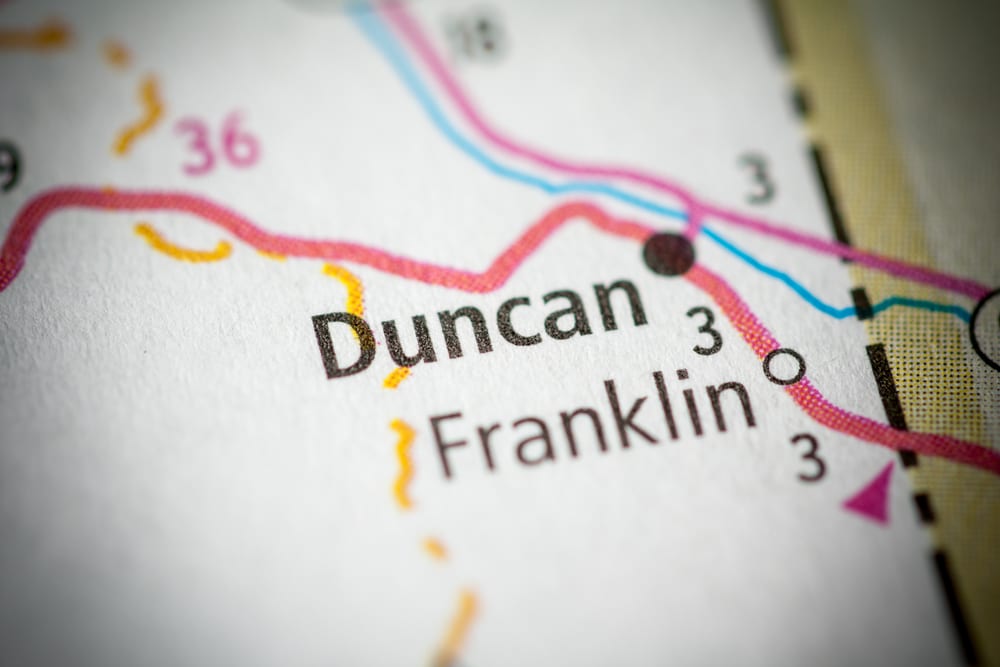
| Location | Southeastern Arizona, Greenlee County, near the New Mexico border |
| Founded | Late 1800s; established as a stage stop and farming settlement |
| Incorporated | 1938 |
| Population | 694 (2020 Census) |
| Elevation | ~3,655 feet (1,114 meters) |
| Climate | Semi-arid; hot summers, mild winters |
| Known For | Farming, ranching, Gila River Valley setting, Old West history |
| Major Attractions | Duncan Museum, historic Main Street, Gila River trails, Hal Empie Studio & Gallery |
| Key Industries | Agriculture (especially cotton, alfalfa, and cattle), local services |
| Cultural Significance | Childhood home of Supreme Court Justice Sandra Day O’Connor, raised on the nearby Lazy B Ranch; long-standing Mormon and Hispanic roots |
| Annual Events | Duncan Pride Days, local rodeos, community parades |
| Transportation | U.S. Route 70; close to Lordsburg, NM, and Clifton/Morenci mining region |
| Education | Duncan Unified School District |
| Nearby Natural Sites | Gila River, Black Hills, Apache-Sitgreaves National Forest (to the north) |
| Community Features | Quiet rural setting, small businesses, churches, local schools |
| Development Style | Agricultural and historical, with a focus on small-town community life |
Duncan’s cultural identity has been shaped by four primary influences: Mormon pioneering traditions, Western ranching culture, Hispanic heritage, and mining industry connections. These distinct cultural streams have sometimes maintained separate traditions while in other aspects blending to create a distinctive local culture uniquely adapted to this borderland region.
The Mormon influence remains significant, with descendants of original pioneering families maintaining cultural practices around community cooperation, self-sufficiency, and religious observance. The practice of “work parties,” where community members gather to assist neighbors with large projects like barn-raising or harvest, stems from this Mormon tradition but has expanded to include the broader community. Similarly, food preservation techniques introduced by Mormon settlers have become widespread throughout the community, with annual canning sessions bringing together families from diverse backgrounds.
Ranching culture has contributed its own distinctive traditions, particularly around horsemanship, leather-working, and seasonal activities like cattle drives and brandings. These working traditions remain vibrant rather than ceremonial, with practical skills passed down through generations and adapted to contemporary contexts.
Hispanic cultural influences are evident in architectural styles, culinary traditions, and religious practices. Many families maintain connections with relatives across the border in Mexico, creating cultural continuity that transcends national boundaries. Traditional adobe building techniques have influenced local construction, while Hispanic food traditions have become integral to community celebrations.
Despite being primarily an agricultural community, Duncan’s proximity to the Clifton-Morenci mining district has created cultural connections to mining traditions as well. Many residents worked in the mines while maintaining homes and small farms in Duncan, creating a cultural identity that bridges agricultural and industrial worlds. Stories and songs from mining culture have been incorporated into local oral traditions, while practical skills like metalworking have found applications in agricultural contexts.
Duncan’s artistic expression emerges organically from its working landscape and cultural traditions rather than through formal arts institutions. This deeply pragmatic community has developed distinctive creative traditions where functionality and beauty intertwine, reflecting the community’s values of resourcefulness and connection to place.
Traditional Western crafts form the foundation of Duncan’s artistic identity, with multiple generations practicing leatherwork, rawhide braiding, quilting, and woodworking. These craft traditions originated as practical skills needed for daily life on ranches and farms but have evolved to include increasingly elaborate decorative elements.
Visual arts celebrating the surrounding landscape have gained prominence in recent decades, with several local painters developing distinctive interpretations of the Gila Valley’s dramatic light and topography. The volcanic formations of the Peloncillo Mountains, with their complex textures and colors changing throughout the day, provide inspiration for both representational and abstract works.
Folk art traditions flourish, particularly in the creation of yard art and garden ornaments that repurpose found objects from agricultural and mining contexts. Windmills constructed from discarded farm equipment, garden sculptures incorporating obsolete tools, and decorative fences made from historic barbed wire samples exemplify the community’s waste-not approach to aesthetics. These creations reflect Duncan’s values of resourcefulness while documenting the material culture of its agricultural and industrial past.
Public gatherings often incorporate arts that might elsewhere be considered craft, including Dutch oven cooking competitions that evaluate both taste and visual presentation, horsehair hitching demonstrations that create intricate decorative patterns for practical use, and saddle-making exhibitions where aesthetic choices reflect both regional traditions and individual expression.
What distinguishes Duncan’s artistic identity is its integration into daily life rather than separation as specialized activity. Here, artistic expression remains connected to work, community, and landscape in ways that many contemporary arts communities strive to recapture. This integration ensures that creative traditions remain vital and evolving rather than preserved as static artifacts of the past.
Locals often refer to their community as “The Valley,” reflecting the geographic reality that shapes daily life along the Gila River flood plain. This reference point emphasizes the community’s connection to its landscape—residents don’t just live in Duncan; they live in “The Valley,” a place defined by natural boundaries rather than political ones.
The physical character of Duncan reflects its agricultural purpose and evolutionary development rather than formal planning. The historic downtown features predominantly brick buildings constructed in the early 1900s, many with Western false fronts and simple utilitarian designs intended for commercial function. Residential areas display a mix of architectural styles, from early adobe structures and pioneer-era wood frame houses to mid-century ranch homes, with few deed restrictions or design regulations creating an organic, incremental development pattern.
Community values center on self-sufficiency, neighborly support, and pragmatic problem-solving. “Make do or do without” remains a commonly expressed ethic reflecting both the Mormon pioneering influence and the practical realities of life in a remote rural community. This self-reliance is balanced by strong traditions of mutual aid, exemplified by the community’s response to periodic Gila River flooding. When waters rise, residents mobilize across family, religious, and cultural lines to sandbag vulnerable properties and provide shelter for displaced neighbors, demonstrating the communal bonds that underlie the individualist ethos.
Perhaps most distinctive about Duncan’s identity is its matter-of-fact relationship with history—residents don’t preserve historical practices as performance or nostalgia but because many traditional approaches remain practical and efficient in this particular environment. Historic irrigation systems continue to function effectively, traditional building techniques remain well-adapted to the local climate, and community customs around water management and communal work still solve real problems. This living relationship with history creates an authenticity that distinguishes Duncan from communities where historical elements are maintained primarily for touristic or sentimental purposes.
Duncan is an incorporated town with an elected mayor and council. This formal governance structure oversees basic municipal services including water, sewer, police protection, and road maintenance within town limits. However, the true governance of community life extends far beyond official municipal boundaries, encompassing a complex network of formal and informal institutions that manage resources, address conflicts, and maintain community standards.
Religious institutions play important governance roles beyond their spiritual functions. The Church of Jesus Christ of Latter-day Saints ward and the First Baptist Church, the community’s two largest congregations, maintain formal assistance programs that complement government services and coordinate volunteer responses to community needs. Their buildings serve as emergency shelters, community meeting spaces, and distribution points for assistance during periodic flooding or other crises.
Despite limited financial resources, Duncan maintains relatively high citizen participation in formal governance, with town council meetings regularly attended by engaged residents and municipal elections generating robust engagement. This participation reflects the community’s understanding that in a small rural town, government functions as a direct extension of community will rather than a distant bureaucracy, creating both opportunity and responsibility for citizen involvement in decisions that directly affect daily life.
Duncan’s economy remains firmly rooted in agriculture, with farming and ranching continuing as primary economic drivers despite the challenges facing rural agricultural communities nationwide. The fertile soil of the Gila River flood plain, combined with the irrigation infrastructure developed over generations, supports a diverse agricultural base including chile peppers, cotton, alfalfa, corn, and various vegetable crops. Cattle ranching predominates in the surrounding uplands, with several multi-generational operations maintaining herds on both private land and federal grazing allotments.
Unlike many agricultural areas that have transitioned to large-scale industrial operations, Duncan’s agricultural sector remains characterized by family-scale enterprises, with most operations ranging from 100-500 acres. This scale allows for greater crop diversity and more rapid adaptation to changing market conditions than larger monoculture operations. Recent years have seen increasing specialization in chile pepper varieties uniquely adapted to local growing conditions, creating market differentiation that commands premium prices from regional food processors and specialty markets.
The small business ecosystem reflects the community’s agricultural foundation and remote location. Main Street businesses include farm supply stores, equipment repair shops, and agricultural service providers alongside basic retail establishments serving local needs.
Economic challenges include limited access to capital for business expansion, aging irrigation infrastructure requiring significant investment, and the ongoing struggle to retain young people who often leave for education or employment opportunities in larger communities. Water security represents perhaps the most significant long-term economic concern, with climate change projections suggesting decreased Gila River flows that could threaten the agricultural foundation upon which the community depends.
Education in Duncan centers on the Duncan Unified School District, which serves students from both the town and surrounding rural areas. Despite limited resources common to rural districts, Duncan schools maintain strong academic performance and exceptionally high graduation rates, reflecting the community’s commitment to educational excellence and the close relationships possible in a small school environment.
The educational philosophy underlying these diverse initiatives emphasizes practical application, intergenerational knowledge transfer, and connection to place—preparing young people both to succeed in the wider world and to maintain the specific knowledge and skills that have sustained this community through multiple generations.
Duncan exists in intimate relationship with its natural environment, situated where the Gila River valley creates a green oasis surrounded by the arid landscapes of the Peloncillo and Blue Mountain ranges. This geographically diverse setting, ranging from riparian river corridors to desert uplands and forested mountains, has shaped community life since the earliest settlements. Residents maintain deep practical knowledge of local ecosystems, weather patterns, and natural resources—knowledge essential for agricultural success in this challenging environment where rainfall averages just 11 inches annually and summer temperatures regularly exceed 100 degrees.
Traditional relationships with the natural world remain evident in agricultural practices adapted to local conditions. Irrigation techniques developed by indigenous peoples and refined by generations of farmers channel the Gila River’s flow through gravity-fed earthen ditches that follow natural contours of the land. These traditional systems use significantly less energy than pumped irrigation while maintaining soil health through mineral-rich river sediment. Similarly, ranching families maintain detailed knowledge of seasonal grazing patterns that maximize rangeland health, rotating cattle through upland and valley pastures according to precipitation patterns and plant growth cycles.
Plant knowledge represents another dimension of the community’s environmental relationship. Many residents maintain working knowledge of native plant uses, from medicinal applications of creosote bush and Mormon tea to food uses of mesquite pods and prickly pear fruit.
Hunting maintains both practical and cultural significance, with seasonal deer and javelina hunting providing an important protein source for many families while strengthening intergenerational bonds through shared outdoor experiences. Hunting camps established generations ago continue as sites of knowledge transfer, where young people learn not just hunting skills but broader lessons about wildlife behavior, landscape reading, and ethical harvest practices. These traditions emphasize subsistence rather than trophy hunting, focusing on full utilization of harvested animals and respect for the natural systems that support wildlife populations.
Duncan’s food traditions reflect its position at the confluence of multiple cultural influences and its continuous agricultural history. The community’s culinary heritage combines elements from Mormon pioneer cooking, Hispanic borderland traditions, Western ranch cuisine, and adaptations to the specific ingredients available in this river valley oasis.
Central to Duncan’s food identity is the chile pepper, with the community maintaining distinct local varieties adapted to the specific growing conditions of the Gila Valley. Annual chile roasting gatherings in late summer bring families together to prepare and preserve the year’s harvest, with wood-fired roasters set up in backyards throughout the community. The distinctive aroma of roasting chiles permeates the town during these weeks, creating a sensory marker of seasonal transition recognized by residents across generations.
Hispanic culinary influences are evident in numerous community traditions, particularly techniques for preparing beef. “Carne Seca,” a method of dry-curing thin-sliced beef in the desert sun, originated with vaquero traditions and continues as both practical food preservation and cultural practice. This preparation method creates intensely flavored dried beef used in multiple dishes throughout the year, providing protein when fresh meat might be unavailable. Similarly, traditional tamale-making gatherings bring together extended families and neighbors for daylong preparation sessions, with specific techniques and seasoning blends distinguishing family traditions while maintaining the broader cultural practice.
Perhaps most significant in Duncan’s food culture is the continuing prevalence of home food production and preservation. These practices represent not just economic necessity but cultural values around self-sufficiency, quality, and connection to food sources—values that have regained wider appreciation as local food movements have developed in more urban areas.
In Duncan, community gathering places serve essential functions beyond mere socializing—they create the spaces where information is exchanged, traditions maintained, and community identity reinforced. These gathering places include both formal venues designated for public use and informal locations that have organically developed as social hubs through patterns of community life.
Religious facilities serve important gathering functions beyond spiritual purposes. The LDS Ward House and First Baptist Church both maintain multipurpose spaces used for community events, youth activities, and emergency services during floods or other disasters. These buildings function as extensions of community infrastructure rather than exclusively religious spaces, hosting 4-H Club meetings, adult education classes, and community health clinics that serve the broader population regardless of religious affiliation.
Perhaps most distinctive among Duncan’s gathering places are the irrigation ditches that traverse the community. These working waterways double as social spaces, with informal gatherings occurring during communal maintenance days when neighbors work together to clear vegetation and repair earthen banks. The ditches serve as communication networks as water users encounter each other while adjusting gates and managing flow, creating opportunities for information exchange about crop conditions, community news, and upcoming events. These interactions maintain a traditions of water diplomacy essential in arid agricultural communities, where face-to-face communication prevents conflicts over this critical shared resource.
Outdoor gathering places reflect the community’s connection to its natural environment. The Gila River crossing near the historic “Duncan Bridge” serves as an informal recreation area where families gather for swimming and picnicking during summer months, maintaining a tradition that spans generations. The Duncan Rodeo Grounds hosts not just formal competitions but regular practice sessions, team roping events, and horsemanship clinics that bring together participants and spectators in a shared cultural space celebrating western heritage.
School facilities serve gathering functions beyond formal education, with the football field and gymnasium providing venues for events that bring together the broader community. Friday night football games function as weekly community gatherings during fall months, while the school library hosts monthly community book discussions that connect residents around shared reading experiences.
What distinguishes Duncan’s gathering places is their multifunctional, intergenerational character—spaces serve multiple purposes and bring together community members across age groups, occupations, and cultural backgrounds. This integration creates the ongoing interactions that maintain community cohesion despite differences that might otherwise create separation or isolation in larger communities with more specialized gathering places.
Duncan faces significant challenges common to many rural agricultural communities while confronting unique issues specific to its location and circumstances. The community’s responses to these challenges demonstrate remarkable resilience rooted in both practical problem-solving capacity and strong social connections that enable collective action in the face of adversity.
Water security represents perhaps the most fundamental challenge, with climate change projections suggesting decreased Gila River flows and increased drought frequency that could threaten the agricultural foundation upon which the community depends. Historic water rights established in territorial days provide legal protection for existing uses, but diminished overall water availability could undermine these rights’ practical value. The community has responded with multiple adaptation strategies, including conversion to more efficient irrigation technologies, transition to less water-intensive crops, and watershed restoration projects designed to improve water retention and aquifer recharge.
Economic challenges include limited employment opportunities beyond agriculture, resulting in ongoing population loss as young people leave for education and careers elsewhere. Between 2000 and 2020, Duncan experienced approximately 15% population decline, with particularly significant losses among adults aged 25-40. This demographic shift threatens long-term community sustainability by reducing school enrollment, diminishing the workforce, and interrupting intergenerational knowledge transfer.
Infrastructure maintenance presents ongoing challenges for a small municipality with limited resources. Many community systems—from water delivery to road networks—were established decades ago and require significant investment to meet contemporary standards.
Access to healthcare represents another significant challenge, with the nearest hospital located 40 miles away in Safford and no full-time medical providers within the community itself. This situation creates particular hardships for elderly residents and young families.
Perhaps most significant is Duncan’s response to the periodic flooding that has threatened the community throughout its history. The Gila River, while essential to agricultural life, represents an ongoing threat, with major flood events occurring approximately once per decade. Rather than relocating or constructing elaborate flood control infrastructure, the community has developed remarkable adaptive capacity—maintaining evacuation plans, designing critical buildings with flood-resistant features, and creating community response networks that activate rapidly when waters rise.
These demonstrations of community resilience share common elements: they combine traditional knowledge with appropriate contemporary adaptations, they mobilize broad participation across social boundaries, and they build on existing relationships and institutions rather than creating separate emergency responses. This integrated approach to community challenges reflects Duncan’s fundamental character—practical, self-reliant, and deeply connected to both place and people.
What distinguishes Duncan’s approach to balancing past and future is its orientation toward practical solutions rather than ideological positions. The community evaluates potential changes based on their compatibility with core values and their practical benefit to current and future residents rather than abstract notions of progress or preservation. This pragmatic approach creates space for innovation within tradition, allowing the community to evolve while maintaining authentic connections to its agricultural heritage and distinctive sense of place.
The essence of Duncan cannot be captured in statistics or mapped in property boundaries—it resides in the intangible qualities that create deep attachment to this place and its people. When asked what makes their community special, residents consistently mention the seamless integration of past and present, the authentic connections between people and landscape, and the remarkable continuity that allows multiple generations to share meaningful experiences despite the rapid changes transforming the wider world.
The heritage, arts, culture, and community events that define Duncan remain vital precisely because they continue to serve authentic purposes rather than becoming performances for outside observers. Irrigation practices persist because they effectively deliver water to crops, traditional building techniques continue because they remain well-adapted to local climate conditions, and community celebrations mark genuine transitions in agricultural cycles and community life rather than arbitrary commemorations.
Perhaps most remarkable about Duncan is how unremarkable residents find their community’s distinctiveness—the continuity that appears increasingly exceptional in contemporary America represents simply “how things are done” for those who have maintained these traditions through generations. This unpretentious authenticity, where history remains a living presence rather than a curated display, constitutes the true soul of this resilient desert community—a place that faces forward while remaining deeply rooted in the agricultural traditions and human connections that have sustained it through nearly 150 years of challenges and adaptations along the banks of the Gila River.
We use cookies to improve your experience on our site. By using our site, you consent to cookies.
Manage your cookie preferences below:
Essential cookies enable basic functions and are necessary for the proper function of the website.
Statistics cookies collect information anonymously. This information helps us understand how visitors use our website.
Monetize your website by displaying targeted ads and earning revenue from clicks and impressions.
Google Analytics is a powerful tool that tracks and analyzes website traffic for informed marketing decisions.
Service URL: policies.google.com (opens in a new window)
You can find more information about our Cookie Policy and Privacy Policy.