Castle Dome Landing grew up on the east bank of the Colorado River, about 30 miles north of Yuma, as the shipping point for the silver and lead mines of the Castle Dome Mountains. From 1878 to 1884 it had its own post office and served as the first steamboat stop upriver from Yuma. The old landing now lies beneath the reservoir behind Imperial Dam, while the mining camp it served survives as the Castle Dome Mines Museum.
The first prospectors in the Castle Dome Mountains came looking for silver, but much of what they found was lead ore, and many left disappointed. The landing was founded on the Colorado River in 1864 to supply the mines and ship their ore. Sherman and Sherman’s Ghost Towns of Arizona (1969) prints an 1877 photograph of the landing from the Sharlot Hall Museum.
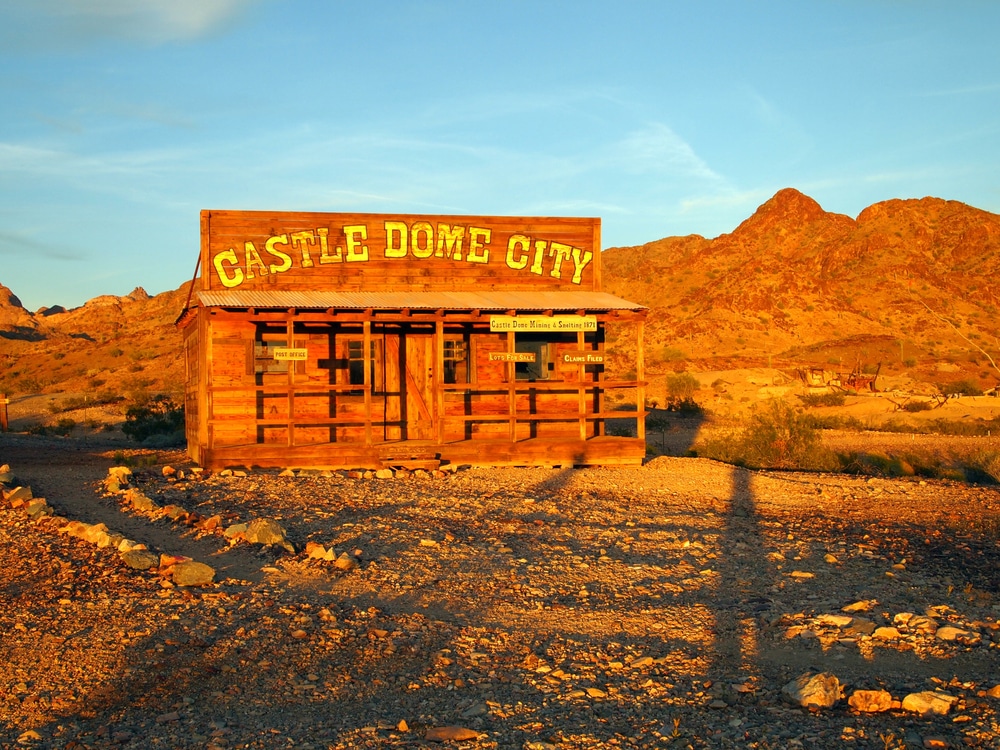
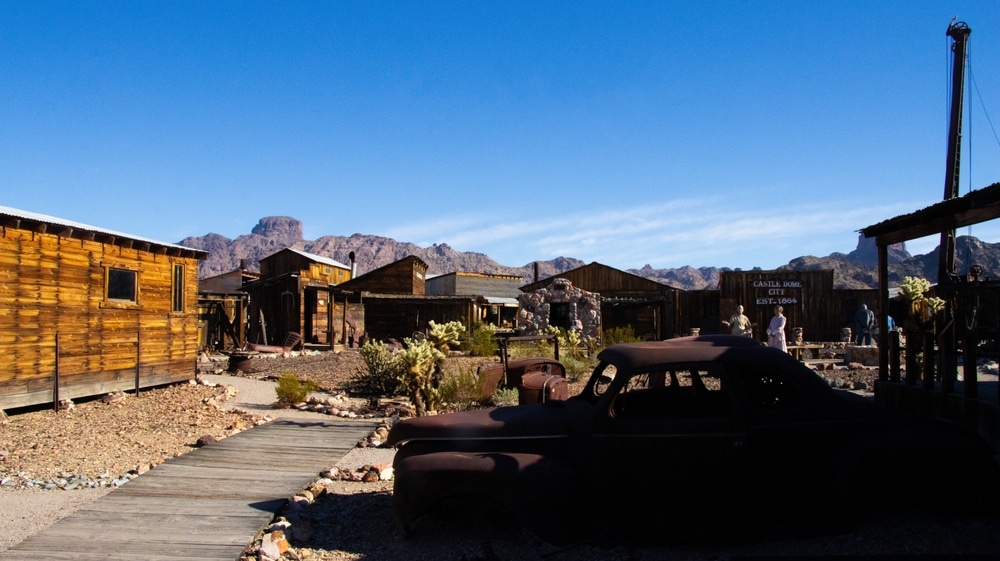
The heart of any visit is the Castle Dome Mine Museum, a sprawling outdoor museum with over 50 reconstructed and restored buildings that recreate life in the late 1800s mining town. Visitors can wander through authentic structures including:
A sheriff’s office and jail
General store and saloon
Schoolhouse and chapel
Blacksmith shop, miners’ cabins, and brothel
Each building is filled with period-correct artifacts, giving a sense of daily life during Arizona’s early mining boom. Interpretive signs and friendly staff bring the history to life.
The museum is built atop the original Castle Dome Mine, which produced significant amounts of silver, lead, and zinc. You can see old mine shafts (safely fenced off), headframes, ore carts, and tools used in the rugged terrain of the Castle Dome Mountains. It’s one of the best places in Arizona to see preserved mining infrastructure in a realistic setting.

A highlight of the museum is the fluorescent mineral exhibit, located underground in one of the original mine shafts. Under blacklight, the minerals glow in brilliant colors—an exciting and educational experience for both kids and adults interested in geology and mining science.

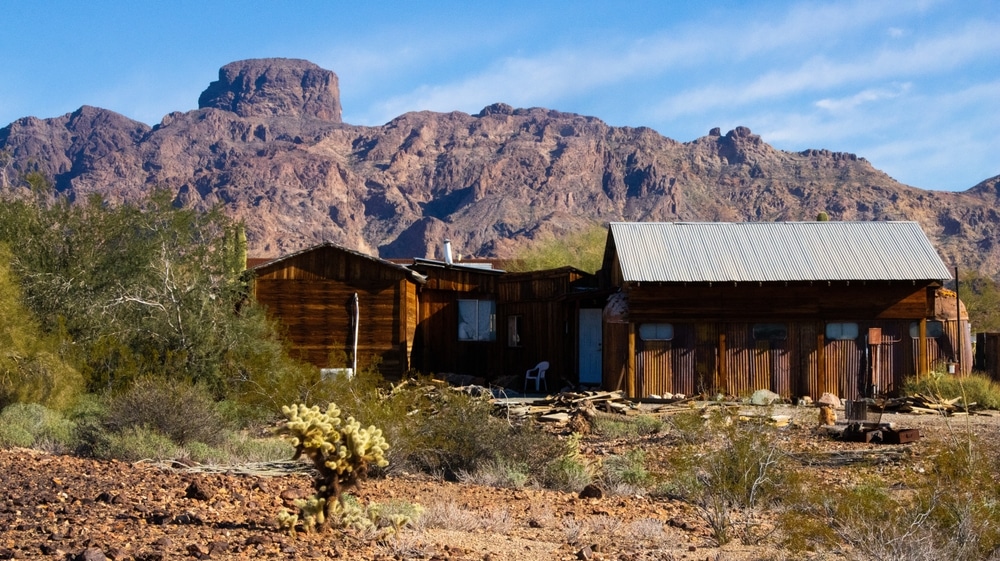
The Castle Dome Mountains provide a stunning backdrop to the ghost town. With their jagged volcanic peaks, saguaro-studded hills, and expansive desert skies, the area is a dream for photographers. The golden hour transforms the ghost town into a cinematic scene straight from the Old West.
The remote location offers opportunities to spot desert wildlife, including hawks, owls, mule deer, coyotes, jackrabbits, and lizards. Birdwatchers will appreciate the peaceful, undeveloped surroundings and the occasional appearance of desert-dwelling raptors and songbirds.
The museum is on private property, and the road to it crosses the Yuma Proving Ground and Kofa National Wildlife Refuge, so check the rules for any land before collecting outside the museum grounds. The region is known for its variety of minerals, including wulfenite, fluorite, vanadinite, and colorful quartz specimens.

With almost no light pollution, the Castle Dome Mountains are a fantastic place for stargazing. After sunset, the skies come alive with stars, constellations, and meteor showers. Bring a telescope or simply recline and enjoy the Milky Way stretching across the sky.
| Category | Details |
|---|---|
| Name | Castle Dome Landing, Arizona |
| Type | Ghost town (former Colorado River steamboat landing) |
| County | Yuma County |
| Founded | 1864 |
| Status | Abandoned; the site now lies under the reservoir behind Imperial Dam |
| Population (Historic) | Over 3,000 around 1880 by some accounts; about 50 full-time residents by others |
| Population (Current) | None |
| Historical Significance | Served as a major mining camp and Colorado River port during Arizona’s silver and lead boom |
| Primary Industry | Supply and shipping point for the Castle Dome lead and silver mines |
| Post Office | 1875–1876 (Castle Dome) and 1878–1884 (Castle Dome Landing) |
| Decline Factors | Ore depletion, isolation, railroad bypass, Colorado River course changes |
| Remnants Today | None at the landing; the mining camp it served survives as the Castle Dome Mines Museum |
| Managed As | Landing: under water. Mining camp: privately owned Castle Dome Mines Museum |
| Nearby Landmark | Castle Dome Peak, Castle Dome Mountains |
| Access | Landing site not accessible. Museum: from US 95 at mile marker 55, about 10 miles east (first 3 miles paved) |
| Elevation | Approx. 200 feet (62 meters) at the old river landing |
| Climate | Sonoran Desert – extremely hot summers, mild winters |
| Best For | Ghost town tourists, photographers, family travelers, mining history buffs |
Castle Dome Landing’s story begins with the discovery of silver and lead deposits in the nearby Castle Dome Mountains in the early 1860s. Earlier miners had worked these deposits before Americans arrived, and the mineral riches attracted renewed interest after the 1848 Treaty of Guadalupe Hidalgo brought this territory north of the Gila River under American control.
By 1864, the Castle Dome Mining District had been officially established, and miners needed a reliable way to transport ore and receive supplies. The logical solution was to create a port on the Colorado River, which served as the region’s primary transportation artery before the arrival of railroads. Thus, Castle Dome Landing was established about 30 miles north of Yuma, where steamboats could dock.
The settlement quickly grew from a simple landing site to a proper community serving as the lifeline for the mining district located about 17 miles to the east in the Castle Dome Mountains. While the mines themselves spawned their own small settlement (Castle Dome City), the Landing became the commercial hub due to its critical transportation function.
By some accounts, Castle Dome Landing housed more than 3,000 people around 1880 and rivaled Yuma in size, though other sources put its full-time population at only about 50. At its peak the community had a post office, a hotel, a saloon, a general store and smelting facilities.
The Landing represented an economic bright spot during Arizona’s territorial period, flourishing while much of the territory struggled with isolation, Apache conflicts, and limited resources. Its development paralleled Arizona’s gradual transition from military outpost to mining region to more diverse economy. The Colorado River steamboat network that sustained Castle Dome Landing was part of a transportation revolution that helped integrate this remote corner of the Southwest into the nation’s economic fabric before railroads rendered river commerce obsolete.
Today, visitors will find nothing left of the once-thriving port town. The site of Castle Dome Landing, once on the bank of the Colorado River, now lies beneath the reservoir behind Imperial Dam near Martinez Lake.
Flooding and the construction of modern dams have significantly altered the Colorado River since the Landing’s heyday, erasing the historical landscape.
While Castle Dome Landing itself has virtually disappeared from the physical landscape, the associated mining district has been better preserved. The Castle Dome Mine Museum, created after Allen and Stephanie Armstrong bought the old town site in 1994, has reconstructed portions of the mining camp located in the mountains east of the Landing. This open-air museum features over 50 restored and reconstructed buildings including a church, saloons, assay office, and various miners’ cabins, providing visitors a tangible connection to the region’s mining heritage.
Castle Dome Landing’s story is inextricably linked to transportation networks—first through its dependence on river navigation and later through its decline in the face of railroad competition. Unlike many Western settlements that owed their existence to railroad expansion, Castle Dome Landing predated trains in Arizona Territory, flourishing instead through the Colorado River steamboat system that served as the region’s commercial lifeline.
From the 1860s through the 1880s, steamboats represented the most efficient transportation option for the isolated southwestern territories. Castle Dome Landing developed specifically to serve as a transfer point between the mines in the Castle Dome Mountains and the steamboats plying the Colorado. Ore would travel by wagon from the mines to the Landing, where it was loaded onto steamboats bound for processing facilities in California. Return trips brought necessary supplies, mail, and passengers to the isolated mining district.
Companies like the Colorado Steam Navigation Company operated vessels specifically designed for the challenging river conditions—shallow-draft stern-wheelers that could navigate the Colorado’s frequent sandbars and changing channels.
The arrival of railroads in Arizona Territory beginning in 1877 fundamentally altered this transportation equation. The Southern Pacific Railroad reached Yuma in 1877, connecting it directly to California markets and bypassing the more time-consuming river route. Though Castle Dome Landing was not immediately affected, this development foreshadowed the coming transformation.
Castle Dome Landing’s heyday was short. As mining activity slackened, the landing’s post office closed on June 16, 1884. The mines in the Castle Dome Mountains reopened in 1890 and later supplied lead during both world wars, but by 1978 the mines had shut down and the last residents were gone.
Castle Dome Landing occupies a distinctive place in Arizona’s territorial history as both a transportation hub and mining service community that flourished before railroads redefined the region’s development patterns. The settlement represents an important chapter in the Colorado River’s commercial history, when steamboats connected the isolated Southwest to California markets and eastern goods.
Historically, Castle Dome Landing served as a vital link in the mineral extraction economy that drove much of Arizona’s early development. The silver and lead from the Castle Dome Mining District contributed significantly to territorial growth, providing both direct employment and tax revenue that supported broader infrastructure development.
The Landing’s development paralleled Arizona’s transition from military outpost to mining region to more diversified economy. Its rise and fall exemplify the boom-and-bust cycle that characterized many Western resource communities, though its transportation function gave it greater longevity than some purely extractive settlements.
Today, while the site of Castle Dome Landing lies beneath the waters behind Imperial Dam, its historical significance is preserved and interpreted through the Castle Dome Mine Museum. This facility is located at the former mining camp rather than at the Landing itself. The museum’s preservation work ensures that the Landing’s story remains part of public understanding of Arizona’s development, connecting visitors to this vanished river port and the economic networks it supported.
Because the site of Castle Dome Landing now lies underwater, visitors interested in this historical community connect with it through the mining camp it once served.
The primary point of connection for most visitors is the Castle Dome Mine Museum, located in the Castle Dome Mountains about 17 miles east of the original Landing site. This open-air museum preserves and interprets the mining community that the Landing once served, with over 50 restored and reconstructed buildings creating an immersive historical environment.
As the sun sets over the waters that now cover the site of Castle Dome Landing, we are reminded of the ephemeral nature of human endeavor. A river port that by some accounts once rivaled Yuma has vanished entirely.
Yet in this seeming emptiness, Castle Dome Landing speaks eloquently about the cycles of Western American development—the rush of mineral discovery, the vital importance of transportation networks, and the eventual reconciliation with economic and environmental realities. The settlement’s rise and fall paralleled Arizona’s territorial development, reflecting broader patterns of frontier exploitation, community building, and eventual transformation or abandonment.
The pioneers of Castle Dome Landing came seeking opportunity on a distant frontier but created something more lasting in the process—they helped establish the economic and social foundations of modern Arizona. Their riverboat connections integrated this remote outpost into national and international networks of commerce and communication before changing transportation technology rendered their location obsolete.
Lingenfelter, R. E. (1978). Steamboats on the Colorado River, 1852-1916. University of Arizona Press.
Castle Dome Mine Museum
Primary site for artifacts and information about the mining district and Landing
Castle Dome Mine Museum is reached by turning off US 95 at mile marker 55, between Yuma and Quartzsite, and following that road about 10 miles to its end
Site is accessible via Castle Dome Road off Highway 95
GPS coordinates: 33°02′45″N 114°11′20″W
The museum is open seasonally; check its website for hours before you go
We use cookies to improve your experience on our site. By using our site, you consent to cookies.
Manage your cookie preferences below:
Essential cookies enable basic functions and are necessary for the proper function of the website.
Statistics cookies collect information anonymously. This information helps us understand how visitors use our website.
Monetize your website by displaying targeted ads and earning revenue from clicks and impressions.
Google Analytics is a powerful tool that tracks and analyzes website traffic for informed marketing decisions.
Service URL: policies.google.com (opens in a new window)
You can find more information about our Cookie Policy and Privacy Policy.