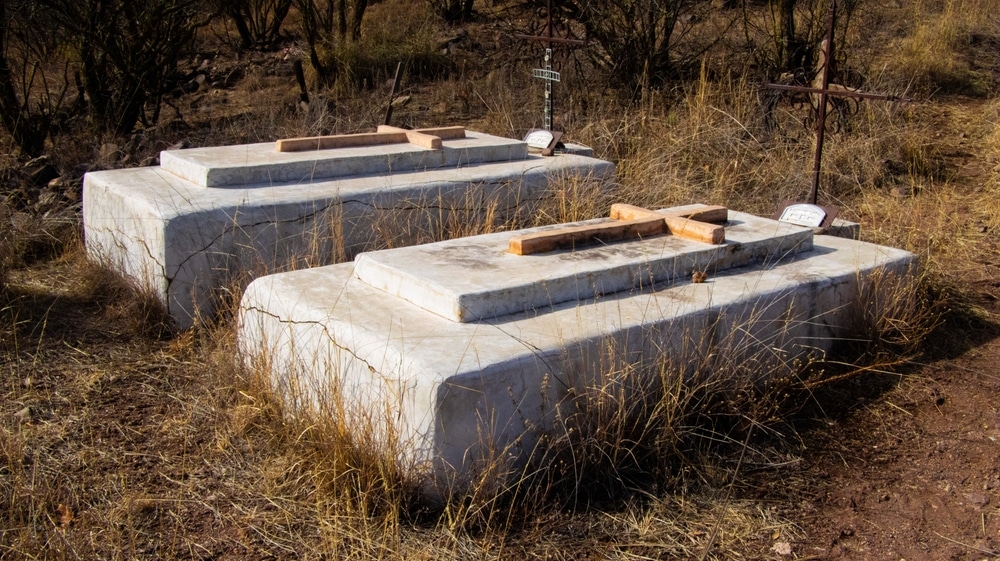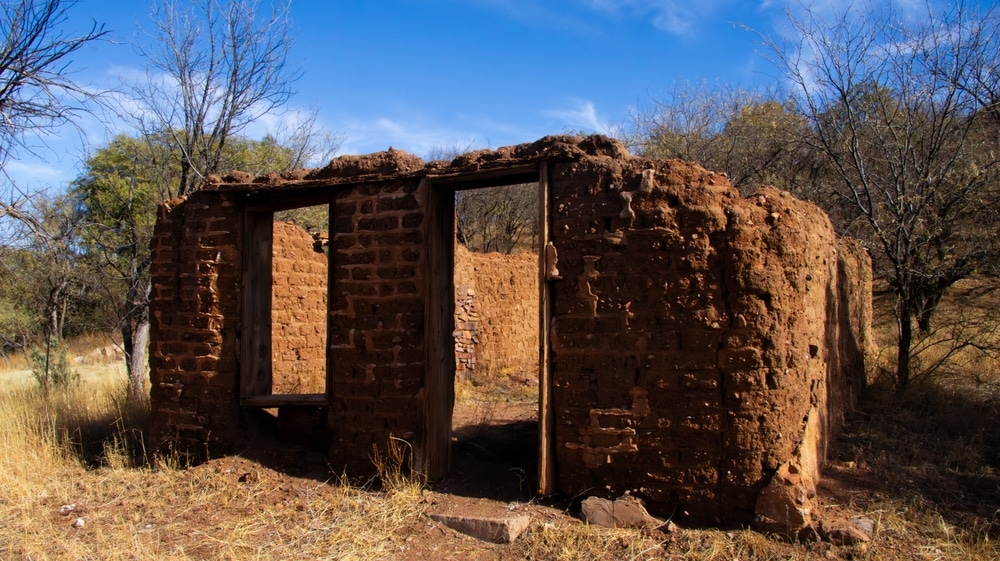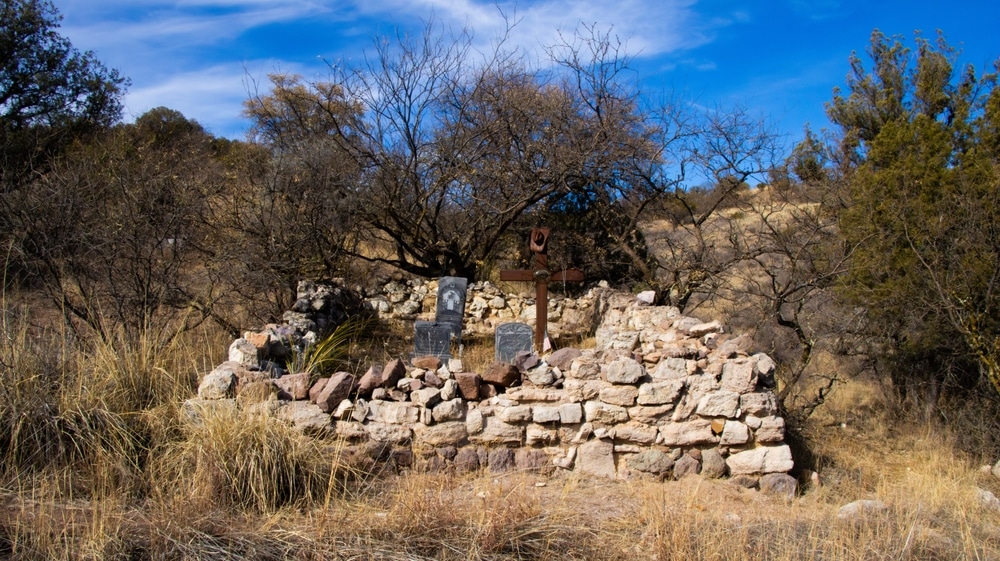
The afternoon sun casts long shadows across weathered wooden crosses and crumbling stone markers as a gentle breeze rustles through the oak trees surrounding Harshaw Cemetery. Nestled in the rolling hills of southern Arizona’s Patagonia Mountains, this final resting place tells silent stories of ambition, hardship, and community that once defined the now-vanished town of Harshaw. Just down the winding dirt road, scattered adobe ruins and stone foundations are all that remain of what was once a bustling silver mining community of several hundred people—a place where fortunes were made and lost, where diverse cultures converged, and where life played out in all its complexity against the backdrop of Arizona’s territorial days.
Located approximately eight miles southeast of present-day Patagonia in Santa Cruz County, Harshaw emerged in the 1870s as one of Arizona’s promising silver boomtowns before fading into obscurity by the early 20th century. Today, this ghost town and its remarkably intact cemeteries offer a poignant window into Arizona’s mining frontier—a landscape where the dreams of pioneers rest beneath the same mountain skies that once witnessed their daily struggles and triumphs.
As we explore the story of Harshaw, its cemeteries, newspapers, and railroad connections, we encounter not just the physical remains of a bygone era but the human narratives that continue to echo across time—stories etched in stone, preserved in fading newsprint, and embedded in the very landscape itself. Here, among the graves of miners, merchants, and their families, we can trace the arc of a community that rose quickly, flourished briefly, and ultimately faded, leaving behind only fragments for us to piece together the complex tapestry of Arizona’s pioneer past.
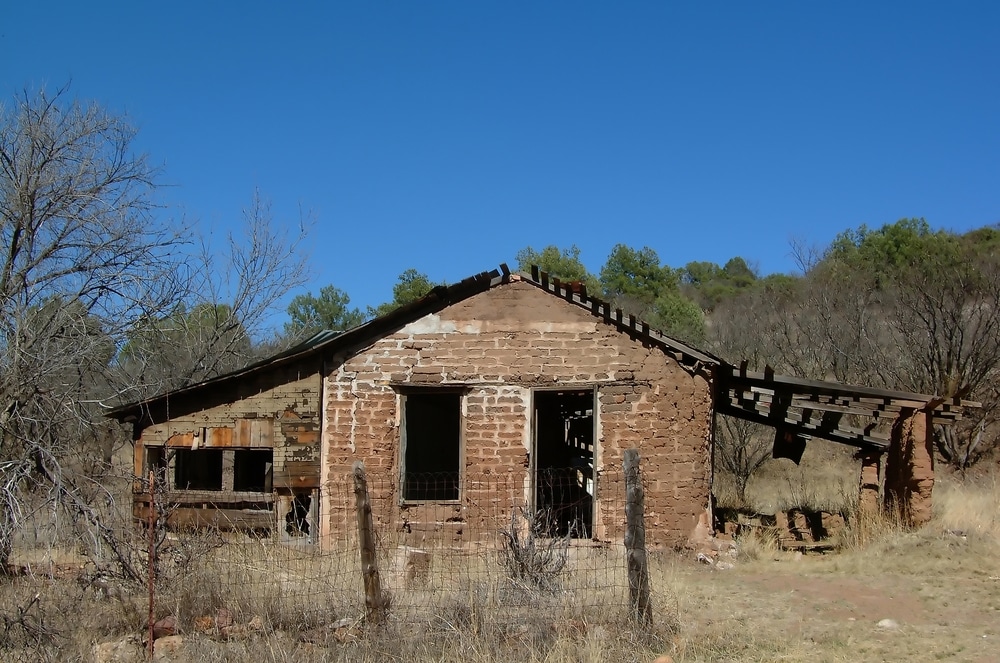
Harshaw was founded in the 1870s following the discovery of silver in the Patagonia Mountains. At its peak, it was home to hundreds of residents. Today, visitors can explore stone foundations, adobe remnants, and scattered relics of the town’s once-bustling structures. The atmosphere is peaceful and eerie, especially in the quiet morning hours.
A short hike off the main road brings you to the Harshaw Cemetery, a modest and solemn space with a few surviving grave markers. It provides a powerful glimpse into the lives—and hardships—of the town’s early residents, many of whom were miners or their family members.
The drive to Harshaw itself is part of the experience. Harshaw Road is a scenic backroad that takes you through the rolling hills and grasslands of the Patagonia region. You’ll see oak woodlands, wildflowers (in spring), and possibly even wildlife like deer or javelina.

While there’s no formal campground in Harshaw, the surrounding Coronado National Forest offers dispersed camping. Set up under the stars with views of the mountains and total serenity. Be prepared with water, food, and supplies—there are no services in the immediate area.

The Hermosa Mine was the central economic force behind Harshaw’s boom. The area is now the site of South32’s Hermosa Critical Minerals Project, a large modern mine that received Forest Service approval in 2026, so much of the property is private or restricted land—respect all signage and boundaries.

Harshaw offers outstanding subject matter for photographers and plein air painters. The weathered ruins, crumbling adobe, rusted metal, and rugged desert-meets-woodland backdrop make for atmospheric and hauntingly beautiful scenes.

The area around Harshaw is biologically diverse and ideal for birdwatching and wildlife viewing. This region is part of the Sky Islands, known for attracting species like the elegant trogon, Montezuma quail, and coatimundi. Early mornings are the best time for sightings.

Outdoor enthusiasts can hike several trails in the nearby Patagonia Mountains. While not directly in Harshaw, forest roads and trails around Red Mountain offer forested paths, high-elevation views, and access to remote, scenic canyons.

| Category | Details |
|---|---|
| Name | Harshaw, Arizona |
| Type | Ghost town |
| County | Santa Cruz County |
| Founded | Settled 1873; post office opened 1880 |
| Status | Abandoned; partial ruins and cemetery remain |
| Population (Historic) | 640 (1880 census) |
| Population (Current) | None |
| Historical Significance | One of the most prosperous silver mining towns in southern Arizona during the 1880s |
| Founder | David Tecumseh Harshaw, a cattleman turned prospector who settled in the area in 1873 |
| Primary Industry | Silver and lead mining |
| Major Mine | Hermosa Mine and other smaller operations |
| Post Office | Operated from 1880 to 1903 |
| Decline Factors | Falling silver prices, depletion of ore, fires, and better opportunities elsewhere |
| Remnants Today | Adobe and brick walls, cemetery, mill site, foundations |
| Nearby Towns | Patagonia (about 8 miles away); other ghost towns include Duquesne, Mowry, and Washington Camp |
| Access | Accessible by dirt roads south of Patagonia via Harshaw Road |
| Geographic Setting | Nestled in the Patagonia Mountains, scenic oak and juniper woodland |
| Elevation | Approx. 4,870 feet (1,485 meters) |
| Climate | Mild summers, cool winters – comfortable mountain climate |
| Best For | Ghost town explorers, history buffs, off-road travelers, photographers |
| Land Ownership | Mostly public land (Coronado National Forest), though Hermosa Project mining claims are under review by private interests |
The story of Harshaw begins, like many Arizona mining towns, with a fortuitous discovery. David Tecumseh Harshaw, a former California Column sergeant turned rancher, settled along Harshaw Creek in 1873 to find new pasture for his cattle. After a few years of prospecting in the eastern Patagonia Mountains, he staked claims to several silver deposits.
Word of the silver strikes spread through mining circles, attracting prospectors, investors, and entrepreneurs to this remote corner of the Arizona Territory, and the community of Harshaw took shape along the creek valley below the mines. Its post office opened on April 29, 1880.
The region’s mineral wealth proved substantial. Around 1879 David Harshaw sold one of his claims to the Hermosa Mining Company, which developed the Hermosa Mine. Under this new ownership, the mine was developed more systematically with proper tunneling, supporting infrastructure, and a 20-stamp mill constructed to process the ore locally.
The timing of Harshaw’s development coincided with broader territorial growth. The southern Arizona mining boom was in full swing, with nearby communities like Tombstone, Bisbee, and Tubac all experiencing rapid development. The completion of the Southern Pacific Railroad to Tucson in 1880 improved regional transportation, making it easier to ship supplies in and silver out, though Harshaw itself remained dependent on wagon roads for connection to the rail line.
The community that emerged reflected the diverse cultural mixture characteristic of the Arizona borderlands. Anglo-American miners and business owners worked alongside Mexican laborers who brought generations of mining expertise from Sonora. Chinese merchants established stores and restaurants, while European immigrants—particularly Cornish, Irish, and German—brought their own mining traditions and cultural practices. This multicultural character would leave its mark on everything from the town’s architecture to its cemetery, where burial customs from different traditions exist side by side.
By 1880, Harshaw had evolved from a mining camp into a proper town with all the amenities and institutions of civilization. The community’s main street stretched for about three-quarters of a mile along the creek valley, lined with substantial adobe and wood-frame buildings housing a variety of businesses and services.
At its height Harshaw had some 200 buildings, about 30 of them commercial, including eight or ten general stores, hotels, blacksmiths, stables, breweries, dance halls, and numerous saloons.
The town’s economic foundation remained the Hermosa Mine and several smaller operations in the surrounding mountains. The Hermosa Mining Company employed about 150 people in the mine, and its 20-stamp mill, which began operating on August 5, 1880, processed about 75 tons of ore a day.
Supporting industries developed around the mining operations. Lumberyards supplied timber for mine shoring and construction. Freighting companies operated wagon trains to Tucson and later to railroad stations in Crittenden and Patagonia. Local ranches provided beef, while small farms established along the more fertile creek bottoms supplied fresh produce to the mining community.
The relative isolation of the community fostered a spirit of self-reliance and mutual support. Residents organized volunteer fire brigades, community improvement committees, and mutual aid societies that provided assistance during times of illness or accident. This cooperative spirit would prove essential during periodic hardships that tested the community throughout its existence.
Harshaw had its own newspaper, the Arizona Bullion, published by Charles D. Reppy and Company. The Bullion was launched on April 28, 1880, and had reached a circulation of 400 by 1881.
While Harshaw itself never had direct railroad access, the development of regional rail transportation significantly influenced the town’s economic fortunes and physical connections to the wider world. The relationship between Harshaw and the evolving railroad network illustrates how transportation infrastructure shaped the development and eventual decline of mining communities throughout Arizona Territory.
In Harshaw’s early years, all transportation depended on wagon roads connecting the settlement to Tucson to the north-northwest. These primitive roads, often little more than cleared paths following natural contours, made travel and shipping arduous and expensive. Freight wagons pulled by mule teams made the journey in approximately three days under good conditions, longer during seasonal rains when roads became nearly impassable.
This transportation challenge affected every aspect of life in Harshaw. Mining equipment, construction materials, and industrial supplies had to be hauled in at considerable expense. Processed silver had to be transported out under armed guard due to its value. Even basic necessities commanded premium prices due to shipping costs. Contemporary accounts note that freight charges often doubled the cost of goods compared to prices in Tucson.
The arrival of the Southern Pacific Railroad in Tucson in March 1880 marked the first significant improvement in Harshaw’s transportation situation. Though still requiring a long wagon connection, the railroad’s presence in Tucson created a more reliable supply chain and reduced overall shipping time from distant manufacturing centers and ports.
More directly significant was the construction of the New Mexico and Arizona Railroad, a branch line that extended south from the Southern Pacific at Benson. This line reached Crittenden and Nogales in 1882. While still requiring wagon transportation for the final leg, this development cut freight costs significantly and made passenger travel much more practical.
However, railroad development ultimately contributed to Harshaw’s decline as well as its prosperity. The same rail lines that reduced transportation costs for Harshaw also opened other mining districts to development, creating increased competition for investment capital. When silver prices declined in the late 1880s and 1890s, investors increasingly focused on districts with direct rail access rather than those still requiring costly wagon transportation.
By the time Harshaw entered serious decline, the regional railroad network had fundamentally transformed the territory’s economic geography. Communities with direct rail access generally survived mining downturns better than those without, either by diversifying their economies or by reducing operational costs enough to maintain marginally profitable mining. Harshaw, still dependent on wagon connections, could not achieve either of these adaptations sufficiently to sustain its community when ore quality diminished.
The physical evidence of this transportation history remains visible in the landscape around Harshaw today. Traces of the old wagon roads can still be identified, particularly where they were cut into hillsides or where stone culverts were constructed to cross seasonal drainages. These engineering works, modest compared to the mines or buildings, nevertheless represent significant community investment and connection to the wider economic networks that both sustained and ultimately failed to save Harshaw.
Harshaw’s two small cemeteries sit beside Harshaw Road (Forest Route 49) and, together with a nearby adobe ruin, are the most easily reached remains of the town. They provide the most poignant record of the community that once thrived here.
Today, the Harshaw Cemetery remains the most intact physical connection to the vanished community. While buildings have collapsed and mining works have deteriorated, the cemetery continues to serve its original purpose—preserving the memory of those who lived and died in this brief but significant chapter of Arizona history.
Like many mining communities, Harshaw’s existence depended on a combination of geological reality and economic conditions that proved ultimately unsustainable. The town’s decline unfolded in several stages, beginning with the first significant mining challenges in the early 1880s and culminating in near-complete abandonment by the early 1900s.
The first serious setback came in late 1881, when the Hermosa mine and mill both closed after the quality of the silver ore dropped. Severe thunderstorms that same year caused a damaging fire, and in 1882 the Tombstone Epitaph reported that most of the town’s 200 buildings stood empty.
Harshaw revived in 1887, when Tucson resident James Finley bought the Hermosa mine. By 1891 the town still had seven businesses, a school, and a hotel, and the Hardshell Mine began producing silver in 1896.
This smaller revival lasted until around the turn of the century, when silver prices fell and James Finley died in 1903, closing the Hermosa mine again.
Unlike some mining communities that transitioned to other economic activities, Harshaw had few alternatives to sustain its population. Some limited ranching developed in the surrounding valleys, but the relatively arid conditions could not support extensive agriculture. Small-scale mining continued intermittently as individual prospectors and small partnerships worked smaller claims or reprocessed tailings from earlier operations, but these activities could support only a fraction of the former population.
The closing of key community institutions marked the stages of decline. The post office was discontinued in 1903 after years of steadily decreasing activity.
A small population remained. When a forest fire swept the Patagonia Mountains in May 1929, Harshaw’s roughly 50 residents were evacuated, and the town was spared. ASARCO worked the nearby Flux and Trench mines from 1937 to 1956, and about 70 people still lived there in 1963.
Harshaw became part of the Coronado National Forest in 1953, and most of its remaining buildings were torn down by locals or the Forest Service in the mid to late 1970s. Adobe walls, once unprotected by maintained roofs, gradually melted back into the earth from which they were formed.
Throughout this decline, the cemeteries remained as the most enduring record of the community. While economic activity ceased and buildings disappeared, the burial grounds continued to receive occasional maintenance from descendant families living in nearby communities like Patagonia and Nogales. These tenuous connections ensured that while Harshaw itself disappeared from the landscape, the memory of those who had lived and died there persisted through the markers and monuments on the hillside overlooking the vanished town.
Today’s visitor to Harshaw encounters a landscape where nature has reclaimed much of what humans built during the mining boom. The townsite consists primarily of scattered stone foundations, partial adobe walls, and the concrete pads that once supported industrial equipment. Tailings piles and slag heaps, now weathered and partially vegetated, still mark the locations of processing operations.
Access to Harshaw is via a well-maintained dirt road (Forest Road 49) that follows the historic route from Patagonia. The site lies within Coronado National Forest lands, providing some protection from development while allowing public access.
The James Finley House, the red-brick home of the Hermosa mine superintendent, has been listed on the National Register of Historic Places since 1974. Most remaining buildings stand on private ranch land, and the remote location makes it hard to prevent vandalism and unauthorized artifact collecting.
The site has attracted increasing attention from heritage tourists and photography enthusiasts interested in Arizona’s ghost towns. While this interest raises awareness of Harshaw’s historical significance, it also creates preservation challenges as increased visitation accelerates wear on fragile resources. The Forest Service has attempted to balance access with preservation by maintaining the access road while discouraging off-road vehicle use and providing clear guidelines for responsible visitation.
While Harshaw never achieved the fame or longevity of mining centers like Bisbee or Jerome, its history offers valuable insights into Arizona’s territorial development and the complex social dynamics of frontier communities. Several aspects of Harshaw’s story make it particularly significant for understanding broader historical patterns.
Economically, Harshaw exemplifies the silver mining boom that complemented Arizona’s better-known copper industry. The town’s rise coincided with the period when silver mining was transitioning from individual prospecting to more industrial operations with corporate investment and advanced technology. This transition, visible in the physical remains of different processing methods and the newspaper accounts of technological changes, illustrates important shifts in how mineral resources were extracted and how mining communities were organized.
Demographically, Harshaw provides an excellent case study of the multicultural communities that developed in the Arizona borderlands. The mix of Anglo-American, Mexican, European immigrant, and Chinese residents created social dynamics different from both the Hispanic-dominated communities of earlier periods and the more segregated towns established later. The relative integration of different ethnic groups in economic and community life, while still maintaining distinct cultural traditions, represents an important aspect of Arizona’s complex cultural heritage.
As a physical site, Harshaw offers archaeological and historical value for understanding everyday life in mining communities. The spatial arrangement of buildings, technological adaptations to the local environment, and material culture revealed through artifacts all contribute to a more complete understanding of how people actually lived during this formative period of Arizona history. The combination of physical remains, documentary sources (particularly newspapers), and the cemetery records provides multiple lines of evidence that together create a more nuanced historical portrait than any single source could provide.
Perhaps most importantly, Harshaw represents the impermanence that characterized much of Arizona’s early development. The boom-and-bust cycle of resource-dependent communities created a landscape where settlements appeared, flourished briefly, and disappeared with remarkable speed. This pattern shaped Arizona’s development in ways that continue to influence state identity, economic planning, and cultural memory.
For modern visitors, Harshaw offers a tangible connection to this dynamic period of Arizona history. Standing among the scattered ruins or beside the weathered grave markers, one can sense the aspirations and hardships of those who sought their fortunes in this remote mountain valley. The contrast between the bustling community documented in newspaper accounts and the quiet abandonment of the present site creates a powerful reminder of how quickly human endeavors can rise and fall in the face of economic and environmental realities.
For those interested in experiencing this piece of Arizona history firsthand, visiting Harshaw requires preparation and respect for both the natural environment and historical resources. The site is accessible year-round, though the dirt access road may become difficult during periods of heavy rain or snow. High-clearance vehicles are recommended but not absolutely necessary in dry conditions.
Visitors should come prepared for variable weather conditions and limited facilities. No drinking water is available at the site, and shade is minimal. Summer temperatures can exceed 100°F, making spring and fall the most comfortable seasons for exploration. Sturdy footwear is essential given the uneven terrain and occasional hazards like rusty metal or partially collapsed structures.
The cemeteries and a nearby adobe ruin are the most easily reached remains, as they sit beside Harshaw Road (Forest Route 49). Most other surviving buildings are on private ranch property, so view them from the road.
When visiting these historical sites, appropriate respect includes:
As the sun sets over the Patagonia Mountains, casting the Harshaw Cemetery in golden light, the connection between past and present becomes palpable. Here, in this quiet hillside burial ground, the most complete record of Harshaw’s brief but significant existence endures—names, dates, relationships, and epitaphs that collectively tell the story of human endeavor in one of Arizona’s countless mining communities.
The persistence of these cemeteries, maintained through decades of volunteer effort and descendant commitment, speaks to the enduring power of memory and connection to place. While the town’s physical structures have largely returned to the earth, the stories of those who lived and died there continue through both the tangible markers of the cemetery and the intangible transmission of family histories and community memory.
Harshaw’s legacy, like that of many similar communities throughout Arizona, lies in its contribution to the complex mosaic of the state’s development. The silver extracted from its mines helped build American infrastructure during a period of rapid industrialization. The multicultural community that developed around the mines demonstrated patterns of integration and adaptation that would characterize Arizona’s social evolution. The boom-and-bust cycle exemplified by Harshaw’s rise and fall established economic patterns that continue to influence state planning and identity.
For modern visitors who make the effort to visit this remote site, Harshaw offers something increasingly rare—an authentic connection to Arizona’s mining past largely unmediated by tourist development or historical reconstruction. Standing among the stone foundations or beside the weathered grave markers, visitors can experience a direct link to the individuals who sought their fortunes and built their lives in this harsh but beautiful landscape.
As contemporary Arizona continues its own cycles of growth, development, and occasional contraction, places like Harshaw provide valuable perspective on the impermanence of human endeavors and the resilience of memory. The pioneer dreams that once animated this mining community may now rest in the quiet cemeteries overlooking the vanished town, but their legacy continues through the stories preserved in stone, document, and living memory—a testament to the enduring human urge to seek opportunity and build community even in the most challenging environments.
We use cookies to improve your experience on our site. By using our site, you consent to cookies.
Manage your cookie preferences below:
Essential cookies enable basic functions and are necessary for the proper function of the website.
Statistics cookies collect information anonymously. This information helps us understand how visitors use our website.
Monetize your website by displaying targeted ads and earning revenue from clicks and impressions.
Google Analytics is a powerful tool that tracks and analyzes website traffic for informed marketing decisions.
Service URL: policies.google.com (opens in a new window)
You can find more information about our Cookie Policy and Privacy Policy.