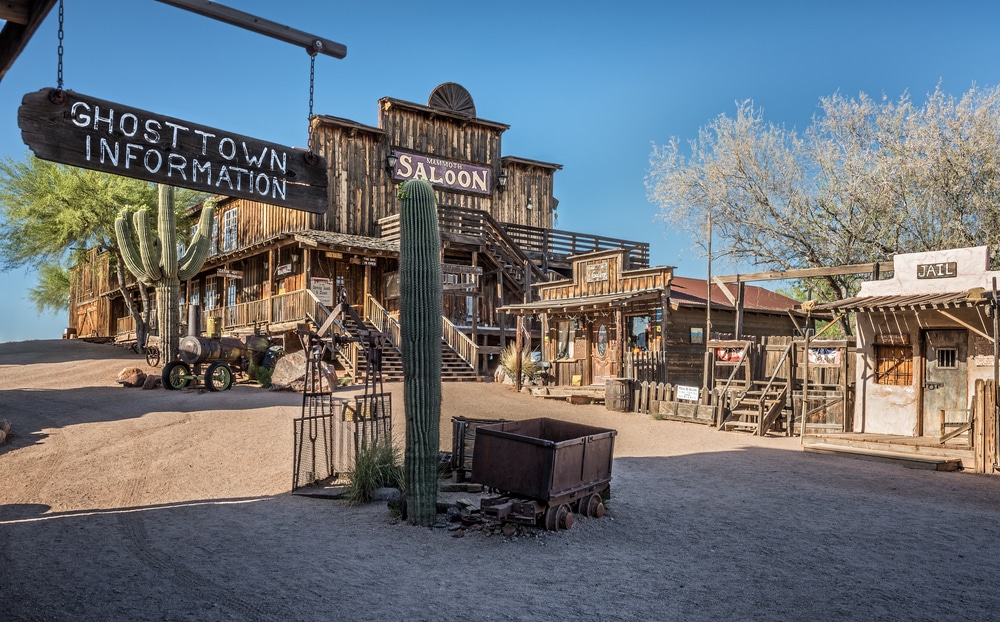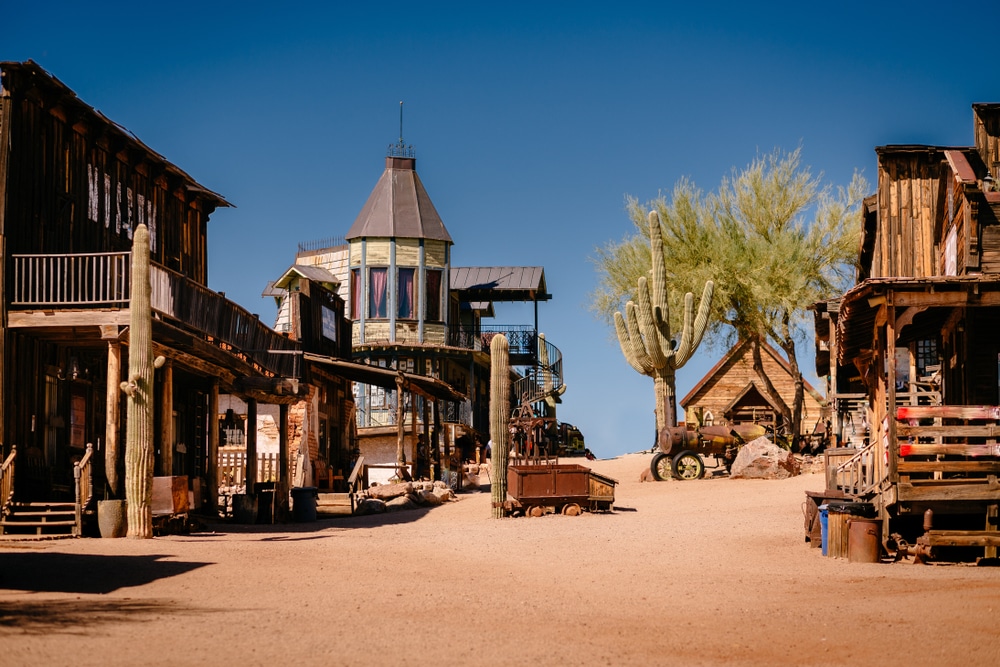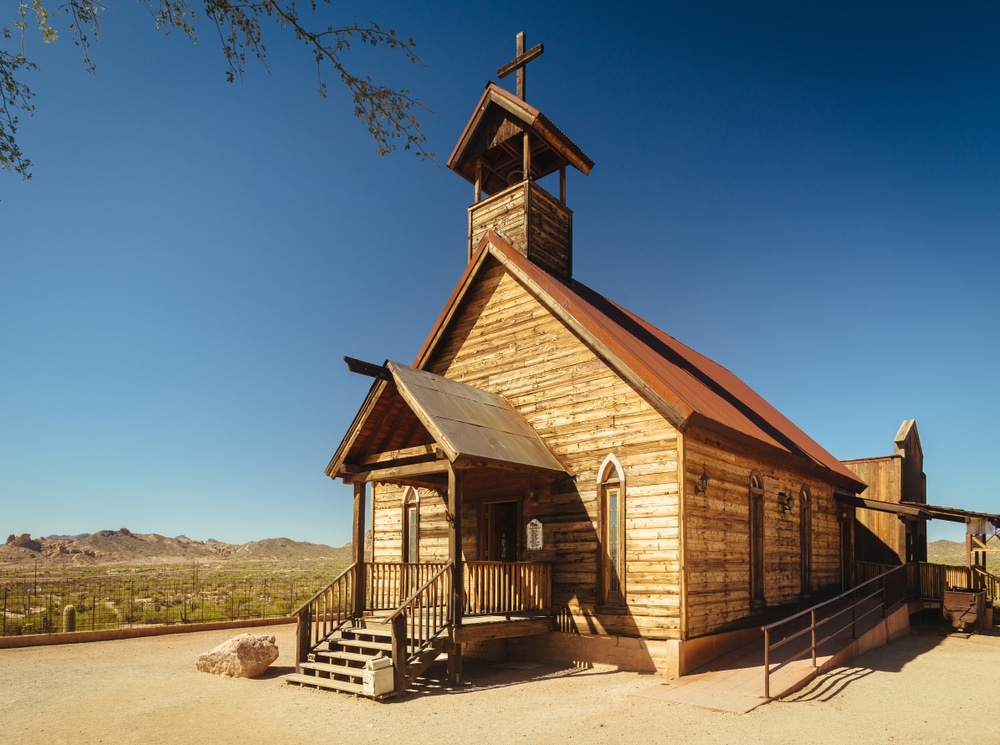
The afternoon sun casts long shadows across weathered wooden boardwalks and faded storefronts that line the dusty main street of what was once one of Arizona’s most promising mining settlements. Here, beneath the watchful gaze of the Superstition Mountains, Goldfield stands as a testament to the fleeting nature of frontier prosperity. The creak of an old wooden sign and the distant call of a red-tailed hawk are the only sounds that break the desert stillness where the bustling noises of 4,000 gold-seekers once filled the air.
Located in what is now Pinal County, about 4.5 miles northeast of Apache Junction and a short journey from Phoenix, Goldfield emerged in the early 1890s as a shining example of how quickly fortune could transform the Arizona wilderness into a center of commerce and community. Today, the town’s reconstructed streets and the remains of its mines tell a compelling story of ambition, hardship, and the impermanence of resource-driven settlements.
As we walk these grounds where dreams were built and ultimately abandoned, the silent mine shafts reveal fundamental truths about the nature of Arizona’s territorial development—where the promise of mineral wealth could conjure entire communities from the desert floor, only to see them reclaimed by the same unforgiving landscape when the gold veins narrowed and the profits dwindled.
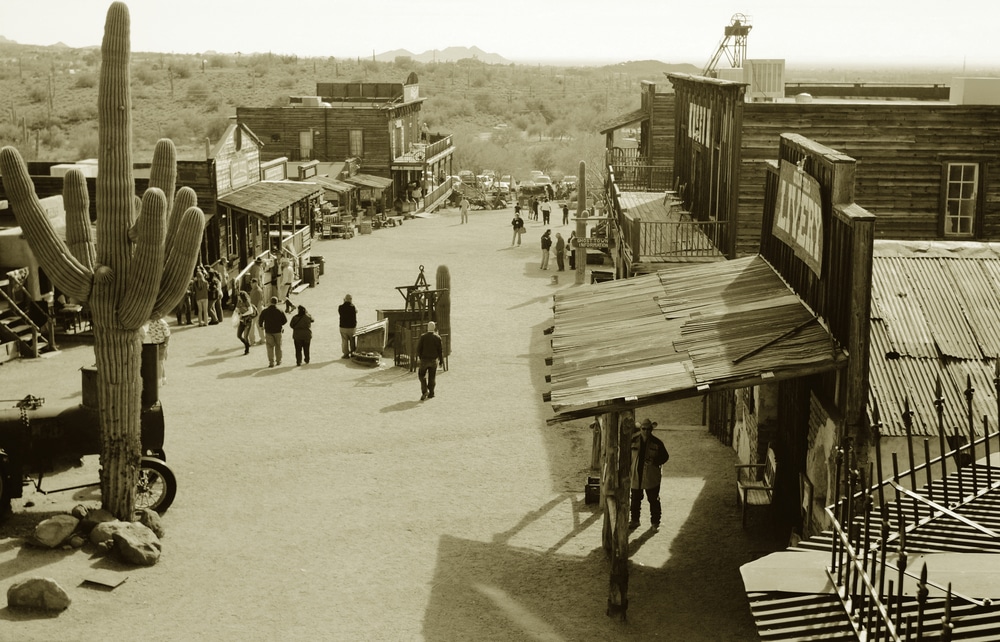
Step into the past as you stroll the wooden boardwalks of Goldfield’s restored streets. The town includes original and reconstructed buildings such as a saloon, blacksmith shop, church, jail, and general store—each packed with character and Old West charm.
Descend into a reconstructed section of the historic Mammoth Gold Mine with a guided tour that explains how miners once lived and worked in the treacherous tunnels. You’ll learn about mining techniques, tools, and the gold rush that put Goldfield on the map.
This 36-inch gauge train takes passengers on a scenic 20-minute ride around the perimeter of the town. Along the way, you’ll get views of the Sonoran Desert, old mining equipment, and hear fun historical narration about Goldfield and the surrounding Superstition Mountains.
On weekends from November through April, Goldfield hosts staged Old West shootouts featuring the Goldfield Gunfighters. These fun, theatrical performances bring the lawless frontier days to life with comedy, drama, and authentic period costumes.

Learn more about the town’s rise and fall during the 1890s gold boom. The museum contains fascinating exhibits on mining, local legends (including the Lost Dutchman Mine), and artifacts from Goldfield’s heyday.

For thrill-seekers, the Superstition Zipline offers a soaring ride over the ghost town with spectacular views of the desert and mountains. It’s a family-friendly adventure that adds a modern twist to the historic setting.

Get your hands dirty with gold panning activities available in the town. It’s a fun, hands-on experience for kids and adults alike, offering a glimpse into the hopes and struggles of prospectors who once searched for riches in these hills.

Just steps from the ghost town, the surrounding landscape offers hiking trails that lead into the rugged beauty of the Superstition Wilderness. Popular routes include the Hieroglyphic Trail and the Lost Dutchman State Park trails.

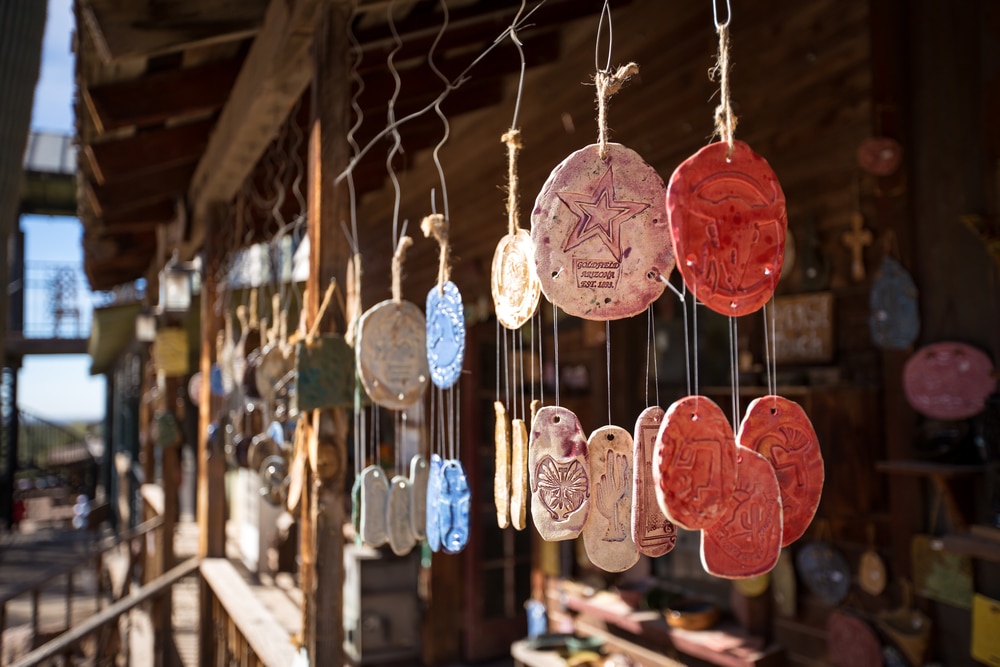
Goldfield offers a variety of Western-themed shops where you can buy everything from cowboy hats and old-time photos to handcrafted jewelry, Native American art, and desert souvenirs. Don’t miss the blacksmith shop for live demonstrations.
| Category | Details |
|---|---|
| Name | Goldfield, Arizona |
| Type | Restored ghost town / living history attraction |
| County | Pinal County |
| Founded | 1893 |
| Status | Reconstructed town with shops, attractions, and tourism |
| Population (Historic) | ~1,500 at peak in the mid-1890s |
| Population (Current) | No residents; operates as a themed tourist town |
| Historical Significance | Founded after gold was discovered near the Superstition Mountains |
| Primary Industry | Gold mining from the Mammoth Mine |
| Post Office | Operated from 1893 to 1898 |
| Decline Factors | Ore vein disappeared; town was abandoned by 1898 |
| Modern Revival | Restored in the 1980s–1990s as a tourist destination |
| Key Attractions | Recreated saloon, gold mine tours, narrow-gauge train, gunfight shows, Superstition Mountain Museum |
| Nearby Landmark | Base of the Superstition Mountains and near Apache Junction, AZ |
| Access | Easily accessible via AZ Highway 88 (Apache Trail) |
| Elevation | Approx. 2,000 feet (610 meters) |
| Climate | Sonoran Desert – hot summers, mild winters |
| Best For | Families, photographers, Old West lovers, Superstition Mountain hikers |
| Notable Lore | Near the alleged site of the Lost Dutchman’s Gold Mine |
Goldfield’s story begins with the discovery of gold in the Superstition Mountains region in 1892. Prospectors had long searched the area, partly inspired by legends of the Lost Dutchman’s Mine, when a significant gold-bearing quartz vein was discovered on the eastern slope of Superstition Mountain. Within months of the initial strike, word spread throughout the territory and beyond, drawing experienced miners from established fields in California, Colorado, and Nevada.
The town was officially established in 1893, strategically located near the Mammoth Mine, which would become the area’s richest producer. From the beginning, gold was the singular economic driver of Goldfield’s existence. Unlike some mining operations that required complex industrial processes, the gold here was found in high-grade ore that could be processed relatively easily, making it attractive to both individual miners and larger mining companies seeking quick returns on investment.
At its peak between 1893 and 1897, Goldfield boasted an impressive population of approximately 4,000 people—a substantial figure for a frontier mining town in territorial Arizona. This rapid growth reflected the richness of the initial ore discoveries and the optimism that pervaded the community during its early years. The settlement quickly developed beyond a mere mining camp to include all the amenities of a proper town, including substantial commercial buildings, residences, and community institutions.
Goldfield’s development occurred during a significant period in Arizona’s territorial history. The 1890s represented a time of transition as the frontier period was giving way to more established governance and infrastructure. The territory was experiencing growth in agriculture, ranching, and mining, with communities like Phoenix, Tucson, and Prescott expanding their influence. Goldfield’s gold boom coincided with increased railroad development throughout the territory, though the town itself would struggle with transportation challenges that would ultimately contribute to its decline.
During its brief heyday, the town weathered the economic uncertainties of the Panic of 1893, largely insulated by the intrinsic value of its gold production during a time when many silver-based communities suffered from falling silver prices following the repeal of the Sherman Silver Purchase Act.
Today’s Goldfield presents visitors with a curious blend of authentic historical remains and thoughtful reconstruction. Unlike many ghost towns that have disappeared entirely or exist only as scattered ruins, Goldfield has experienced a partial rebirth as a tourist destination that seeks to capture the spirit of its 1890s heyday.
The original townsite, located on private land, has been developed into Goldfield Ghost Town, a tourist attraction that combines preserved historical structures with reconstructed buildings designed to evoke the appearance of the mining boomtown. The main street features boardwalks fronting a collection of period-appropriate storefronts including a saloon, general store, and assay office. Some buildings incorporate materials salvaged from the original structures, while others have been constructed using historical photographs as references.
Among the most notable authentic remains is the entrance to the Mammoth Mine, now secured but visible as part of guided tours. Several original mining equipment pieces are displayed throughout the site, including an ore cart, stamp mill components, and various hand tools that offer glimpses into the labor-intensive process of hard-rock gold mining in the 1890s.
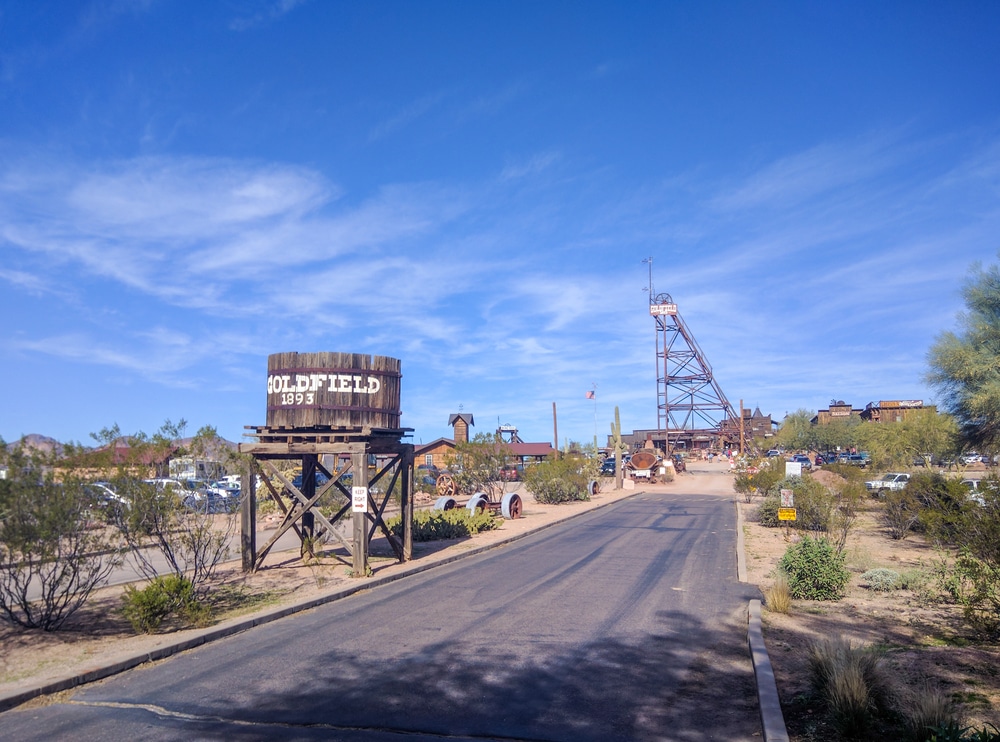
The infrastructure of the original town is partially represented through reconstructed elements. A water tower stands near the center of town, reminiscent of the original that supplied the community during its productive years. The street layout generally follows historical patterns, though adapted for modern visitor circulation and safety requirements.
Accessibility for modern visitors is excellent, with Goldfield Ghost Town located just off State Route 88 (the Apache Trail), approximately 45 minutes from downtown Phoenix. The site offers guided tours, demonstrations of period mining techniques, and various entertainment options designed to give visitors a sense of life in a mining boomtown. While the commercial nature of the site necessarily affects its historical authenticity, it has preserved and interpreted a history that might otherwise have been lost to the desert elements.
Transportation infrastructure played a crucial role in Goldfield’s development and eventual decline. Unlike some more fortunate mining centers, Goldfield never secured the direct railroad connection that might have extended its productive life, instead relying on a network of wagon roads and stage lines that connected it to Phoenix and the outside world.
The nearest railroad during Goldfield’s heyday was the Maricopa & Phoenix Railroad, which terminated in Phoenix approximately 35 miles southwest of the mining district. This distance, though not insurmountable, created significant challenges for shipping ore, bringing in heavy equipment, and moving people efficiently.
Freight service was critical to Goldfield’s operations. Specialized freight wagons hauled ore from the mines to Phoenix for further transport to smelters in El Paso or California, while bringing back mining equipment, construction materials, and commercial goods for the growing community. The freight yard located at the edge of town became a hub of activity, with teamsters, merchants, and miners converging to conduct business.
The impact of these transportation systems on town life was substantial. Stagecoach arrivals became community events, with residents gathering to receive mail, welcome newcomers, or hear news from Phoenix and beyond. The schedule of freight deliveries dictated the rhythm of commercial activity, with stores restocking and mines receiving equipment according to the predictable pattern of wagon arrivals.
Transportation costs significantly affected Goldfield’s economic viability. Shipping ore to distant smelters reduced profit margins, particularly as the quality of ore began to decline after 1896. Similarly, bringing heavy mining equipment to the district was expensive, limiting the ability of mine operators to implement newer technologies that might have allowed exploitation of lower-grade ores as the richest veins were depleted.
Today, little physical evidence remains of Goldfield’s transportation infrastructure beyond traces of the original wagon roads visible in aerial surveys.
Goldfield’s decline began gradually around 1897, when the rich surface deposits that had fueled the initial boom began showing signs of depletion. The decline accelerated through 1898 as a combination of geological, economic, and technological factors conspired against the settlement’s continued viability.
The gold veins themselves presented the first and most fundamental challenge. As surface deposits were exhausted, mining operations needed to follow the ore deeper underground, requiring more substantial capital investment in equipment and infrastructure. Several mines encountered water at depth, necessitating expensive pumping operations that reduced profit margins. Most critically, the high-grade ore that had made the district so attractive initially began giving way to lower-quality deposits that were more expensive to process.
This geological reality coincided with financial pressures affecting mining investment nationally. While Goldfield had weathered the Panic of 1893 relatively well due to the intrinsic value of gold, by the late 1890s, capital for speculative mining ventures was becoming more cautious and concentrated in proven districts. New discoveries in the Klondike beginning in 1896 diverted investment and experienced miners northward, making it harder for Goldfield’s operations to secure necessary funding for expansion.
Technological limitations further complicated the district’s prospects. The lack of railroad access made importing advanced mining and milling equipment prohibitively expensive, preventing the kind of industrial-scale operations that might have profitably extracted lower-grade ores. The district’s water limitations also restricted milling operations, forcing some operators to transport ore to facilities along the Salt River at additional expense.
The mines closed in 1897, and the post office followed in November 1898—a sure sign of the community’s diminished status.
Most residents relocated to Phoenix, Mesa, or other mining districts in Arizona and beyond. Some followed the pattern common to career miners, moving from one boom town to another as opportunities shifted. Others abandoned mining altogether, turning to agriculture, commerce, or other professions in the region’s growing towns and cities.
By 1900, Goldfield had effectively ceased to exist as a functioning community, though isolated prospectors and small-scale mining operations continued in the area well into the 20th century. Later attempts to reopen the mines proved short-lived.
Goldfield occupies an important place in Arizona’s territorial development and mining history. While shorter-lived than more famous mining centers like Jerome or Bisbee, it exemplifies the rapid boom-and-bust cycle that characterized many Western mining ventures in the late 19th century. The town’s rise and fall paralleled hundreds of similar communities across the American West, where the discovery of precious metals could create instant prosperity that disappeared just as quickly when deposits were exhausted.
Today, Goldfield Ghost Town serves as an important heritage tourism destination. While the commercialized nature of the site necessarily affects its historical authenticity, it has preserved and interpreted a chapter of Arizona history that might otherwise have been lost to development or erosion. The site offers educational programming for school groups, interpretive exhibits on mining technology and frontier life, and seasonal events that commemorate aspects of the area’s history.
Beyond tourism, Goldfield has secured a place in regional folklore through its proximity to the Superstition Mountains and the legendary Lost Dutchman’s Mine. Though the actual mining operations at Goldfield were unrelated to this famous legend, the historic mining district has become intertwined with the broader mythologies of hidden treasure and frontier adventure that continue to draw prospectors and curiosity-seekers to the region.
For those wishing to experience Goldfield’s history firsthand, ethical considerations should guide any visit to this historic site. While the commercial Goldfield Ghost Town attraction provides a controlled and interpreted experience of the town’s history, the cemetery areas and outlying archaeological sites require particular respect and care from visitors.
Archaeological resources throughout the area face ongoing threats from both natural processes and human activity. Erosion, flash flooding, and plant growth continuously affect remaining structures and features. Meanwhile, unauthorized artifact collection—strictly prohibited by state and federal law—remains a serious concern at less monitored portions of the historic district. Visitors should understand that removing even seemingly insignificant objects depletes the site’s historical integrity and scientific value.
Official management of the various Goldfield sites is divided among several entities. The commercial ghost town attraction operates on private land with its own regulations and interpretive approach. The surrounding historic mining district includes lands managed by the Tonto National Forest, the Bureau of Land Management, and various private owners, each with different access policies and preservation standards. Visitors should research and respect these jurisdictional boundaries and applicable regulations.
For those seeking more information before or after a visit, several regional resources provide context and guidance. The Superstition Mountain Museum, located near the ghost town, offers exhibits on mining technology and local history. The Arizona Historical Society’s Arizona Heritage Center in Tempe holds regional archives and photographs. These institutions can provide depth and nuance beyond what is available at the commercial attraction.
The desert winds that once carried the sounds of stamp mills and miners’ calls now whisper through reconstructed boardwalks, telling a story of ambition, struggle, and impermanence. Goldfield stands as both a physical place and a metaphor for the boom-and-bust cycle that shaped so much of Arizona’s territorial development—a community conjured from wilderness by the promise of mineral wealth, only to fade back into the landscape when those resources were exhausted.
As a chapter in Arizona’s mining heritage, Goldfield’s brief existence paralleled hundreds of similar communities across the American West, where natural resources drew population rapidly, created momentary prosperity, and then faded just as quickly when those resources proved finite or inaccessible. This pattern of swift growth and decline shaped much of the territory’s early development and continues to influence modern Arizona’s relationship with its natural resources and historical legacy.
Today, as visitors walk the reconstructed streets, Goldfield offers a chance to reflect on the temporary nature of even our most substantial achievements. The town that once hummed with commerce and ambition lasted barely five years at its height—a reminder that all human ventures eventually yield to time and changing circumstances.
Yet in the historical record, and in the DNA of Arizona’s development, the legacy of these pioneer communities lives on—a testament to the resilience, adaptability, and unflagging optimism that characterized frontier settlement. The miners of Goldfield may have exhausted the accessible gold in the Superstition foothills, but they left behind something perhaps more valuable: a chapter in the complex, compelling story of how Arizona came to be.
In its preserved ruins and reconstructed buildings, Goldfield invites modern visitors to connect with a pivotal moment in Western history—when the frontier was closing, industrial capitalism was transforming resource extraction, and communities could still spring fully-formed from the desert based on the promise of mineral wealth. That this particular promise proved fleeting makes the story no less significant in understanding the forces that shaped the modern American West.
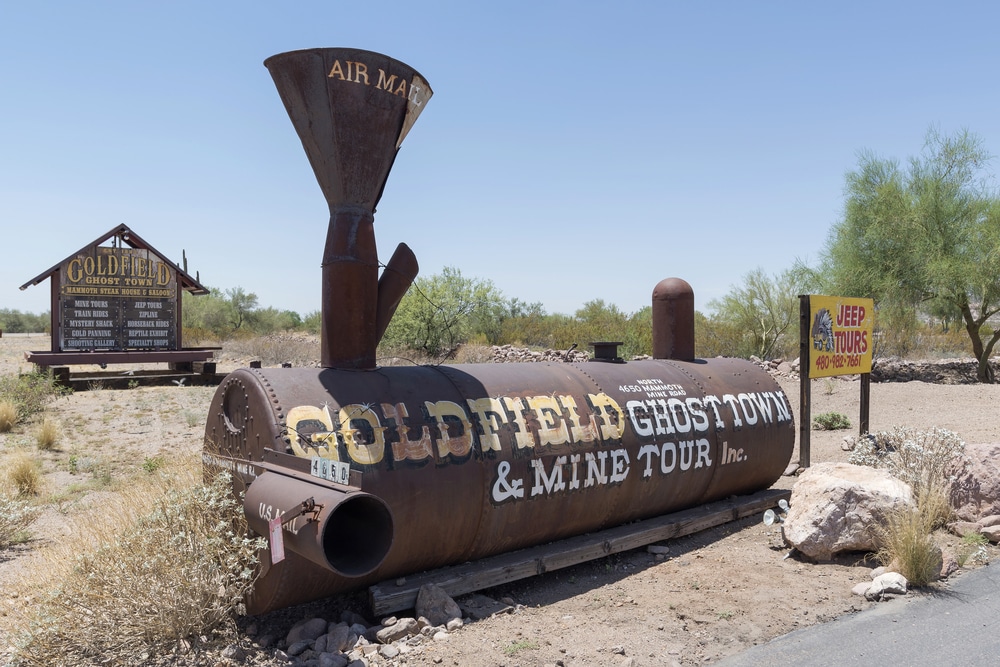
Goldfield Ghost Town is located at 4650 N. Mammoth Mine Road, Apache Junction, AZ, about 4.5 miles northeast of Apache Junction proper, just off State Route 88 (Apache Trail). The site is well-marked and accessible by standard vehicles.
We use cookies to improve your experience on our site. By using our site, you consent to cookies.
Manage your cookie preferences below:
Essential cookies enable basic functions and are necessary for the proper function of the website.
Statistics cookies collect information anonymously. This information helps us understand how visitors use our website.
Monetize your website by displaying targeted ads and earning revenue from clicks and impressions.
Google Analytics is a powerful tool that tracks and analyzes website traffic for informed marketing decisions.
Service URL: policies.google.com (opens in a new window)
You can find more information about our Cookie Policy and Privacy Policy.