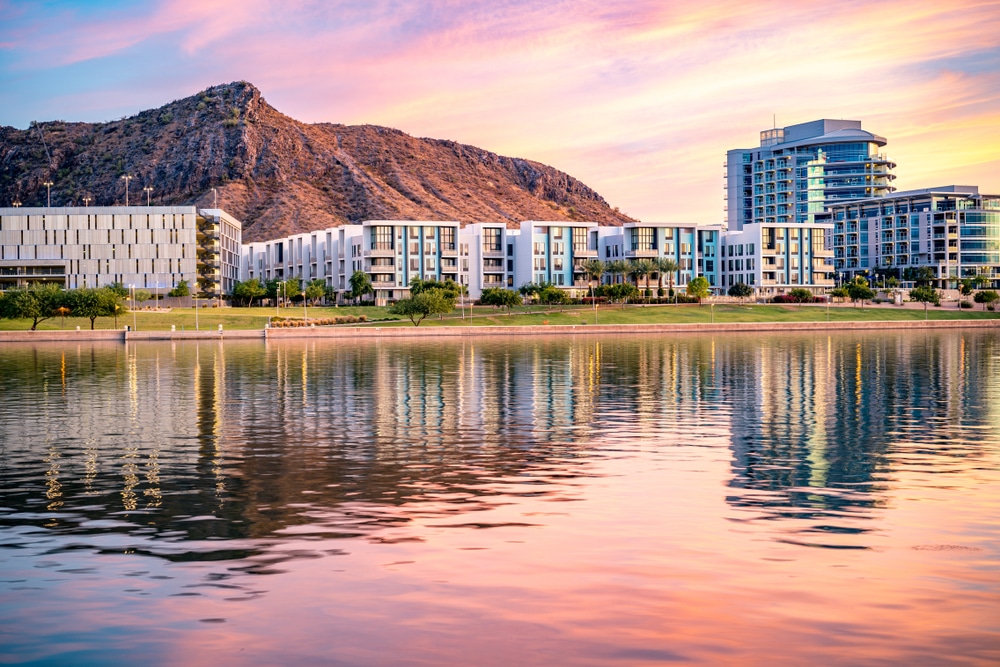
The morning sun reflects off Tempe Town Lake creating shimmer that perfectly captures this city’s transformation of desert into urban oasis through engineering and determination. Here, where 195,000 residents navigate the dynamic environment shaped by Arizona State University’s 75,000-person presence and established neighborhoods, Tempe has emerged as Maricopa County’s innovation laboratory—a place where light rail trains glide past craft breweries, where startup founders pitch investors in repurposed warehouses, and where the question isn’t whether to bike to work but which canal path offers better sunrise views.
You’ll find yourself at the geographic heart of the Valley, where Tempe occupies 40 square miles bordered by Scottsdale to the north, Mesa to the east, Phoenix to the west, and Chandler to the south. This central positioning creates advantages beyond convenience—proximity to Sky Harbor Airport (10 minutes), walking distance from ASU’s resources, and light rail connection to downtown Phoenix employment without sacrificing access to outdoor recreation at Papago Park or Tempe Butte. The city’s compact footprint makes everything accessible, from kayaking on the lake to attending conferences at ASU SkySong.
The atmosphere here runs decidedly progressive and innovative, shaped by university influence, entrepreneurial energy, and sustainability initiatives that distinguish Tempe from typical Arizona suburbs. As electric scooters navigate sidewalks and the Wednesday farmers market at Tempe Beach Park draws crowds, you understand that Tempe operates with different priorities—emphasizing walkability over sprawl, diversity over homogeneity, and innovation over tradition.

Tempe’s median home price reaches $485,000 as of October 2024, reflecting a 4.5% year-over-year appreciation that masks dramatic variation between property types and locations. Proximity to ASU creates unique market dynamics with investor activity in rental properties near campus driving prices beyond typical income support levels. New construction remains limited by geographic constraints and development preferences for mixed-use projects over single-family homes, creating scarcity that supports values during market fluctuations.
The market varies sharply between neighborhoods, with established areas like Maple-Ash and Warner Ranch commanding $600,000+ for ranch homes on large lots while condominiums near campus start at $250,000. West USA Realty reports intense competition for single-family homes south of US 60 where properties offer distance from campus activity. Luxury apartments and condos like LINK at Tempe Town Lake and West 6th create high-end rental alternatives competing with ownership.
Rental markets demonstrate unusual strength with two-bedroom apartments averaging $2,000 monthly, though luxury units near Mill Avenue or Tempe Town Lake exceed $3,000. The university presence creates consistent rental demand supporting investment strategies, though city regulations on rental properties require careful management. Zillow data shows inventory below 1.5 months of supply, creating seller’s market conditions generating multiple offers for well-positioned properties.

Tempe’s economy thrives on education, technology, and innovation with Arizona State University as foundational employer providing 30,000 positions across academic, research, and administrative functions. The university’s $800 million annual research expenditure generates spin-off companies and attracts corporate partners establishing innovation centers. State Farm’s Marina Heights regional headquarters employs 8,000, while Amazon, Wells Fargo, and Carvana maintain significant operations leveraging ASU’s talent pipeline.
ASU Research Park and SkySong innovation center create entrepreneurial ecosystems supporting startups in renewable energy, educational technology, and biotechnology sectors. Salaries vary from entry-level positions to six-figure technology roles, with median household income reflecting diverse workforce composition. Mill Avenue District generates thousands of hospitality positions though many remain part-time or seasonal, creating employment opportunities with varied compensation levels.
The Bureau of Labor Statistics reports Tempe’s unemployment rate at 3.4%, with job growth consistently exceeding state averages as companies value access to university resources and graduates. Remote work has amplified Tempe’s appeal with co-working spaces like The Newton and MAC6 fostering professional communities. Bioscience and sustainable technology sectors aligned with ASU research strengths promise continued economic diversification.

Educational services in Tempe reflect the university’s dominant presence alongside public school options. Tempe Elementary District operates 22 schools with varied performance ratings demonstrating neighborhood disparities. Tempe Union High School District serves grades 9-12 through Corona del Sol, Desert Vista, Marcos de Niza, McClintock, Mountain Pointe, and Tempe High, with outcomes varying based on program participation rather than district-wide excellence.
Kyrene School District serves south Tempe with consistently higher performance, particularly at specialized academies. Charter schools including Tempe Preparatory Academy (Great Hearts) and Arizona School for the Arts provide alternatives emphasizing classical education or arts integration. Private institutions remain limited though available options offer religious and secular curricula with tuitions ranging $6,000-8,000 annually.
Arizona State University defines higher education as America’s largest public university by enrollment, offering 350+ undergraduate programs and 450+ graduate degrees across five Phoenix campuses. The university offers programs in sustainability, engineering, business, and numerous fields. Mesa Community College’s Red Mountain campus provides accessible pathways to university transfer. This educational infrastructure creates intellectual capital elevating community offerings beyond typical suburban dynamics.

Healthcare in Tempe centers on proximity to Banner Desert Medical Center just across the Mesa border, a 649-bed facility providing Level I trauma care and comprehensive services. Within Tempe, urgent care centers and specialty clinics proliferate, particularly near ASU campus. The absence of major hospital within city limits means residents travel to adjacent cities for emergency and inpatient care.
ASU Health Services provides primary care reducing pressure on community providers. Sports medicine practices reflect both ASU athletics and active population, with facilities like EXOS serving professional and recreational athletes. Mental health services expanded through counseling centers and private practices addressing various behavioral health needs with multiple treatment approaches.
Wellness culture permeates Tempe with yoga studios, cycling clubs, and running groups creating fitness communities. Smoke-free ordinances, bike-friendly infrastructure, and abundant parks support preventive health. Alternative medicine thrives with acupuncture, naturopathy, and functional medicine practices. Proximity to Scottsdale and Phoenix ensures specialized care access within 20 minutes, balancing convenience with regional expertise.

Living in Tempe costs approximately 7% more than national average according to BestPlaces, driven by housing costs 20% above national medians—moderate by Phoenix metro standards. The diverse population creates varied market dynamics with grocery costs remaining competitive through chains competing with specialty stores. Restaurant prices range from budget-friendly options to fine dining on Mill Avenue, creating choices across all price points.
Utility costs benefit from some municipal services, with electric bills averaging $250-300 monthly during summer peak. SRP provides electricity with time-of-use plans rewarding conservation. City-operated water and solid waste services reflect sustainability initiatives including recycling and composting programs. Internet infrastructure supporting university and business needs maintains competitive pricing.
Arizona’s 2.5% flat income tax provides modest benefit, while Tempe’s 1.8% sales tax (8.1% combined) remains moderate. Property taxes average 0.69% of assessed value, though rental property regulations affect investment calculations. The cost structure challenges service workers while remaining accessible for established residents and those sharing housing costs.

Tempe stands as the Valley’s transportation hub with unprecedented connectivity reducing automobile dependence. Valley Metro Light Rail runs through Tempe with five stations connecting ASU campuses to Phoenix Sky Harbor Airport (15 minutes) and downtown Phoenix (20 minutes), making car-free living viable. The Orbit shuttle provides free neighborhood circulation while extensive bike lanes create bicycle-friendly infrastructure.
Interstate 10 borders south Tempe while Loop 101 defines eastern boundaries and Loop 202 crosses the north, providing highway access without bisecting neighborhoods. US Route 60 elevates through Tempe maintaining connectivity while minimizing surface impact. These highways position Tempe strategically while internal streets remain walkable, particularly near ASU where parking challenges encourage alternatives.
The multi-use path system along Salt River, Tempe Canal, and Western Canal creates recreational and commuting corridors connecting to regional networks. Sky Harbor Airport lies immediately west with Sky Train providing direct rail connection. Electric scooters and bike-share programs add micro-mobility options particularly popular for short trips. The infrastructure supports diverse transportation choices unusual for Arizona cities.

Tempe experiences Valley’s characteristic desert climate with summer highs averaging 106°F in July and winter conditions ideal with 60s-70s temperatures December through February. Urban heat island effect runs strong given extensive pavement, with Tempe Town Lake providing minimal cooling despite visual impact. Monsoon storms July through September bring dust, wind, and occasional flooding requiring infrastructure adaptation.
Tempe Town Lake creates unique recreation—rowing, paddleboarding, triathlon training—impossible elsewhere in the Valley, though artificial nature requires constant management. Papago Park shared with Phoenix and Scottsdale provides desert hiking nearby, while “A” Mountain (Hayden Butte) offers quick workouts with Valley views. Preserved buttes and small desert parks maintain habitat corridors despite urbanization.
Wildlife adapts to urban environment with waterfowl utilizing the lake alongside native desert species. Limited natural space drives residents to regional parks for wilderness experiences. Urban forestry initiatives increased tree canopy in older neighborhoods, creating micro-climates reducing temperatures. The balance between urban development and natural preservation creates unique environmental dynamics.

Arizona’s 2.5% flat income tax provides simplicity though impact varies by income level. The Arizona Department of Revenue’s online systems accommodate address changes and electronic filing efficiently. Tempe imposes additional rental tax affecting housing costs. Tax advantages benefit those building wealth though service workers see minimal impact.
Vehicle registration through ADOT requires emissions testing at Tempe locations completing quickly given multiple sites. Registration fees scale with value though varied vehicle types reflect diverse population. Significant transient population creates seasonal registration patterns. New permanent residents must obtain licenses within 15 days and register vehicles within 30 days.
Tempe’s business climate supports innovation and sustainability with streamlined permitting for technology companies and green building incentives. Commitment to renewable energy and carbon neutrality attracts aligned businesses. Small businesses benefit from local support programs though commercial rents near ASU and Mill Avenue challenge profitability. These policies position Tempe as progressive leader attracting businesses and residents sharing environmental values.

Recreation in Tempe blends urban and outdoor experiences with Tempe Beach Park hosting festivals while Kiwanis Park offers fishing and sports facilities. ASU creates constant cultural programming from Division I athletics to performances at Gammage Auditorium designed by Frank Lloyd Wright. Mill Avenue remains social epicenter with restaurants, bars, and shops creating energy varying between game days and summer sessions.
The dining scene reflects demographic diversity from late-night establishments to sophisticated restaurants. Craft breweries including Four Peaks and independent coffee shops create gathering spaces. Tempe Festival of the Arts, Tour de Fat, and Ironman Arizona create marquee events while farmers markets and Food Truck Fridays provide regular community gatherings.
Arts and culture thrive through ASU Art Museum, community galleries, and public art installations. The library system offers extensive programming beyond traditional services. Shopping ranges from Mill Avenue boutiques to practical retail. The infrastructure supports diverse interests creating vibrant urban environment unusual for Arizona suburbs.

As you explore Tempe’s urban alternative, professional guidance navigates neighborhood complexity and varied property types. West USA Realty’s expertise spans Tempe’s diverse districts from lakeside luxury to investment properties to established neighborhoods south of US 60. The comprehensive Arizona Relocation Guide available through Arizonan.com details everything from parking impacts to development plans affecting values.
The transition to Tempe rewards those embracing urban energy and educational culture while accepting trade-offs in space and tranquility. Resources through Arizonan.com and West USA Realty connect you with lenders familiar with investment properties, contractors experienced with mid-century renovations, and property managers essential for rental strategies.
Whether pursuing ASU opportunities, seeking walkability, or investing in rental properties, Tempe offers Arizona’s most cosmopolitan small city experience. The community continues evolving with sustainable development and innovation initiatives. Your path to Tempe benefits from understanding unique dynamics where education, innovation, and urban amenities create distinctive living environment.

We use cookies to improve your experience on our site. By using our site, you consent to cookies.
Manage your cookie preferences below:
Essential cookies enable basic functions and are necessary for the proper function of the website.
Statistics cookies collect information anonymously. This information helps us understand how visitors use our website.
Monetize your website by displaying targeted ads and earning revenue from clicks and impressions.
Google Analytics is a powerful tool that tracks and analyzes website traffic for informed marketing decisions.
Service URL: policies.google.com (opens in a new window)
You can find more information about our Cookie Policy and Privacy Policy.