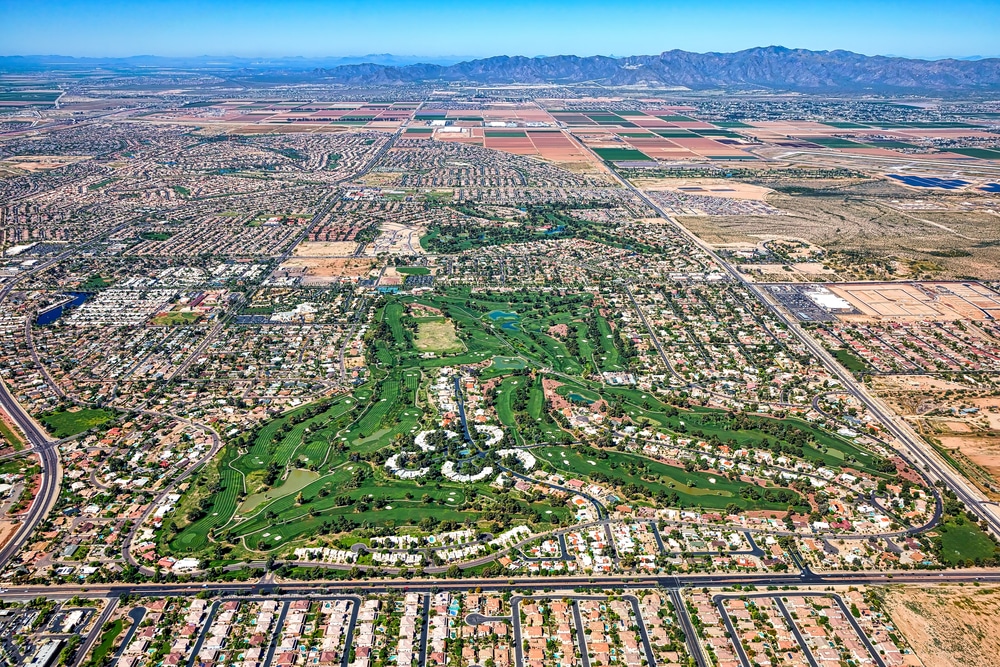
The morning sun illuminates Litchfield Park, Arizona with a distinctive warmth that highlights the community’s carefully preserved palm-lined streets and circular traffic patterns, where 6,800 residents occupy one of America’s most successful master-planned communities dating to 1916. Here, where the Goodyear Tire & Rubber Company once cultivated cotton for tire cords and Paul Litchfield envisioned a model city inspired by Kansas City’s Country Club District, you’ll discover Maricopa County’s hidden architectural gem—a place where original planning principles still guide development, where The Wigwam Resort anchors community identity, and where deliberate growth management maintains small-town character within metropolitan reach.
You’ll find yourself 19 miles west of downtown Phoenix, where Litchfield Park spans just 3.3 square miles bordered by Goodyear and Avondale, creating an island of planning excellence amid West Valley expansion. The compact footprint contains remarkable diversity—historic districts with homes from the 1920s, contemporary custom estates, and The Village at Litchfield Park’s commercial center. This positioning along Interstate 10 and Loop 303 provides metropolitan access while the limited size and careful planning preserve the intimate character that defines Litchfield Park’s appeal.
The atmosphere here reflects cultivated refinement and community pride, where architectural review maintains aesthetic consistency, where The Wigwam’s championship golf courses provide recreational focus, and where residents value preservation of the master-planned vision over maximizing development potential. As joggers navigate tree-lined streets and evening brings residents to Litchfield’s restaurants, you understand that Litchfield Park represents planning’s triumph—proof that thoughtful design endures and that small communities can maintain identity despite metropolitan pressures.

Litchfield Park’s median home price reaches $625,000 as of October 2024, reflecting a 6.8% year-over-year appreciation that demonstrates sustained demand for this limited inventory market where quality and character command premiums. The housing stock ranges from $400,000 historic cottages requiring updates to $2 million custom estates on The Wigwam’s golf courses, with most properties featuring mature landscaping and architectural distinction rare in newer developments. The prevalence of custom homes and architectural diversity creates unique character absent in production-built communities.
The market consists of established neighborhoods with minimal new construction due to geographic constraints and development restrictions. West USA Realty reports exceptional demand for properties in Old Litchfield Park where 1920s-1940s homes on large lots rarely reach market. The Wigwam golf course properties command premiums for views and resort proximity. Limited inventory—only about 2,500 housing units exist—creates competitive conditions where properly priced homes generate multiple offers quickly.
Rental markets remain extremely limited with few apartments and single-residence rentals averaging $2,200-3,500 monthly when available. The Wigwam provides resort accommodations but long-term rentals rarely appear. Investment opportunities focus on appreciation rather than rental income given community restrictions. Zillow shows inventory below 1.5 months of supply, creating strong seller advantages in this boutique market where every property is unique.

Litchfield Park’s economy centers on The Wigwam Resort, municipal services, and small businesses serving local needs, with most residents commuting to Phoenix, Goodyear, or other employment centers. The Wigwam employs hundreds in hospitality roles while generating economic impact through tourism and events. Local businesses in The Village at Litchfield Park provide services though commercial development remains intentionally limited to preserve residential character.
The proximity to Luke Air Force Base (10 minutes) and growing West Valley employment centers provides job access without excessive commutes. Many Litchfield Park residents are established professionals, business owners, or individuals who’ve achieved financial independence, choosing location for quality of life rather than employment proximity. The demographic includes significant numbers managing investments or consulting rather than traditional employment.
Economic stability comes from resident prosperity and The Wigwam’s consistent performance rather than major employers. The city’s economic development strategy focuses on maintaining quality over pursuing growth, preserving the character that attracted residents initially. Small business opportunities exist serving local needs though limited commercial space constrains options. The economic model prioritizes residential excellence accepting limited commercial activity.

Litchfield Elementary School District operates three schools serving Litchfield Park with consistently high performance ratings and strong community support. The district’s small size enables personalized attention with class sizes below state averages. Students transition to Agua Fria Union High School District facilities though many choose private alternatives. The community’s emphasis on education shows in foundation support and volunteer participation exceeding larger districts.
Private school options accessible include Tesseract School and religious institutions with tuitions ranging from $8,000 to $15,000 annually. Many residents choose schools in Phoenix or Scottsdale given resources and willingness to commute for preferred education. The demographic values education highly with college preparation beginning early. Educational decisions often influence property choices despite the small district size.
Higher education requires commuting with Estrella Mountain Community College 10 minutes away and Arizona State University’s West campus 20 minutes north. Grand Canyon University lies 25 minutes east. The proximity to multiple institutions provides options though Litchfield Park maintains its residential focus without educational facilities. Professional development and continuing education are common given the demographic’s emphasis on lifelong learning.

Healthcare for Litchfield Park residents involves travel to nearby facilities with Abrazo West Campus in Avondale (5 minutes) providing emergency and general services. Banner Estrella Medical Center in Phoenix (15 minutes) offers comprehensive care including specialized services. The proximity to multiple hospitals ensures access though no facilities exist within Litchfield Park proper, maintaining the residential character.
Primary care physicians and specialists maintain offices in adjacent communities serving Litchfield Park residents. The demographic often maintains relationships with Phoenix or Scottsdale physicians, willing to travel for preferred providers. Insurance acceptance varies with most major carriers maintaining networks. Concierge medicine appeals to those seeking enhanced access without travel.
Wellness amenities include The Wigwam’s spa and fitness facilities available through memberships. The community’s walkable design and tree-lined streets encourage active lifestyles. Alternative medicine practitioners in nearby communities serve health-conscious residents. Mental health services require travel though quality providers exist within reasonable distances. Healthcare access requires planning but quality remains high through proximity to metropolitan resources.

Living in Litchfield Park costs approximately 15% more than the national average according to BestPlaces, driven by housing costs 35% above national medians reflecting the premium for character and location. This investment delivers unique small-town atmosphere with resort amenities and metropolitan access. Grocery costs align with regional averages through nearby shopping though The Village provides some specialty options at premium prices.
Utility costs benefit from relatively efficient older homes with mature shade trees reducing cooling needs. Summer electric bills average $250-350 for typical homes though larger properties with pools reach $500+. The established landscaping often requires less water than newer xeriscaped properties. City services including water and trash collection maintain reasonable rates. The overall infrastructure benefits from long-term planning and maintenance.
Arizona’s 2.5% flat income tax applies uniformly while Litchfield Park’s 3.0% sales tax (9.3% combined) ranks higher than surrounding communities, funding services and infrastructure preservation. Property taxes average 0.68% of assessed value, reasonable given service levels and community amenities. The cost structure works for those valuing character and planning over pure affordability.

Litchfield Park’s street design reflects 1920s planning with circular patterns, wide medians, and tree-lined boulevards creating distinctive character but sometimes confusing navigation. Indian School Road and Litchfield Road provide primary connections to Interstate 10 (5 minutes) and Loop 303 (10 minutes). The compact size means internal trips rarely exceed 5 minutes though regional travel requires highway access.
Public transportation remains minimal with limited Valley Metro service requiring personal vehicles for most needs. The walkable Village center and pleasant streets encourage local walking and cycling though regional destinations require driving. Many residents maintain multiple vehicles including golf carts for local travel. The Wigwam provides shuttle services for guests.
Phoenix Sky Harbor International Airport lies 25-30 minutes via Interstate 10, manageable for travelers. Luke Air Force Base proximity creates occasional noise from training flights. The street design deliberately slows traffic preserving pedestrian safety and residential character. Parking remains adequate with most properties including garages and driveways. Transportation planning prioritizes community character over traffic efficiency.

Litchfield Park experiences typical West Valley climate with summer highs averaging 107°F though mature tree canopy provides shade rare in newer communities. The established landscaping creates micro-climates several degrees cooler than surrounding areas. Winter brings ideal conditions with temperatures in the 60s and 70s supporting year-round outdoor activities. The Wigwam’s golf courses and parks provide green spaces unusual in desert settings.
The developed nature of Litchfield Park means limited natural desert though careful planning preserved specimen trees and created park spaces. Wildlife adapts to suburban environment with birds abundant in mature trees. The commitment to landscaping maintenance creates oasis atmosphere though water conservation increasingly influences practices. The environment reflects human design rather than natural preservation.
The palm trees lining major streets require maintenance but provide distinctive character. Grass remains common on golf courses and some properties though xeriscaping increases. The balance between traditional landscaping and desert adaptation continues evolving. Environmental quality benefits from long-term planning and consistent maintenance standards. The created environment offers beauty through design rather than natural preservation.

Arizona’s 2.5% flat income tax benefits Litchfield Park’s prosperous residents while simplified structure aids those managing multiple income sources. The Arizona Department of Revenue processes returns efficiently with standard state procedures applying. Litchfield Park’s higher sales tax funds quality services and infrastructure preservation residents value.
Vehicle registration through ADOT requires emissions testing at nearby facilities with typical fees based on vehicle value. Many residents maintain classic or luxury vehicles reflecting the demographic. The nearest MVD office is in Avondale though online services handle most needs. New residents must obtain licenses within 15 days and register vehicles within 30 days.
Business climate reflects limited commercial space with focus on serving local needs rather than regional attraction. The city maintains strict development standards preserving character over maximizing tax revenue. Professional services and specialty retail find niches though expansion remains limited. The economic model accepts constraints for preservation of residential quality.

Recreation centers on The Wigwam Resort’s three golf courses available through memberships, with the resort also providing dining and spa services defining community social life. The Village at Litchfield Park offers restaurants and shops within walking distance for many residents. Community events including art festivals, concerts, and holiday celebrations create gathering opportunities in Litchfield Park’s town center.
The library serves as community hub with programs beyond traditional services. Youth activities include sports leagues and swimming at community pools. The compact size fosters neighborly connections with many residents knowing each other. Social clubs and organizations provide involvement opportunities. The Wigwam’s events draw regional attendance while serving as community gathering place.
Community character reflects pride in Litchfield Park’s planning heritage and determination to preserve its unique character. Long-time residents and newcomers unite around preservation values. Civic participation runs high with volunteer involvement in town activities. The shared appreciation for thoughtful planning and community character transcends other differences. Litchfield Park offers small-town community within metropolitan reach for those valuing planning and preservation.

As you explore Litchfield Park’s planned perfection, professional guidance helps navigate this limited inventory market where properties rarely appear and local knowledge matters. West USA Realty’s expertise in Litchfield Park from historic cottages to golf course estates ensures understanding the unique factors affecting value in this master-planned community. The comprehensive Arizona Relocation Guide available through Arizonan.com details everything from architectural guidelines to community traditions.
The transition to Litchfield Park rewards those appreciating planning excellence, valuing character over convenience, and seeking small-town community with resort amenities. Resources through Arizonan.com and West USA Realty connect you with specialists understanding Litchfield Park’s unique market, contractors familiar with preservation standards, and community connections easing integration.
Whether drawn by master-planned heritage, The Wigwam’s amenities, or simply seeking West Valley refinement, Litchfield Park offers distinctive living. The community maintains its vision through careful governance and resident commitment. Your path to Litchfield Park benefits from understanding both its special qualities and the limited opportunities in this boutique market where patience rewards those seeking something truly unique.
We use cookies to improve your experience on our site. By using our site, you consent to cookies.
Manage your cookie preferences below:
Essential cookies enable basic functions and are necessary for the proper function of the website.
Statistics cookies collect information anonymously. This information helps us understand how visitors use our website.
Monetize your website by displaying targeted ads and earning revenue from clicks and impressions.
Google Analytics is a powerful tool that tracks and analyzes website traffic for informed marketing decisions.
Service URL: policies.google.com (opens in a new window)
You can find more information about our Cookie Policy and Privacy Policy.