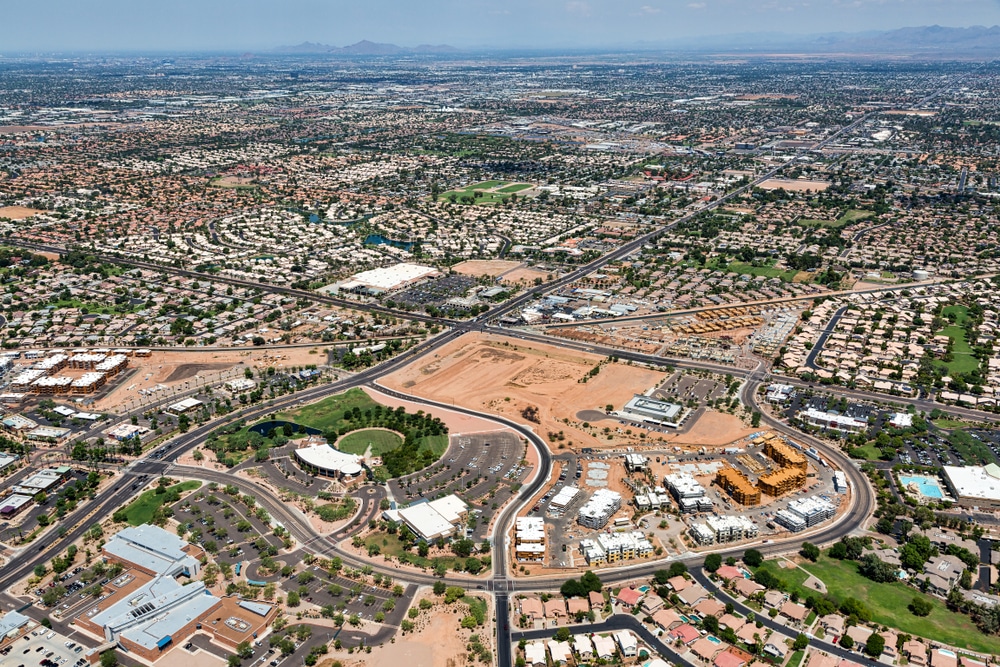
The morning sun illuminates Gilbert, Arizona differently than its Valley neighbors—not with Scottsdale’s resort sheen or Mesa’s expansive sprawl, but with the purposeful energy of 275,000 residents who’ve discovered the Southeast Valley’s remarkable transformation from agricultural heritage to modern suburban excellence. Here, in what was once the “Hay Capital of the World,” agricultural fields have transformed into master-planned communities featuring state-of-the-art amenities, award-winning schools, and meticulously maintained neighborhoods. This is Maricopa County’s fastest-growing municipality, a city that expanded 20-fold since 1990 by perfecting the balance between economic opportunity and residential quality.
You’ll find yourself in the Southeast Valley’s crown jewel, where Gilbert stretches across 76 square miles from the Loop 202 Santan Freeway south to Queen Creek, from Mesa’s border east to the Gila River Indian Community. The geographic positioning creates strategic advantages—proximity to Phoenix Sky Harbor Airport (20 minutes) for business travel, adjacency to Chandler’s technology corridor for employment, yet sufficient separation from urban core to maintain suburban tranquility. This calculated placement means convenient access to employment centers, educational institutions, and regional amenities while preserving neighborhood character.
The atmosphere here runs polished and purposeful, shaped by master-planned development, strong homeowners associations, and community investment in maintaining property values and aesthetic standards. As soccer fields fill at Freestone Park while the downtown Heritage District hosts its weekly farmers market, you understand that Gilbert represents deliberate community planning where every park, school, and commercial center reflects careful consideration of resident needs and preferences.

Gilbert’s median home price reaches $575,000 as of October 2024, reflecting a 7.2% year-over-year appreciation that continues outpacing metro Phoenix averages despite interest rate pressures. This sustained growth reflects fundamental demand for Gilbert’s combination of highly-rated schools, safe neighborhoods, and modern amenities. New construction dominates with communities like Eastmark, Morrison Ranch, and Layton Lakes offering floor plans from $500,000 townhomes to $1 million+ estate homes, while established neighborhoods like Val Vista Lakes provide resale options with mature landscaping and larger lots.
The market demonstrates clear premiums for properties near top-rated elementary schools and those backing to greenbelts or water features. West USA Realty reports properties in the 85295 and 85298 ZIP codes typically receive multiple offers when priced appropriately, particularly those with popular features like pools, three-car garages, and upgraded kitchens. Multigenerational floor plans with dual master suites or attached casitas have emerged as significant market segment, reflecting changing household compositions.
Rental markets remain tight with two-bedroom apartments averaging $2,100 monthly, while single-residence rentals in desirable school zones command $2,500-3,000. New luxury complexes near the Rivulon and downtown Gilbert offer high-end units exceeding $3,000 with resort-style amenities. The town’s development policies limiting apartment density help maintain property values while constraining rental supply. Investment properties face challenging economics as purchase prices have outpaced rent growth.

Gilbert’s economy has evolved from bedroom community to employment destination with 80,000 jobs within town limits and projections reaching 120,000 by 2030. The Rivulon, Gilbert’s 250-acre mixed-use development, attracts corporate offices including Deloitte, Northwestern Mutual, and First Solar, creating professional services positions previously requiring commutes to Phoenix or Scottsdale. These employers offer competitive salaries ranging from $70,000 for entry-level analysts to $150,000+ for senior management, supporting the mortgage payments Gilbert’s housing prices demand.
Healthcare emerged as major economic driver with Banner Health’s Banner Gateway Medical Center and Mercy Gilbert Medical Center collectively employing 4,500 in clinical and administrative roles. These facilities serve the growing Southeast Valley while attracting medical professionals and supporting businesses. The expansion of specialized services from pediatric care to cancer treatment creates multiplier effects through medical offices, imaging centers, and support services.
Small business thrives through municipal support, with the town’s economic development team actively recruiting unique concepts to downtown’s Heritage District and streamlining permit processes. The Bureau of Labor Statistics reports Gilbert’s unemployment rate at 2.9%, the lowest in Maricopa County. Educational attainment ranks high with 45% holding bachelor’s degrees or higher, attracting employers seeking skilled workforce. Remote work has amplified Gilbert’s appeal as professionals discover competitive cost advantages, with co-working spaces like The Coop and WorkHub Gilbert serving location-independent workers.

Gilbert Public Schools operates 41 schools serving 38,000 students with consistently high performance ratings. Elementary schools like Ashland Ranch, Meridian, and Canyon Rim earn top scores through combination of resources, curriculum, and community support. High schools including Highland, Campo Verde, Williams Field, and Perry offer comprehensive academic programs with Advanced Placement courses, STEM academies, and arts programs. Graduation rates exceed 95% with college enrollment approaching 85%.
Chandler Unified and Higley Unified districts serve portions of Gilbert with similarly strong outcomes, creating competition that elevates performance across all schools. Charter schools including BASIS Gilbert, Great Hearts Academies, and American Leadership Academy provide alternative educational approaches with varying philosophies from classical education to STEM focus. Private institutions like Gilbert Christian and Logos Preparatory Academy offer religious or specialized curricula with tuitions ranging from $8,000 to $15,000 annually.
Higher education access includes Chandler-Gilbert Community College’s Williams Campus serving 8,000 students in university transfer and vocational programs. Arizona State University’s Polytechnic campus lies 10 minutes east, while Park University and Ottawa University maintain Gilbert campuses targeting working adults. This educational infrastructure creates talent pipelines supporting workforce development and attracting employers seeking educated employees.

Healthcare in Gilbert exceeds suburban expectations through two full-service hospitals and extensive medical facilities. Banner Gateway Medical Center’s 177-bed facility offers comprehensive services including Level III NICU, cardiac care, and orthopedic surgery. Mercy Gilbert Medical Center adds 212 beds with strengths in emergency medicine, surgical specialties, and women’s health services. Combined, these facilities eliminate most needs for Phoenix travel.
Medical office concentration along Val Vista Drive and Higley Road creates healthcare corridors with virtually every specialty represented. Pediatric practices, reflecting community demographics, often book appointments months ahead. Urgent care centers including NextCare, Banner Urgent Care, and Dignity Health ensure immediate access for non-emergency needs with typical wait times under 30 minutes.
Wellness infrastructure includes 600 acres of parks with aquatic centers, sports complexes, and the 135-acre Riparian Preserve featuring wetlands and trails. The town operates multiple recreation centers with fitness equipment, classes, and programs. Alternative medicine practices offer acupuncture, functional medicine, and integrative approaches. Mental health services have expanded with numerous counseling centers and specialized practices addressing various needs.

Living in Gilbert costs approximately 9% more than the national average according to BestPlaces, driven primarily by housing costs running 30% above national medians. This premium reflects the value proposition of excellent schools, safe neighborhoods, and comprehensive amenities. Grocery costs align with national averages through competition among Fry’s, Safeway, Walmart, Target, Whole Foods, and Trader Joe’s. Arizona’s lack of food tax provides additional savings.
Utility costs follow predictable patterns with summer electric bills reaching $350-400 monthly for typical 2,500 square foot homes. SRP (Salt River Project) serves most of Gilbert with time-of-use plans rewarding off-peak consumption. Water bills average $75 monthly for desert-landscaped properties, though many HOAs maintain common area landscaping through separate assessments. Solar adoption increases with new construction often including panels or pre-wiring for future installation.
Arizona’s 2.5% flat income tax provides competitive advantage, while Gilbert’s 1.5% sales tax (7.8% combined) remains below regional averages. Property taxes average 0.72% of assessed value, with new construction sometimes qualifying for temporary incentives. The overall cost structure works well for households with strong incomes, though service-sector workers face affordability challenges given housing costs.

The Loop 202 Santan Freeway provides Gilbert’s primary east-west corridor, connecting to Loop 101 and the broader Valley freeway system. US Route 60 (Superstition Freeway) serves northern Gilbert with connections to Phoenix and Mesa. These highways position Gilbert strategically for regional access while maintaining distance from traffic noise in residential areas. Major arterials including Gilbert Road, Val Vista Drive, and Higley Road carry significant traffic during peak hours.
Public transportation remains limited with Valley Metro operating minimal bus routes primarily connecting to adjacent cities rather than internal circulation. The absence of light rail reinforces automobile dependence typical of master-planned suburbs. Park-and-ride lots at Greenfield and Baseline provide express bus connections to downtown Phoenix for commuters. The extensive multi-use path system includes the Western Powerline Trail and canal paths creating recreational corridors.
Phoenix Sky Harbor Airport lies 20 minutes via Loop 202, providing convenient access for business and leisure travel. Phoenix-Mesa Gateway Airport, just 15 minutes southeast, offers alternative flight options with growing airline service. The planned State Route 24 (Gateway Freeway) extension promises improved connectivity to regional destinations. Bicycle infrastructure continues expanding though practical commuting remains limited by distances and summer heat.

Gilbert experiences Sonoran Desert climate with summer highs averaging 106°F in July and winter conditions ideal for outdoor activities with daytime temperatures in the 60s-70s from December through February. The monsoon season from July through September delivers dramatic thunderstorms that temporarily cool evenings and fill retention basins designed for flood control and groundwater recharge. Annual rainfall totals just 9 inches, creating 330 days of sunshine that enable year-round outdoor activities.
Natural areas within Gilbert remain limited given development patterns, though the Riparian Preserve provides 110 acres of constructed wetlands attracting over 200 bird species. The Gila River corridor maintains riparian habitat along Gilbert’s southern boundary, though water flows remain rare except during flood events. Parks and retention basins throughout the community create pocket habitats supporting urban wildlife including burrowing owls, roadrunners, and occasional javelinas.
Regional outdoor recreation requires short drives to San Tan Regional Park (20 minutes) or Usery Mountain Regional Park (20 minutes) for hiking and mountain biking. The flat terrain and wide streets within Gilbert make it exceptionally walkable and bikeable for neighborhood activities. The urban heat island effect runs strong given extensive pavement, with temperatures 5-7 degrees warmer than surrounding desert, making shade structures and pools popular amenities.

Arizona’s 2.5% flat income tax structure benefits all income levels equally while remaining competitive with most states. The Arizona Department of Revenue provides efficient online filing with refunds typically processed within two weeks. Gilbert imposes no municipal income tax, maintaining simplicity for residents working across multiple jurisdictions. These tax advantages prove particularly beneficial for those relocating from higher-tax states.
Vehicle registration through ADOT requires emissions testing at multiple Gilbert locations with typical wait times under 20 minutes. Registration fees scale with vehicle value—luxury vehicles common in Gilbert mean higher annual fees, with costs ranging from $280 for standard sedans to $600+ for high-end SUVs. New residents must obtain Arizona driver’s licenses within 15 days and register vehicles within 30 days of establishing residency.
Gilbert’s business-friendly climate earned recognition through streamlined permitting, development incentives, and infrastructure investments supporting growth. The town’s AAA bond rating enables favorable financing for capital projects enhancing community amenities. Programs like the Small Business Big Impact initiative provide resources and networking opportunities. Foreign Trade Zone designation offers customs advantages for international commerce. These policies support economic vitality generating employment and tax revenue.

Recreation in Gilbert centers on extensive youth sports programs with soccer, baseball, and basketball leagues utilizing facilities like Crossroads Park and Mesquite Aquatic Center. The 310-acre Regional Park hosts tournaments drawing participants regionally. Topgolf and Main Event provide entertainment venues while the Hale Centre Theatre presents Broadway-caliber productions. Downtown Gilbert has transformed into dining and entertainment destination with local restaurants, craft beverages, and weekend farmers markets.
The Heritage District preserves agricultural history through restored buildings housing shops, restaurants, and cultural venues. The HD South complex brings additional dining and shopping to southeast Gilbert. Community events including Gilbert Days, weekly farmers markets, and seasonal festivals create gathering opportunities throughout the year. The extensive trail system connects neighborhoods to parks, schools, and commercial areas.
Arts and culture continue developing with public art installations, the Gilbert Historical Museum, and various performance venues. The library system offers extensive programming beyond traditional services including technology classes, cultural events, and meeting spaces. Shopping ranges from national retailers at SanTan Village to local boutiques in the Heritage District. The community’s investment in quality-of-life amenities creates an environment supporting diverse interests and activities.

As you explore Gilbert’s opportunities, professional guidance helps navigate between master-planned communities with varying amenities and price points. West USA Realty’s expertise in Gilbert’s diverse neighborhoods—from Agritopia’s agri-urban design to Morrison Ranch’s traditional suburbs to The Islands’ waterfront properties—ensures alignment between your priorities and property selection. The comprehensive Arizona Relocation Guide available through Arizonan.com details school boundaries, HOA regulations, and development plans affecting future values.
The transition to Gilbert life rewards those seeking modern amenities, educational excellence, and community investment in maintaining property values. Resources through Arizonan.com and West USA Realty connect you with lenders familiar with jumbo loans common at Gilbert prices, contractors understanding HOA architectural requirements, and service providers essential for property maintenance.
Whether drawn by employment opportunities, educational excellence, or Southeast Valley convenience, Gilbert delivers contemporary suburban living with sustained value appreciation. The town continues investing in infrastructure, amenities, and economic development while maintaining development standards that protect community character. Your path to calling Gilbert home benefits from understanding both current advantages and future potential as this dynamic community continues its planned growth.
We use cookies to improve your experience on our site. By using our site, you consent to cookies.
Manage your cookie preferences below:
Essential cookies enable basic functions and are necessary for the proper function of the website.
Statistics cookies collect information anonymously. This information helps us understand how visitors use our website.
Marketing cookies are used to follow visitors to websites. The intention is to show ads that are relevant and engaging to the individual user.