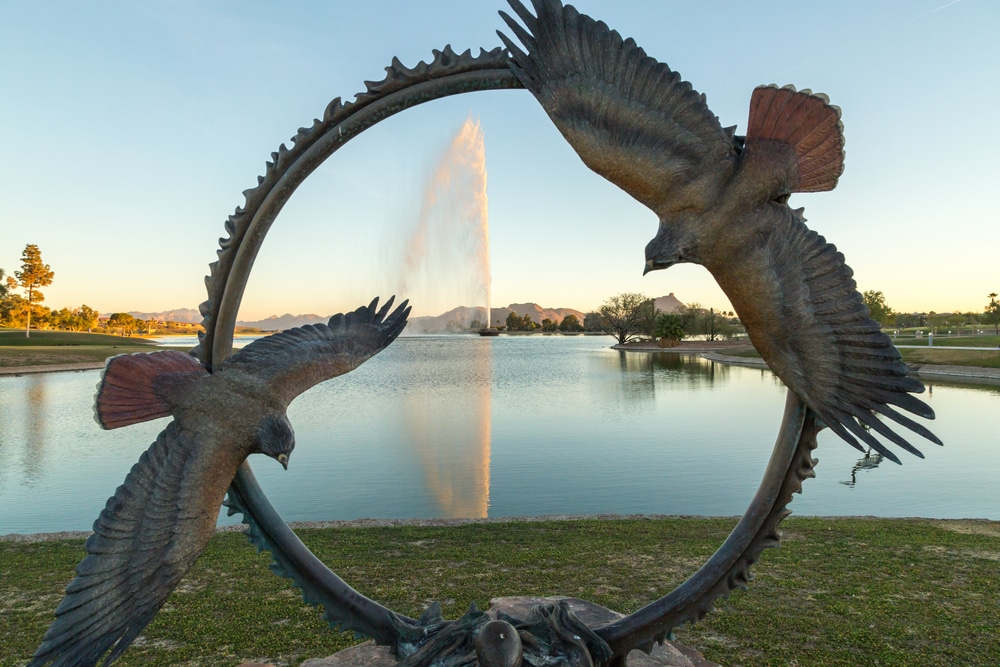
The morning sun illuminates Fountain Hills, Arizona with spectacular brilliance across the McDowell Mountains, revealing a community where 25,000 residents have discovered the Valley’s most dramatic setting—a master-planned oasis where the world’s fourth-tallest fountain shoots water 560 feet skyward every hour, creating an iconic centerpiece for this elevated desert community. Here, perched at 1,500 to 3,000 feet elevation along the McDowell Mountain slopes, you’ll find Maricopa County’s most cohesive architectural vision, where building codes preserve mountain views, dark sky ordinances protect celestial observations, and every home seems positioned to capture the panoramic Valley vistas that define this remarkable place.
You’ll find yourself northeast of Scottsdale, where Fountain Hills occupies 20 square miles bordered by the McDowell Mountain Regional Park to the west and Fort McDowell Yavapai Nation to the north and east. This geographic positioning creates natural boundaries that preserved Fountain Hills from urban sprawl while maintaining easy access via Shea Boulevard to Loop 101 and greater Phoenix. The elevation changes throughout town create distinct neighborhoods—lakeside properties near the fountain, hillside homes climbing the mountainsides, and ridge-top estates commanding 360-degree views.
The atmosphere here reflects sophisticated tranquility, shaped by master-planned origins, artistic sensibilities, and residents who chose mountain beauty over urban convenience. As morning walkers circle the lake while artists set up easels to capture desert light, and evening brings crowds to watch the fountain’s illuminated display, you understand that Fountain Hills operates on different priorities—valuing views over proximity, community over convenience, and natural beauty over commercial development.

Fountain Hills’ median home price reaches $625,000 as of October 2024, reflecting a 5.2% year-over-year appreciation that demonstrates steady demand for this unique market where views and elevation command premiums. The housing stock ranges from $300,000 condominiums with fountain views to multi-million dollar estates on Eagle Mountain and Firerock Country Club, creating options across price points though all benefit from the community’s exceptional setting. Custom homes dominate the luxury market with architectural designs maximizing views and integrating with desert landscape.
The market features primarily single-level homes accommodating the elevation and terrain, with most properties built between 1970 and 2000, though continuous renovation maintains modern standards. West USA Realty reports particular demand for properties with unobstructed Valley views, golf course frontage, or fountain proximity. The limited inventory—geographic constraints prevent expansion—creates competitive conditions when quality properties become available, often generating multiple offers for view homes.
Rental markets remain limited with two-bedroom units averaging $1,800 monthly when available, though most rentals are single-residence homes ranging from $2,200 to $4,000 depending on size and views. The seasonal rental market adds complexity as winter visitors seek November-through-April escapes, creating investment opportunities but limiting year-round inventory. Zillow shows inventory below 2 months of supply, firmly favoring sellers in this constrained market.

Fountain Hills’ economy centers on services supporting residents and visitors, with limited major employment requiring most working residents to commute to Scottsdale, Phoenix, or other Valley employment centers. The town’s economic development focuses on maintaining quality of life rather than aggressive commercial recruitment, preserving the character that attracted residents initially. Local employment includes town services, retail, restaurants, and professional services like real estate, financial planning, and healthcare.
The proximity to Scottsdale’s Airpark (20 minutes) and North Scottsdale’s medical corridor provides employment access without excessive commutes. Many Fountain Hills residents are business owners, consultants, or remote workers who chose location for lifestyle rather than job proximity. The town’s demographic includes significant numbers living on investment income or retirement funds, creating economic stability independent of employment cycles.
The Bureau of Labor Statistics includes Fountain Hills in broader regional statistics, though local unemployment typically runs lower than county averages given resident prosperity. Small business opportunities exist serving local needs though the limited commercial space and customer base constrain growth. The economic model prioritizes residential quality over commercial development, a conscious choice reflected in zoning and development policies.

Fountain Hills Unified School District operates four schools serving approximately 2,000 students with consistently high performance ratings. Fountain Hills High School, McDowell Mountain Elementary, and Four Peaks Elementary earn recognition for academic excellence with small class sizes enabling personalized attention. The district’s size fosters community involvement with strong volunteer participation and foundation support enhancing programs beyond tax funding.
The limited student population means fewer specialized programs than larger districts though core academics excel. Advanced Placement courses, arts programs, and athletics compete successfully despite smaller enrollment. The high school’s graduation rate exceeds 90% with college enrollment approaching 85%. The community’s emphasis on education shows in voter support for bonds and overrides funding facilities and programs.
Higher education requires commuting with Scottsdale Community College 20 minutes away and Arizona State University 30 minutes via Loop 101. Many residents pursue online education or professional development given the demographic includes established professionals and lifelong learners. The proximity to metropolitan education resources provides access without requiring local facilities that would alter community character.

Healthcare in Fountain Hills includes urgent care and medical offices though hospital services require travel to Scottsdale or Phoenix, typically 20-30 minutes via Shea Boulevard. HonorHealth Scottsdale Shea Medical Center serves as the primary hospital for Fountain Hills residents. The Mayo Clinic’s proximity (25 minutes) provides world-class medical care for complex conditions. This arrangement works given the demographic and their ability to travel for care.
Primary care physicians and specialists maintain Fountain Hills offices serving the local population with particular depth in internal medicine, cardiology, and age-related specialties. The Fountain Hills Medical Campus houses multiple practices and diagnostic facilities. Insurance acceptance varies with Medicare prominent given demographics, while most major carriers maintain networks. Concierge medicine practices have emerged serving those seeking enhanced access.
Wellness culture thrives through active lifestyle opportunities with extensive hiking and biking trails, golf courses, and the community center’s fitness facilities. Alternative medicine practitioners including acupuncture, naturopathy, and integrative medicine serve health-conscious residents. The elevation and outdoor opportunities support physical and mental well-being. Healthcare access requires planning but quality remains high through nearby facilities.

Living in Fountain Hills costs approximately 15% more than the national average according to BestPlaces, driven by housing costs 35% above national medians reflecting the premium for views and location. This investment delivers unique living environment with natural beauty and community amenities justifying costs for those valuing quality of life. Grocery costs run 8% above national averages with limited competition between Safeway, Bashas’, and specialty stores. Dining and services reflect resort pricing given the demographic and tourist presence.
Utility costs vary with elevation and home size, with summer electric bills ranging from $250 for efficient condominiums to $500+ for large homes with pools. The elevation provides some natural cooling though air conditioning remains essential May through September. Water costs reflect desert location with conservation-focused pricing. Many homes include solar installations taking advantage of abundant sunshine and reducing long-term costs.
Arizona’s 2.5% flat income tax benefits Fountain Hills’ affluent residents while the town’s 2.3% sales tax (8.6% combined) funds services without excessive burden. Property taxes average 0.65% of assessed value, lower than many states though applied to higher property values. The overall cost structure works for those with established wealth or strong incomes prioritizing lifestyle over pure affordability.

Shea Boulevard provides Fountain Hills’ primary connection to greater Phoenix, winding through the McDowell Mountains to Loop 101 in Scottsdale, approximately 20 minutes depending on traffic. This single main access route creates vulnerability during accidents or construction but preserves the community’s separated character. Fountain Hills Boulevard and Saguaro Boulevard provide internal circulation with minimal congestion given the population size.
Public transportation doesn’t exist in Fountain Hills, making personal vehicles essential for all needs. The nearest Valley Metro service requires driving to Scottsdale. The isolated location and limited density make public transit economically unfeasible. Most residents accept this as part of choosing Fountain Hills’ removed setting. Some use ride-sharing for Phoenix airport trips or evening dining in Scottsdale.
Phoenix Sky Harbor International Airport lies 35-40 minutes via Shea Boulevard and Loop 101, manageable for travelers. Scottsdale Airport accommodates private aviation 20 minutes away. The town’s trail system provides recreational cycling and walking though practical transportation requires vehicles. The limited access preserves community character while requiring planning for commutes and services.

Fountain Hills enjoys slightly cooler temperatures than Valley floor due to elevation, with summer highs averaging 102°F compared to 106°F in Phoenix. The elevation provides cooler evenings and spectacular sunset views. Monsoon storms appear dramatic from Fountain Hills’ elevated position with lightning displays visible across the entire Valley. Winter delivers perfect weather with 60s and 70s temperatures and occasional light frost at higher elevations.
The McDowell Mountain Regional Park borders Fountain Hills providing 21,099 acres of pristine Sonoran Desert with extensive trail systems for hiking, mountain biking, and horseback riding. The trails range from easy lake loops to challenging mountain ascents. The fountain itself creates a unique microclimate attracting waterfowl unusual for desert settings. Dark sky ordinances preserve exceptional stargazing opportunities rare in metropolitan areas.
Desert wildlife thrives with javelinas, bobcats, coyotes, and numerous bird species visible throughout town. Rattlesnakes require awareness particularly on hillside properties. The integration of development with natural desert creates beautiful but demanding landscape requiring respect and preparation. The environment offers unparalleled beauty for those appreciating desert aesthetics and accepting associated realities.

Arizona’s 2.5% flat income tax structure benefits Fountain Hills’ prosperous residents many of whom relocated from higher-tax states. The Arizona Department of Revenue provides efficient service for the demographic managing multiple income sources. Fountain Hills’ sales tax funds town services with emphasis on maintaining infrastructure and amenities rather than expansion.
Vehicle registration through ADOT requires emissions testing though many residents maintain multiple vehicles including classic cars and recreational vehicles. Registration fees vary by value with luxury vehicles common in Fountain Hills commanding higher fees. The nearest MVD office is in Scottsdale though many use online services. New residents must obtain Arizona licenses within 15 days and register vehicles within 30 days.
The business climate focuses on serving residents rather than aggressive commercial recruitment. The town maintains strict development standards preserving character over growth. Professional services, art galleries, and specialty retail find niches though limited commercial space constrains options. The economic model prioritizes residential quality accepting limited commercial development as conscious trade-off.

Recreation centers on outdoor activities with McDowell Mountain Regional Park’s trails, three golf courses including Eagle Mountain and Firerock, and the lake path circling the fountain. The Community Center offers fitness facilities, classes, and social activities. Art flourishes with numerous galleries, the Fountain Hills Theater, and public art throughout town. The fountain itself provides entertainment with hourly displays and special illuminated shows.
Dining ranges from casual cafes to fine dining with views, though options remain limited compared to larger cities. The town plaza hosts farmers markets, art festivals, and holiday celebrations creating community gathering opportunities. The library provides programs and services beyond books. Social clubs and organizations cater to varied interests from hiking to philanthropy.
The demographic creates interesting dynamics with established wealth supporting arts and culture while maintaining small-town atmosphere. Community involvement runs high with volunteerism and civic participation. The shared appreciation for natural beauty and quality of life unites residents despite varied backgrounds. Fountain Hills offers sophisticated small-town living for those prioritizing beauty and community over urban amenities.

As you explore Fountain Hills’ elevated lifestyle, professional guidance helps navigate this unique market where views determine value and limited inventory requires patience. West USA Realty’s expertise in Fountain Hills from lakeside condominiums to mountainside estates ensures understanding the subtle factors affecting property values and lifestyle. The comprehensive Arizona Relocation Guide available through Arizonan.com details HOA regulations, view corridors, and community dynamics unique to this master-planned community.
The transition to Fountain Hills rewards those prioritizing natural beauty over convenience, community over commerce, and quality over quantity. Resources through Arizonan.com and West USA Realty connect you with specialists understanding Fountain Hills’ market dynamics, service providers familiar with hillside properties, and community connections easing integration.
Whether drawn by world-famous fountain views, McDowell Mountain access, or simply seeking elevated living above Valley sprawl, Fountain Hills offers distinctive Arizona lifestyle. The town maintains its vision through careful planning and resident commitment to preservation. Your path to Fountain Hills benefits from understanding both its exceptional qualities and the trade-offs required for this remarkable setting.
We use cookies to improve your experience on our site. By using our site, you consent to cookies.
Manage your cookie preferences below:
Essential cookies enable basic functions and are necessary for the proper function of the website.