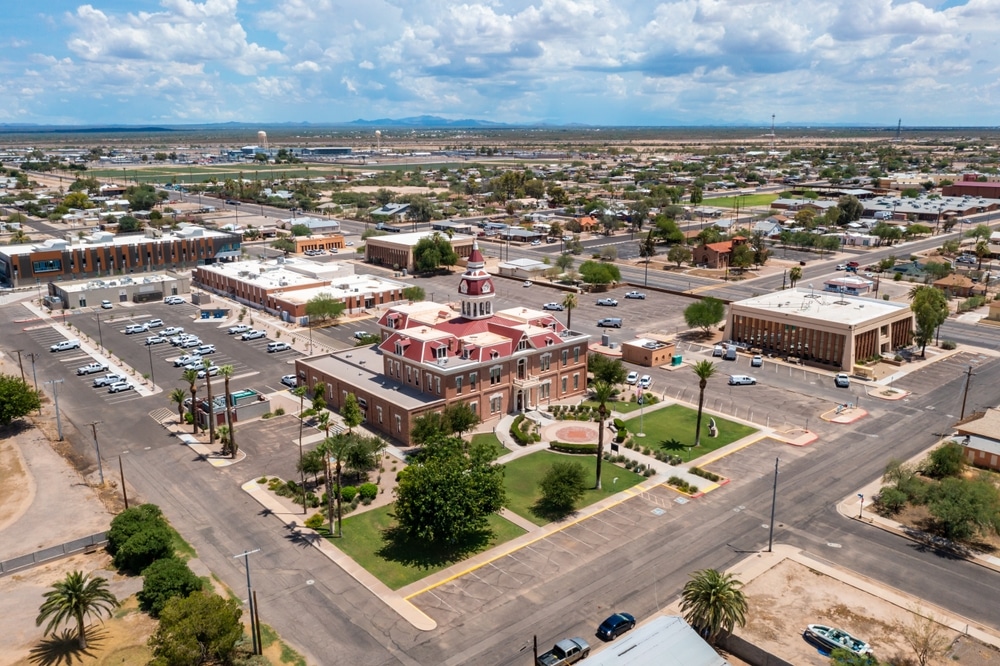
The morning light in Florence carries weight—not the harsh glare of noon, but that particular golden quality that transforms adobe walls and historic facades into something timeless. This is Arizona’s fifth oldest town, where the courthouse square still anchors community life and where about 25,000 residents have discovered that history and growth need not be mutually exclusive. As county seat of Pinal County since 1875, Florence wears its heritage with quiet dignity, even as new developments stretch toward the surrounding mountains. The juxtaposition is striking: Victorian-era buildings share streets with modern correctional facilities, while master-planned communities rise from lands where Hohokam Indians once carved elaborate canal systems.
Florence occupies a strategic position 52 miles southeast of Phoenix and 65 miles north of Tucson, making it equidistant from Arizona’s two largest metropolitan areas. This placement along the Highway 79 corridor has shaped its evolution from territorial prison town to modern community, attracting those who appreciate both its accessibility and its independence. The Gila River runs through the northern reaches, though its waters now feed agriculture rather than defining town boundaries. To the north, the Superstition Mountains create a dramatic backdrop, while the Picacho Peak punctuates the southern horizon.

Most Florence homes are detached single-family houses, about 70% of all housing units in the Census Bureau’s 2020–2024 American Community Survey (ACS). The housing stock tells Florence’s story in architectural chapters—from territorial-era adobes near downtown to contemporary energy-efficient homes in developments like Anthem at Merrill Ranch.
In the 2020–2024 ACS, 86.8% of occupied homes in Florence were owner-occupied, well above the Arizona figure of 67.4%. The median year built of 2005 in the same survey shows a community transformed by 21st-century growth while maintaining its historic core. New construction continues at measured pace, with builders offering modern floor plans that respect the desert environment through thoughtful orientation and xeriscaped yards that celebrate rather than fight the landscape.
Rental options, though limited at 13.2% of occupied units in the 2020–2024 ACS, provide alternatives for those testing Florence’s waters before committing.

Florence’s economy reflects its unique position as both county seat and home to significant state and federal correctional facilities. In the 2020–2024 ACS, 1,170 employed Florence residents worked in public administration. The Arizona State Prison Complex-Florence and Eyman, along with federal and private facilities, create an employment ecosystem extending beyond guards to administration, healthcare, medical services, and support staff.
The same survey counts 604 residents in educational services and 790 in professional, scientific and technical services, out of 5,947 employed residents.
The daytime population swells by over 4,000 due to commuting patterns, as workers travel from surrounding communities for employment in Florence’s institutions. Many residents commute to Chandler, Mesa, or Phoenix, finding Florence’s quality of life worth the morning drive. In the 2020–2024 ACS, about 55% of Florence’s working residents worked in the town itself.

Educational opportunities in Florence blend traditional public schools with modern alternatives. The Florence Unified School District serves the community with a comprehensive K-12 system focused on preparing students for both college and career pathways. The district’s commitment to excellence shows in its investment in technology and programs that rival larger urban districts.
Among adults 25 and older in the 2020–2024 ACS, 84.3% have at least a high school diploma and 17.3% hold a bachelor’s degree or higher. The presence of Central Arizona College’s satellite programs provides accessible higher education without requiring lengthy commutes.
For families with school-age children, the relatively small district size means more personalized attention and community involvement in education. Parents know teachers, administrators know students, and the Friday night football games draw crowds that represent genuine community gatherings rather than mere sporting events. This intimate educational environment appeals to families seeking alternatives to massive urban schools where students become numbers.

Healthcare infrastructure in Florence has evolved to meet growing demand while maintaining small-town accessibility. Local clinics and medical practices handle routine care, with several family physicians and specialists maintaining offices downtown and in newer medical complexes. The proximity to major medical facilities in both Phoenix and Tucson—each roughly an hour away—ensures access to specialized care when needed.
Banner Health and Dignity Health operate facilities within reasonable driving distance. The town has attracted healthcare providers drawn by the growing population and the opportunity to establish practices without the saturation found in metropolitan areas.
For seniors—a growing demographic given Florence’s appeal to retirees—home health services and assisted living facilities have expanded. The combination of a dry climate and proximity to comprehensive medical care makes Florence increasingly attractive for active retirement. Medical transport services connect residents to appointments in larger cities, addressing the transportation challenges that can affect healthcare access.

Electricity use follows Arizona’s seasons, peaking in summer when air conditioning runs for long stretches and dropping in the mild winters. Water conservation matters in this desert environment.
Internet service has improved dramatically with population growth, supporting the increasing number of remote workers who’ve discovered Florence. Multiple providers offer speeds suitable for video conferencing and streaming, eliminating the connectivity concerns that once limited rural communities.

Transportation in Florence centers on personal vehicles, with the street grid making navigation intuitive even for newcomers. Highway 79 serves as the main arterial, connecting to US 60 and eventually Interstate 10. These routes provide access to Phoenix Sky Harbor International Airport (52 miles) and Tucson International Airport (65 miles), keeping air travel accessible without airport noise and congestion.
Within Florence, traffic remains minimal even during peak hours. The wide streets, originally designed for horse-drawn carriages, now easily accommodate modern vehicles with ample parking throughout downtown and commercial areas. This ease of movement—where errands can be completed quickly without fighting traffic—represents a quality of life factor that daily shapes residents’ experience.
For those requiring public transportation, options remain limited but functional. Regional shuttles connect to Phoenix and Tucson for medical appointments and airport runs, while local services primarily serve seniors and those with disabilities. The walkable downtown district allows car-free living for those choosing residences near services, though most find personal vehicles essential for full community participation.

Florence’s climate embodies the Sonoran Desert’s extremes and beauty. Summer arrives early and stays late, with temperatures exceeding 100°F from May through September. July and August bring the most intense heat, when afternoon temperatures might reach 115°F, sending residents indoors or to community pools until evening brings relief. Yet the low humidity makes this heat different from Eastern summers—dry, penetrating, but somehow cleaner.
Winter transforms Florence into paradise, with December through February bringing daytime temperatures in the 60s and 70s. These months attract winter visitors and showcase why people endure summer’s intensity. Clear skies dominate—over 300 days of sunshine annually—creating reliable conditions for outdoor activities and solar energy generation. Freezing temperatures occur occasionally but rarely last long enough to damage desert-adapted landscaping.
Monsoon season, roughly July through September, brings drama to Florence skies. Afternoon thunderstorms build over mountains, delivering spectacular lightning shows and brief but intense rainfall. These storms cool evening temperatures and provide most of Florence’s annual 10 inches of precipitation. The desert’s response—sudden wildflower blooms and the perfume of wet creosote—rewards those who’ve learned to appreciate this landscape’s subtle beauty.

Arizona’s tax structure in Florence favors retirees and families alike. Arizona’s state income tax is a flat 2.5%, and the absence of tax on Social Security benefits particularly benefits seniors.
Sales tax in Florence combines state, county, and town rates for 10.2% on most retail purchases, and the town also taxes groceries even though the state exempts them. New residents should get an Arizona driver license and register their vehicles with ADOT’s Motor Vehicle Division once they establish residency. Registration fees are based on vehicle value and decrease annually. The Phoenix-area emissions-testing boundary extends into parts of Pinal County, so check ADEQ’s map for your address.
Business-friendly policies attract entrepreneurs, with relatively simple incorporation procedures and reasonable regulatory requirements. The transaction privilege tax system offers certain advantages over traditional sales tax structures, particularly for service businesses. These factors create opportunities for small business establishment and growth.

Life in Florence revolves around authentic community connections and accessible recreation. The historic downtown, with its territorial-era buildings and courthouse square, hosts farmers markets, festivals, and gatherings that draw residents together. The Pinal County Historical Museum chronicles the region’s evolution, while art galleries and antique shops occupy restored storefronts where authentic history trumps tourist kitsch.
Outdoor recreation abounds, with the Picacho Peak State Park nearby offering hiking trails and hosting Arizona’s only Civil War battle reenactment. The Tom Mix monument, marking where the silent film star died in 1940, has become an unlikely pilgrimage site for classic film enthusiasts. Golf courses provide manicured contrast to wild desert, while shooting ranges and off-road vehicle areas cater to those preferring more active pursuits.
The presence of multiple correctional facilities has created an unexpected cultural dimension, with employees from across the country bringing diverse perspectives to this historic town. This mixing of longtime residents, correctional staff, and newcomers creates a community more cosmopolitan than its size might suggest.

Starting your Florence journey requires understanding both its historic character and modern evolution. West USA Realty’s local agents know individual neighborhoods and can match properties to specific needs, from historic downtown homes to new construction in master-planned communities. The Town of Florence website provides comprehensive information about utilities, services, and community programs essential for newcomers.
Arizonan.com offers broader context about regional living, helping potential residents understand how Florence fits within Arizona’s diverse community tapestry. The Florence Chamber of Commerce connects newcomers with business and social networks, facilitating integration into community life. Given Florence’s unique character—neither purely rural nor suburban—extended visits during different seasons prove invaluable for confirming fit.
Consider joining community groups or attending town events before committing to relocation. The Saturday farmers market, First Friday art walks, and seasonal festivals provide glimpses into community character that statistics cannot capture. Many successful relocations begin with vacation rentals that allow exploration of neighborhoods and establishment of routines before making permanent moves.

We use cookies to improve your experience on our site. By using our site, you consent to cookies.
Manage your cookie preferences below:
Essential cookies enable basic functions and are necessary for the proper function of the website.
Statistics cookies collect information anonymously. This information helps us understand how visitors use our website.
Monetize your website by displaying targeted ads and earning revenue from clicks and impressions.
Google Analytics is a powerful tool that tracks and analyzes website traffic for informed marketing decisions.
Service URL: policies.google.com (opens in a new window)
You can find more information about our Cookie Policy and Privacy Policy.