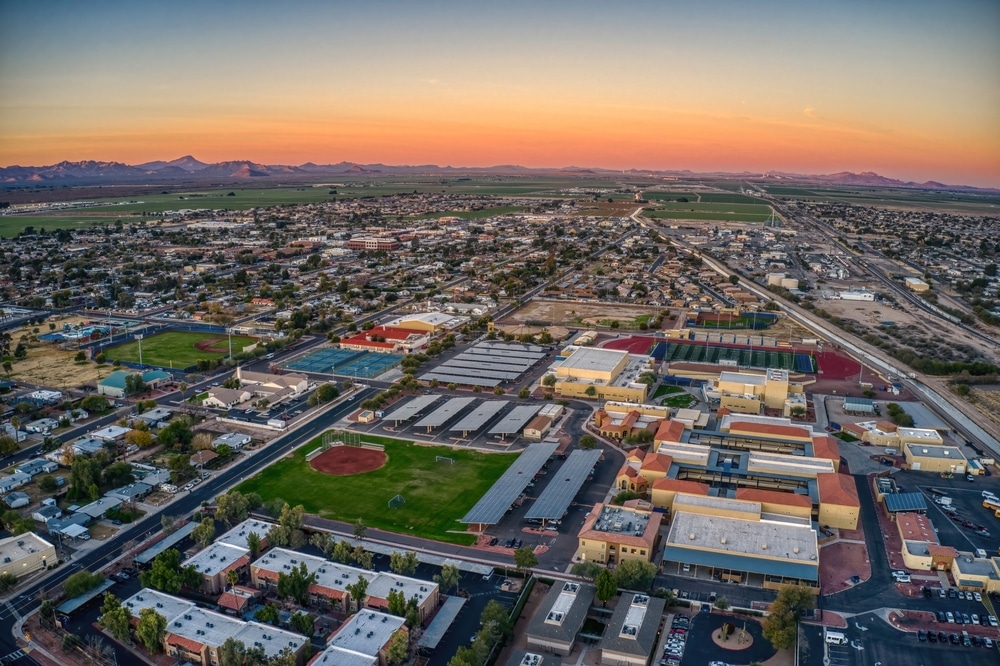
The morning sun rises over Buckeye, Arizona, illuminating vast expanses of desert that stretch from the White Tank Mountains to the Gila River, where 105,000 residents occupy what might be America’s most ambitious municipal territory—652 square miles of possibility. Here, where the Gillespie Dam once tamed the Gila River for agricultural prosperity and the historic downtown maintains its small-town character, you’ll discover Maricopa County’s final frontier—a city with more land area than Phoenix, Los Angeles, or New York City, yet just beginning to write its metropolitan story.
You’ll find yourself at the western edge of the Valley of the Sun, where Buckeye extends from Interstate 10 south to the Sonoran Desert National Monument, from the White Tank Mountains west toward the Hassayampa River. This extraordinary scale creates unique dynamics—downtown Buckeye maintains walkable charm while Verrado rises like a hilltop Tuscan village, and vast stretches of state trust land await transformation into master-planned communities. The geographic positioning along Interstate 10 provides straight-shot access to Phoenix (35 minutes) and California markets, making Buckeye strategic for both residential growth and economic development.
The atmosphere here pulses with anticipation and opportunity, where long-time residents who remember when Buckeye meant cotton fields now witness daily transformation as construction crews frame thousands of new homes annually. As hikers explore Skyline Regional Park’s ridgeline trails while developers unveil plans for communities housing hundreds of thousands, you understand that Buckeye represents Arizona’s biggest bet on growth—a place building not just neighborhoods but entire city sectors from scratch.

The morning sun rises over Buckeye, Arizona, illuminating vast expanses of desert that stretch from the White Tank Mountains to the Gila River, where 105,000 residents occupy what might be America’s most ambitious municipal territory—652 square miles of possibility. Here, where the Gillespie Dam once tamed the Gila River for agricultural prosperity and the historic downtown maintains its small-town character, you’ll discover Maricopa County’s final frontier—a city with more land area than Phoenix, Los Angeles, or New York City, yet just beginning to write its metropolitan story.
You’ll find yourself at the western edge of the Valley of the Sun, where Buckeye extends from Interstate 10 south to the Sonoran Desert National Monument, from the White Tank Mountains west toward the Hassayampa River. This extraordinary scale creates unique dynamics—downtown Buckeye maintains walkable charm while Verrado rises like a hilltop Tuscan village, and vast stretches of state trust land await transformation into master-planned communities. The geographic positioning along Interstate 10 provides straight-shot access to Phoenix (35 minutes) and California markets, making Buckeye strategic for both residential growth and economic development.
The atmosphere here pulses with anticipation and opportunity, where long-time residents who remember when Buckeye meant cotton fields now witness daily transformation as construction crews frame thousands of new homes annually. As hikers explore Skyline Regional Park’s ridgeline trails while developers unveil plans for communities housing hundreds of thousands, you understand that Buckeye represents Arizona’s biggest bet on growth—a place building not just neighborhoods but entire city sectors from scratch.

Buckeye’s economy transforms rapidly from agricultural heritage to diverse employment base, with massive industrial development along Interstate 10 and the planned Loop 303 corridor. The Goodyear Tire & Rubber Company maintains significant operations while Amazon, Walmart, and other logistics giants leverage Buckeye’s strategic location and available land for distribution centers employing thousands. These facilities offer positions from $15 hourly warehouse work to six-figure management roles, creating economic diversity.
The Douglas Ranch master-planned community promises to bring 300,000 residents and 55,000 jobs over coming decades, representing one of America’s largest planned developments. Current infrastructure investments including the widening of Interstate 10 and Loop 303 extension support this growth. The city’s economic development strategy targets manufacturing, renewable energy, and technology sectors with available land and competitive incentives attracting corporate attention.
The Bureau of Labor Statistics reports Buckeye’s unemployment rate at 4.5%, reflecting ongoing transition as employment opportunities develop alongside residential growth. Many residents currently commute to Phoenix or other Valley employment centers, though local job creation accelerates. Remote work flourishes as professionals discover Buckeye’s space and affordability advantages. Small business opportunities emerge daily serving the exploding population’s needs.

Educational services in Buckeye involve multiple districts managing rapid enrollment growth through aggressive construction programs. Buckeye Elementary School District operates 10 schools with several new campuses under construction to accommodate growth. Performance ratings vary though newer schools often achieve strong results. Buckeye Union High School District operates Buckeye Union High School, Estrella Foothills High School, and Youngker High School, with additional high schools planned.
Saddle Mountain Unified School District serves northern Buckeye including Tartesso and Festival Foothills communities with newer facilities and growing programs. Charter schools include Odyssey Preparatory Academy and Crown Charter School providing alternatives. Private options remain limited though growing population will likely attract additional institutions. The challenge remains building schools fast enough to accommodate thousands of arriving students annually.
Higher education presence includes Estrella Mountain Community College operating locally with plans for expanded facilities. Arizona State University and Grand Canyon University are exploring Buckeye campuses responding to projected growth. Current students travel to nearby cities for university access though this will likely change as population increases. Educational infrastructure races to keep pace with residential development.

Healthcare in Buckeye currently centers on urgent care facilities and medical offices, with Banner Health and Abrazo planning hospital construction to serve the growing population. Current hospital needs require travel to Goodyear or Phoenix, though emergency services and urgent care provide immediate access. The massive population growth projections ensure major healthcare investments are coming, with sites already identified for future medical centers.
Medical office development accelerates along Watson Road and Verrado Way with primary care physicians, pediatricians, and specialists establishing practices. The challenge remains attracting sufficient healthcare providers to match population growth. Insurance acceptance varies with most major carriers maintaining networks while AHCCCS participation ensures broad access. Telehealth adoption helps bridge current gaps in specialist availability.
Wellness amenities include multiple recreation centers with aquatic facilities, sports complexes, and extensive trail systems throughout master-planned communities. The emphasis on outdoor recreation supports active lifestyles with hiking, biking, and equestrian opportunities. Alternative medicine practitioners increasingly establish practices. Mental health services remain limited though growing as providers recognize opportunity.

Living in Buckeye costs approximately equal to the national average according to BestPlaces, making it one of Phoenix metro’s most affordable cities considering new construction quality and amenities. Housing costs run just 8% above national medians—remarkable for brand-new homes—while other expenses often fall below national averages. Grocery costs remain competitive with Fry’s, Walmart, and Safeway competing for market share in this growing population.
Utility costs follow desert patterns with summer electric bills reaching $300-350 monthly for typical new construction homes with modern insulation and efficient systems. Water remains relatively affordable though conservation-minded rate structures encourage desert landscaping. Many new communities include solar panels or pre-wiring as standard features reducing long-term energy costs. HOA fees vary widely from $30 monthly to over $200 depending on amenities.
Arizona’s 2.5% flat income tax benefits all residents while Buckeye’s 2.0% sales tax (8.3% combined) funds massive infrastructure needs. Property taxes average 0.71% of assessed value, reasonable considering required municipal investments. The overall affordability attracts value-conscious buyers who prioritize space and newness over established neighborhoods, with particular appeal for those escaping California’s costs.

Interstate 10 serves as Buckeye’s lifeline, connecting to Phoenix and Los Angeles with ongoing widening projects improving flow. The Loop 303 extension will create north-south connectivity while the planned State Route 30 promises additional east-west capacity. Current infrastructure struggles with explosive growth, creating peak-hour congestion on main arterials like Verrado Way and Watson Road though continuous improvements address bottlenecks.
Public transportation remains minimal with limited Valley Metro bus service inadequate for most needs. The vast geography and continuing expansion make comprehensive transit economically unfeasible currently. Most residents depend entirely on personal vehicles with commute times to central Phoenix averaging 45-60 minutes. Future transportation plans include possible commuter rail though implementation remains decades away.
Phoenix Sky Harbor International Airport lies 40-45 minutes east, manageable though requiring planning for flight times. Buckeye Municipal Airport serves general aviation without commercial service. The city’s Master Transportation Plan includes numerous road projects to accommodate projected growth though infrastructure typically lags development. Navigation challenges increase as new communities open faster than mapping services update.

Buckeye experiences classic low desert climate with summer highs averaging 108°F in July, among the Valley’s hottest temperatures. The lower elevation and distance from mountain cooling effects create intense heat requiring adaptation strategies. Monsoon season brings dramatic thunderstorms with spectacular lightning, dust storms, and flash flooding in numerous washes crossing the area. Winter delivers ideal conditions with 60s and 70s temperatures supporting year-round outdoor activities.
Skyline Regional Park preserves 8,700 acres of pristine Sonoran Desert providing hiking, mountain biking, and horseback riding with spectacular Valley views from ridgeline trails. The Hassayampa River maintains riparian corridors supporting diverse wildlife. Vast open desert surrounds Buckeye offering unlimited exploration opportunities though development pressures threaten some areas. The White Tank Mountains and Sonoran Desert National Monument provide nearby wilderness experiences.
Wildlife thrives in undeveloped areas with javelinas, coyotes, bobcats, and numerous snake species requiring awareness. The interface between development and desert creates interesting dynamics as animals adapt to human presence. Desert wildflowers following wet winters create spectacular displays across open areas. The environment offers beauty and recreation for those respecting desert realities.

Arizona’s 2.5% flat income tax structure provides simplicity and competitive rates attracting residents from higher-tax states. The Arizona Department of Revenue offers efficient online services supporting the influx of new residents. Buckeye’s sales tax funds explosive infrastructure needs from roads to utilities. The tax environment remains favorable despite growth-related costs.
Vehicle registration through ADOT requires emissions testing with facilities in Buckeye and nearby cities. Registration fees vary by vehicle value, averaging $250-400 annually. The rapid population growth sometimes creates MVD office delays though online services help. New residents must obtain Arizona licenses within 15 days and register vehicles within 30 days of establishing residency.
Business climate initiatives capitalize on available land and strategic location with aggressive recruitment of employers. The city offers competitive incentive packages for job-creating businesses. Foreign Trade Zone designation provides advantages for international commerce. Small businesses find opportunities serving exponential population growth though competition increases as national chains arrive.

Recreation opportunities expand continuously with new parks, trails, and facilities opening regularly. Verrado’s Main Street creates downtown atmosphere with restaurants, shops, and events while Buckeye’s historic downtown maintains authentic Western character. Skyline Regional Park offers world-class mountain biking drawing enthusiasts regionally. Youth sports leagues struggle to keep pace with demand as thousands of new residents arrive annually.
Dining options multiply from food trucks to upscale restaurants as population density supports diverse concepts. Shopping remains limited with residents traveling to Goodyear or Avondale for major retail though this changes as development continues. Entertainment venues are coming as population reaches critical mass. The infrastructure develops in real-time as growth creates opportunities.
Community events include Buckeye Air Fair, Spring Festival, and holiday celebrations building connections among new and established residents. The library system expands with new branches planned. Master-planned communities create instant neighborhoods through HOA events and shared amenities. Buckeye’s character evolves daily as agricultural heritage yields to suburban future while maintaining Western roots.

As you explore Buckeye’s unlimited potential, professional guidance helps navigate this rapidly evolving landscape where new communities appear monthly. West USA Realty’s expertise in Buckeye’s growth dynamics from Verrado’s established appeal to emerging developments helps identify opportunities aligning with your timeline and priorities. The comprehensive Arizona Relocation Guide available through Arizonan.com provides insights into builder options, growth projections, and investment potential across Buckeye’s vast territory.
The path to calling Buckeye home rewards those who appreciate being part of something building rather than built, who see opportunity in growth rather than inconvenience in construction. Resources through Arizonan.com and West USA Realty connect you with builders offering incentives, lenders familiar with new construction, and service providers essential for desert living.
Whether drawn by affordable new construction, investment potential, or simply space to breathe, Buckeye offers Arizona’s last frontier for attainable homeownership at scale. The city’s momentum continues accelerating through infrastructure investments, economic development, and amenity expansion. Your transition to Buckeye benefits from professional guidance ensuring you understand both current value and extraordinary future potential in Arizona’s fastest-growing city.

We use cookies to improve your experience on our site. By using our site, you consent to cookies.
Manage your cookie preferences below:
Essential cookies enable basic functions and are necessary for the proper function of the website.