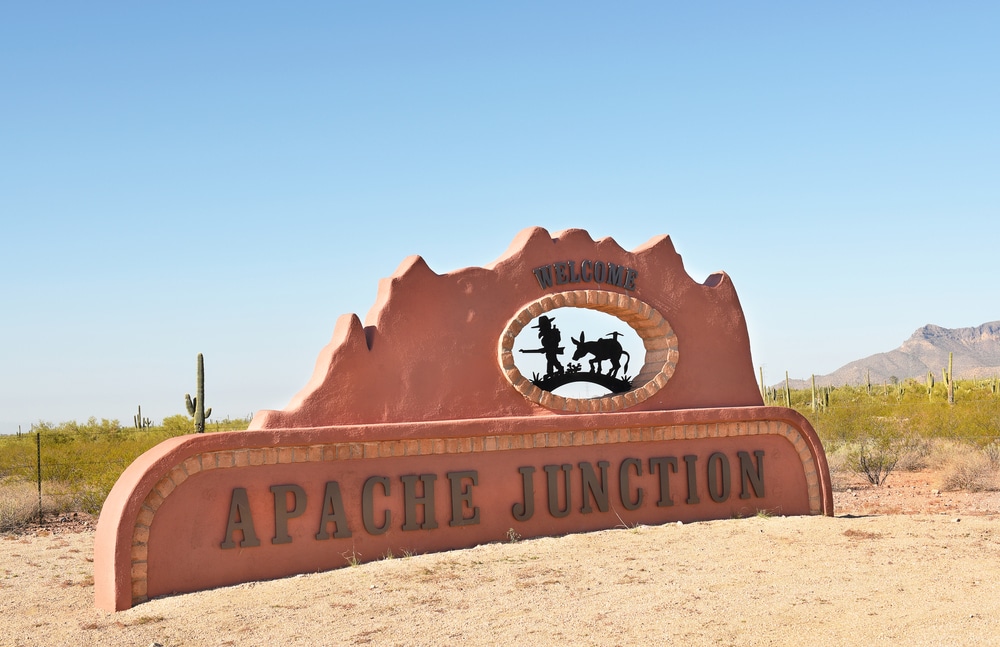
Morning light strikes the Superstition Mountains with theatrical drama in Apache Junction, where jagged peaks rise like ancient sentinels above a city that straddles two worlds—the rugged desert wilderness and the expanding Phoenix metropolitan area. This community of 44,300 residents spreads across 35 square miles at the eastern gateway to the Valley of the Sun, where Pinal and Maricopa counties meet and where urban convenience yields to the raw beauty of the Sonoran Desert. As you drive along Apache Trail, the historic route that connected Phoenix to the copper mines, you’ll understand why this place attracts those seeking affordable desert living with a backyard that includes some of Arizona’s most spectacular scenery.
The city’s character divides distinctly between established neighborhoods of manufactured homes where retirees have created tight-knit communities, and newer developments attracting families drawn by housing affordability and outdoor recreation opportunities. Located 35 miles east of downtown Phoenix, Apache Junction serves as base camp for adventures into the Superstition Wilderness, while maintaining connections to Valley employment centers. The legendary Lost Dutchman’s Gold Mine supposedly lies somewhere in those mountains, but today’s residents have found their own treasure in a community where $400,000 still buys a real house with mountain views that would cost millions elsewhere.

The Apache Junction housing market offers remarkable affordability in a region where housing costs have soared beyond reach for many families, with median home prices around $405,000—accessible compared to most Valley communities. This pricing reflects a diverse housing stock where 46.34% consists of manufactured homes, providing affordable options for retirees and first-time buyers, while traditional single-family homes comprise 39.32% of the market. Recent appreciation has been modest at 6.9% year-over-year, suggesting a stable market without the volatile swings plaguing other Phoenix-area communities.
Properties typically spend 65 days on market, allowing buyers time for thorough inspection and negotiation—a luxury absent in Phoenix’s hypercompetitive neighborhoods. The eastern sections near Gold Canyon offer newer construction with stunning mountain views, while established areas along Apache Trail feature affordable manufactured home communities with amenities like pools, clubhouses, and organized activities. Many properties include RV parking and workshop spaces, acknowledging residents’ outdoor lifestyles. The 77.7% owner-occupancy rate indicates neighborhood stability, while the remaining rental inventory, with median rents around $1,019, provides options for those testing Apache Junction’s waters before committing to purchase.

Apache Junction’s economy reflects its position as a residential community where 45.7% of residents participate in the labor force—lower than state averages but reflecting the significant retiree population alongside working families. The unemployment rate of 8.4% suggests economic challenges, though many residents commute to employment centers throughout the East Valley. Professional and administrative positions account for 72.1% of employment, indicating a skilled workforce that has chosen Apache Junction for lifestyle reasons despite potentially longer commutes.
Major regional employers accessible within reasonable driving distance include Banner Health facilities, Intel’s Chandler campuses, and the Boeing facility in Mesa. The city itself provides employment through municipal services, schools, and the growing tourism sector centered on the Superstition Mountains. Small businesses along Apache Trail serve both residents and the steady stream of tourists heading to Canyon Lake and the Apache Trail scenic drive. The median household income of $58,619 supports comfortable living given the area’s reasonable costs, while 13.2% of residents work in government positions, benefiting from stable public sector employment. The proximity to US Route 60 provides direct access to Phoenix’s job centers, making Apache Junction increasingly attractive for remote workers seeking affordable housing with natural beauty.

Education in Apache Junction involves multiple school districts serving different areas, with Apache Junction Unified School District operating several elementary schools and Apache Junction High School, home of the Prospectors. The district faces challenges common to rapidly growing communities, working to maintain quality while accommodating increasing enrollment. Class sizes remain manageable, and the district has invested in technology and STEM programs to prepare students for modern careers.
High school options include Apache Junction High School, which offers Advanced Placement courses, career and technical education programs, and dual enrollment opportunities through Central Arizona College. The school’s proximity to the Superstition Mountains provides unique outdoor education opportunities, with environmental science classes conducting field studies in actual wilderness areas. For families seeking alternatives, several charter schools operate in the area, including Arizona Charter Academy and Eduprize School. Higher education access includes Central Arizona College’s Superstition Mountain Campus offering associate degrees and workforce training programs. Arizona State University’s Polytechnic campus in Mesa sits just 20 miles away, providing four-year degree programs in aviation, engineering, and technology fields.

Healthcare in Apache Junction centers on Banner Goldfield Medical Center, a 30-bed hospital providing emergency services, imaging, and basic surgical procedures. While smaller than urban medical centers, this facility handles routine emergencies and health needs, with more complex cases transferring to larger Banner facilities in Mesa or Chandler. The hospital’s presence means residents don’t face long drives for urgent care, a significant advantage over many rural Arizona communities.
Outpatient services cluster along Apache Trail and Idaho Road, with several urgent care facilities, medical offices, and specialty clinics serving the community. The concentration of retirees has attracted physicians specializing in geriatric care, chronic disease management, and mobility issues. For specialized procedures or pediatric care, Banner Desert Medical Center in Mesa provides comprehensive services just 20 minutes away. The Mayo Clinic’s Scottsdale campus, one of the nation’s premier medical facilities, remains accessible for complex cases requiring world-class expertise. Many medical providers accept AHCCCS (Arizona’s Medicaid program) and Medicare, acknowledging the community’s diverse economic demographics.

Living costs in Apache Junction remain refreshingly manageable, with the overall cost index at 98.6% of the national average, making it one of the Phoenix area’s most affordable communities. Housing costs drive this affordability, but savings extend to daily expenses, with local markets and restaurants offering competitive prices. Grocery shopping at Walmart, Fry’s, or Bashas’ provides options from budget to premium, while the Saturday farmers market at Flatiron Community Park offers fresh produce and local products.
Utility expenses follow regional patterns, with Salt River Project or Arizona Public Service providing electricity depending on location. Summer cooling bills typically range from $200 to $400 monthly for average homes, dropping dramatically to $50 to $100 during mild winters. Apache Junction Water District serves most areas with rates averaging $60 to $80 monthly for typical residential use, though some areas rely on private water companies or wells. Republic Services handles solid waste collection at approximately $25 monthly. Internet service through Cox or CenturyLink costs $70 to $100 monthly, with speeds adequate for remote work and streaming. The lower cost structure allows families earning median incomes to maintain comfortable lifestyles while building savings or pursuing outdoor hobbies.

Transportation in Apache Junction centers entirely on personal vehicles, with the city’s spread-out nature and limited public transit making cars essential. US Route 60 (Superstition Freeway) serves as the primary corridor, providing direct access to Phoenix and the East Valley with commute times ranging from 45 minutes to over an hour during peak periods. State Route 88 (Apache Trail) heads northeast into the mountains, transitioning from paved suburban arterial to dirt road adventure route as it winds toward Roosevelt Lake.
Within Apache Junction, navigation remains straightforward with a grid system in developed areas giving way to winding roads in foothill neighborhoods. Parking is abundant and free throughout the city, even at popular trailheads during off-peak times. Public transit options remain minimal, with limited Valley Metro bus service primarily serving commuters rather than local transportation needs. The Apache Junction Municipal Airport accommodates small aircraft but offers no commercial service. Many residents maintain multiple vehicles—a reliable commuter car and a truck or SUV for desert exploration. The emerging State Route 24 gateway project promises to improve regional connectivity, potentially reducing commute times to employment centers in Mesa and Chandler.

Apache Junction’s desert climate delivers the full Sonoran Desert experience, with summer temperatures regularly exceeding 110°F from June through August, forcing life into early morning and evening patterns. Yet this intensity yields to perfection from November through March, when daytime temperatures hover in the 70s and the Superstition Mountains provide a stunning backdrop for outdoor activities. The elevation of roughly 2,000 feet provides minimal temperature moderation compared to Phoenix, though mountain breezes occasionally offer relief.
Annual rainfall totals just 10 inches, concentrated in winter storms and the dramatic monsoon season from July through September. These summer thunderstorms create spectacular lightning displays over the Superstitions while bringing flash flood risks in washes and low-lying areas. Air quality generally remains good given the distance from central Phoenix’s pollution, though dust storms (haboobs) occasionally engulf the area, reducing visibility and requiring residents to secure outdoor items quickly. The proximity to wilderness areas means wildlife encounters are common—javelinas, coyotes, and various reptiles share the landscape, requiring awareness and appropriate precautions, particularly for pet owners.

Tax advantages contribute to Apache Junction’s affordability, with Arizona’s state income tax ranging from 2.59% to 4.5%—lower than many states—while Social Security benefits remain exempt. The combined state, county, and city sales tax totals 9.1%, applied to most goods except groceries, helping maintain reasonable daily expenses. Property taxes average around 0.8% of assessed value, though Apache Junction’s lower home prices mean actual tax bills remain modest compared to properties in Scottsdale or Paradise Valley.
Vehicle registration through the Arizona Department of Transportation requires new residents to register within 15 days, with fees based on vehicle value. Newer vehicles might cost $300-400 annually, while older models drop below $100. The nearest MVD office in Mesa handles most transactions, though many services complete online. Business licensing through the City of Apache Junction remains straightforward and affordable, supporting the many small businesses and home-based enterprises that contribute to the local economy. The Arizona Department of Revenue’s online systems simplify tax compliance for residents managing rental properties or small businesses, common income sources for retirees supplementing fixed incomes.

Community life in Apache Junction blends outdoor adventure with small-town traditions, where the annual Lost Dutchman Days celebration brings rodeos, parades, and gold panning contests that honor the area’s mining heritage. The Superstition Mountain Museum preserves local history while the Elvis Memorial Chapel, featured in Elvis Presley’s film “Charro!”, attracts visitors from worldwide. Yet daily life centers on simpler pleasures—morning hikes at Lost Dutchman State Park, evening gatherings at the Mammoth Saloon, and the steady rhythm of a community where neighbors still look out for each other.
Recreation opportunities define Apache Junction’s appeal, with the Superstition Wilderness Area providing world-class hiking, rock climbing, and horseback riding literally in residents’ backyards. The Peralta Trail to Weaver’s Needle, the Flatiron via Siphon Draw, and dozens of other trails offer everything from casual strolls to challenging summit attempts. Golfers enjoy multiple courses including the Superstition Mountain Golf Club, while water enthusiasts head to nearby Canyon Lake for boating and fishing. The Apache Trail scenic drive, one of America’s most spectacular routes, begins at city limits. Social life includes active senior centers, veterans’ organizations, and outdoor clubs where newcomers quickly find like-minded adventurers.

Your Apache Junction journey begins with understanding this isn’t just affordable Phoenix suburbs but a gateway community where desert wilderness meets urban convenience. The Apache Junction Chamber of Commerce provides newcomer resources and connects you with local services, from reliable contractors familiar with desert construction to the best spots for watching sunrise paint the Superstitions gold. Their visitor center offers maps, trail guides, and honest advice about desert living realities.
Local real estate professionals, particularly those with West USA Realty who understand the unique aspects of manufactured home communities and desert properties, can guide you through Apache Junction’s diverse neighborhoods. Understanding water rights, flood zones, and HOA regulations becomes crucial when evaluating properties. Join online communities like “Apache Junction Community” on Facebook to tap into local knowledge about everything from rattlesnake removal services to which restaurants serve authentic Sonoran cuisine.
The Apache Junction Public Library offers resources beyond books, including newcomer programs covering desert safety, local history, and community resources. Schedule visits during spring or fall when comfortable weather allows thorough exploration of neighborhoods and trails. Spend time at the Mining Camp Restaurant or Handlebar Pub to engage with locals who can share insights about choosing between established manufactured home communities or newer subdivisions, understanding monsoon preparation, and discovering hidden trails that don’t appear on tourist maps.
Your story in Apache Junction begins with embracing a frontier spirit that values independence, natural beauty, and community over metropolitan amenities. Here, success isn’t measured by commute times or property values but by sunrises over the Superstitions, perfect hiking weather in January, and the satisfaction of finding affordable paradise where the desert still feels wild and the mountains still hold mysteries worth exploring.

We use cookies to improve your experience on our site. By using our site, you consent to cookies.
Manage your cookie preferences below:
Essential cookies enable basic functions and are necessary for the proper function of the website.