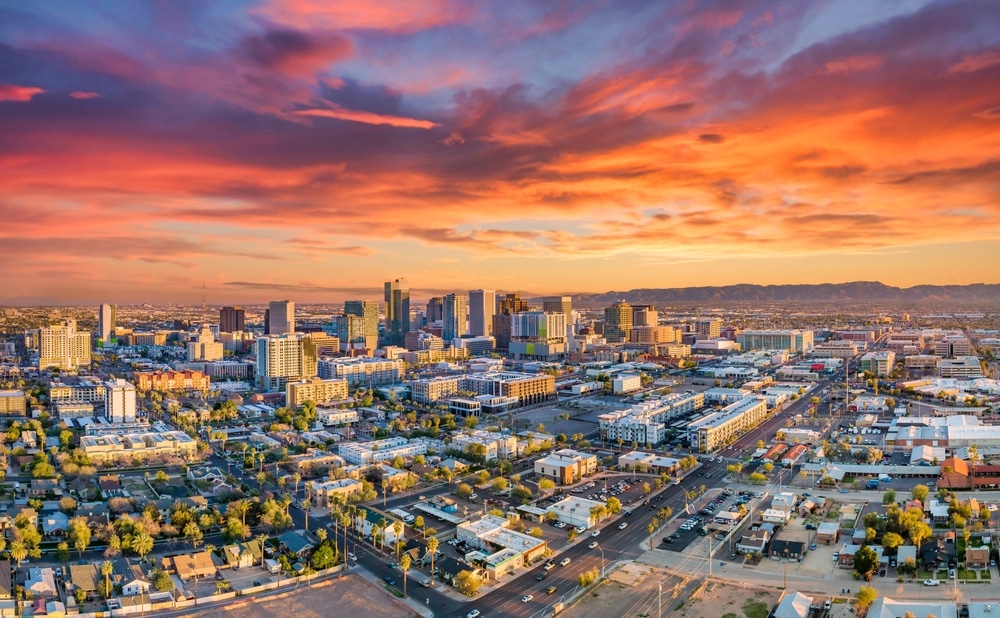
Dawn breaks differently in Phoenix, Arizona than anywhere else in the Southwest—not with the gentle touch of a small desert town, but with the energy of 1.6 million residents preparing to navigate a metropolitan area sprawling across 519 square miles of Sonoran Desert. You’ll find yourself at the center of the Valley of the Sun, where the convergence of Interstate 10 and Interstate 17 creates more than just a transportation hub; it establishes Phoenix as the economic and cultural heartbeat of the Southwest. This is a city that has transformed from agricultural settlement to America’s fifth-largest city, where glass towers reflect desert sunsets and mountain preserves provide hiking trails minutes from downtown offices.
You’ll discover a municipality so vast that neighborhoods feel like distinct cities—downtown Phoenix pulses with urban energy and high-rise living, while Ahwatukee Foothills maintains suburban tranquility against South Mountain’s backdrop. North Phoenix climbs toward Cave Creek with custom homes on acre lots, while historic districts like Encanto-Palmcroft preserve mid-century architecture alongside modern developments. This geographic diversity means your Phoenix experience varies dramatically whether you choose the urban core’s walkability or the desert lots of Desert Ridge.
The atmosphere here reflects remarkable dynamism, shaped by continuous growth, economic diversification, and a culture that embraces both innovation and tradition. As morning hikers summit Piestewa Peak before work and evening brings crowds to Roosevelt Row’s galleries, you understand that Phoenix has evolved beyond its reputation for sprawl and heat into a genuine metropolitan center offering career opportunities, cultural depth, and surprising livability for those who adapt to its rhythms.

Phoenix’s median home price reaches $450,000 as of October 2024, reflecting a 5.5% year-over-year appreciation that demonstrates market stabilization after the dramatic swings of recent years. This pricing positions Phoenix as relatively affordable among major Western cities, where housing investments deliver modern amenities and metropolitan access at values unmatched in California or Colorado. New construction continues throughout the Valley with master-planned communities offering homes from $350,000 townhomes to multi-million dollar estates, while established neighborhoods provide character properties suitable for renovation or immediate occupancy.
The market varies significantly by location, with Paradise Valley commanding millions for hillside estates while Maryvale offers entry points under $300,000 for value-focused buyers. Central Phoenix neighborhoods like Arcadia and Biltmore attract premiums for their mature landscaping and proximity to employment centers. West USA Realty reports that properties near light rail stations and in walkable neighborhoods generate particular interest as urban living gains traction. The emergence of downtown high-rise living creates alternatives to traditional suburban models.
Rental markets demonstrate strength with two-bedroom apartments averaging $1,600 monthly citywide, though luxury units downtown or in Scottsdale-adjacent areas exceed $3,000. The massive inventory of rental properties—from garden apartments to single-residence homes—creates options across all price points. Investment opportunities exist throughout Phoenix, with properties near Arizona State University’s downtown campus and growing employment centers providing reliable returns. Zillow shows inventory at 2.5 months of supply, creating balanced conditions favoring neither buyers nor sellers exclusively.

Phoenix’s economy generates remarkable diversity with no single industry dominating, creating recession resistance through balanced employment across technology, healthcare, finance, manufacturing, and services. Major employers include Banner Health (39,000 employees), Walmart (34,000), State of Arizona (32,000), Wells Fargo (15,000), and Intel (12,000), providing stability through varied sectors. The emergence of Taiwan Semiconductor Manufacturing Company’s $40 billion investment promises to transform north Phoenix into a semiconductor hub creating thousands of high-paying positions.
Downtown Phoenix has evolved into a legitimate urban core with companies like Deloitte, Amazon, and PwC establishing significant operations alongside government offices and healthcare facilities. Phoenix Sky Harbor Airport drives economic activity as America’s busiest airport for connecting flights, supporting logistics, hospitality, and transportation sectors. Average salaries vary widely from service positions at $30,000 to technology and healthcare roles exceeding $100,000, creating opportunities across education and skill levels.
The Bureau of Labor Statistics reports Phoenix’s unemployment rate at 3.6%, with job growth consistently outpacing national averages as companies relocate operations attracted by business climate and workforce availability. Remote work has amplified Phoenix’s appeal with professionals maintaining coastal salaries while enjoying Arizona’s cost advantages. Co-working spaces proliferate throughout the Valley, from WeWork downtown to local operators in suburban areas, fostering entrepreneurial communities.

Educational services in Phoenix involve numerous districts with varied characteristics and performance levels. Phoenix Union High School District operates 22 high schools including specialized programs at Metro Tech, Bioscience, and Coding academies. Elementary districts including Phoenix Elementary, Creighton, and Washington serve different geographic areas with performance ratings varying significantly between schools. Charter schools proliferate with Great Hearts, BASIS, and Arizona School for the Arts providing alternatives to traditional public education.
Private institutions range from religious schools to elite preparatory academies with tuitions spanning $5,000 to $30,000 annually. Phoenix Country Day School, Xavier College Preparatory, and Brophy College Preparatory rank among Arizona’s most prestigious educational institutions. The diversity of options allows matching educational approaches to individual priorities and budgets.
Higher education anchors at Arizona State University’s downtown Phoenix campus bringing 12,000 students to the urban core while Grand Canyon University’s 25,000-student campus transforms west Phoenix. Maricopa Community College District operates 10 colleges throughout Phoenix providing accessible pathways to certificates, associates degrees, and university transfer. This educational infrastructure creates talent pipelines supporting economic growth while offering continuing education opportunities for career advancement.

Healthcare in Phoenix exceeds expectations with 35 hospitals creating one of America’s most competitive healthcare markets. Banner Health, HonorHealth, Dignity Health, and Abrazo compete for patients, driving service improvements and facility investments. Phoenix Children’s Hospital ranks among the nation’s best pediatric facilities while Mayo Clinic’s Phoenix campus attracts patients globally for complex procedures. Barrow Neurological Institute at St. Joseph’s Hospital leads internationally in neurosurgery and neurology.
Specialist density surpasses most American cities with virtually every medical specialty represented, often with multiple competing practices. This competition benefits patients through shorter wait times, treatment options, and price transparency initiatives. Urgent care centers and standalone emergency departments proliferate, ensuring medical access within minutes regardless of location. Insurance acceptance varies by system but major carriers maintain broad networks.
Wellness infrastructure extends beyond traditional medicine with thousands of fitness facilities, yoga studios, and alternative medicine practitioners. Phoenix’s year-round outdoor weather enables active lifestyles that contribute to health outcomes. Integrated medicine combining conventional and alternative approaches gains acceptance at major medical centers. Mental health services continue expanding though demand still exceeds supply in many specialties.

Living in Phoenix costs approximately 5% more than the national average according to BestPlaces, driven primarily by housing costs while other expenses often fall below national medians. This relative affordability for a major metropolitan area attracts residents from expensive coastal cities who discover their dollars stretch significantly further. Grocery costs align with national averages through intense competition among Fry’s, Safeway, Walmart, Whole Foods, Trader Joe’s, and ethnic markets. Arizona’s lack of food tax provides additional savings.
Utility costs follow predictable patterns with summer electric bills reaching $350-450 monthly for typical homes running air conditioning continuously May through September. Winter heating costs remain minimal, often under $50 monthly. Water bills average $80 monthly with conservation-focused rate structures encouraging desert landscaping. Internet and telecommunications remain competitive given infrastructure investments and provider competition.
Arizona’s 2.5% flat income tax provides significant advantages compared to progressive tax states, while Phoenix’s 2.3% sales tax (8.6% combined) generates revenue without excessive burden. Property taxes average 0.69% of assessed value, well below national averages. The cumulative tax advantage can exceed $10,000 annually for higher-income households relocating from California or New York, effectively providing raises without changing employers.

Phoenix’s freeway system includes Interstate 10 running east-west, Interstate 17 running north-south, Loop 101 circling through suburbs, Loop 202 providing alternative routes, and Loop 303 emerging in western areas. This extensive network enables navigation across the vast metropolitan area though rush-hour congestion on certain segments can double commute times. Surface streets follow a logical grid system with major arterials on one-mile intervals simplifying navigation.
Valley Metro operates bus routes throughout Phoenix with light rail extending 28 miles connecting Mesa through downtown Phoenix to north Phoenix, with extensions underway. The system works well for commuters along the corridor but limited coverage means most residents require personal vehicles. Park-and-ride lots serve suburban commuters while downtown circulator buses provide free local transportation.
Phoenix Sky Harbor International Airport ranks among America’s busiest, providing nonstop flights to 120+ destinations domestically and internationally. The Sky Train connects terminals to light rail, eliminating parking hassles for travelers. Extensive bicycle infrastructure includes protected lanes and multi-use paths, though summer heat limits practical cycling May through September. The transportation network continues evolving with planned freeway expansions and light rail extensions.

Phoenix experiences classic Sonoran Desert climate with summer highs averaging 106°F in July and virtually no humidity, creating the famous “dry heat” that many find more tolerable than humid climates. Monsoon season from July through September brings dramatic thunderstorms, dust storms (haboobs), and flash flooding requiring awareness and preparation. Winter delivers near-perfect conditions with daytime temperatures in the 60s and 70s, explaining Phoenix’s popularity with seasonal visitors.
The urban heat island effect means temperatures run 5-10 degrees warmer than surrounding desert, particularly overnight when concrete and asphalt radiate stored heat. This requires adaptation strategies including covered parking, window treatments, and strategic landscaping. The reliable sunshine—299 days annually—enables solar energy adoption and year-round outdoor activities for those who adjust schedules seasonally.
Phoenix maintains the nation’s largest municipal park system with 41,000 acres including mountain preserves providing immediate access to desert hiking. South Mountain Park, Camelback Mountain, Piestewa Peak, and McDowell Mountains offer trails ranging from casual walks to technical climbing. The canal system creates linear parks and paths throughout the city. Desert wildlife including javelinas, coyotes, and various reptiles require coexistence strategies, while the diverse bird population includes everything from roadrunners to migrating species.

Arizona’s 2.5% flat income tax structure benefits all income levels equally while remaining competitive nationally. The Arizona Department of Revenue provides efficient online services with quick refund processing. Phoenix imposes city sales tax generating revenue for services and infrastructure, with rates varying by purchase type. Food for home consumption remains exempt from sales tax providing savings on groceries.
Vehicle registration through ADOT requires emissions testing for Phoenix residents at numerous locations throughout the city. Registration fees vary by vehicle value and age, averaging $300-400 annually for typical vehicles. The MVD offices throughout Phoenix provide licensing and registration services, with online appointments reducing wait times. New residents must obtain Arizona licenses within 15 days and register vehicles within 30 days of establishing residency.
Phoenix’s business climate consistently ranks among the nation’s most favorable with streamlined permitting, competitive tax structures, and pro-growth policies. The city offers various incentive programs for businesses creating quality jobs or locating in targeted areas. Foreign Trade Zone designation provides advantages for international commerce. Small businesses benefit from programs supporting entrepreneurship and expansion. These policies contribute to Phoenix’s continued economic growth and job creation.

Recreation opportunities abound with professional sports teams including the Suns (NBA), Mercury (WNBA), Diamondbacks (MLB), and Cardinals (NFL) creating year-round sports culture. Spring training brings 15 Major League Baseball teams to the Valley each March. The extensive golf course network includes municipal courses and championship layouts. Desert Botanical Garden, Phoenix Zoo, and numerous museums provide cultural experiences.
Phoenix’s dining scene has evolved remarkably with James Beard-nominated chefs, innovative concepts, and authentic international cuisine reflecting demographic diversity. The craft brewery and cocktail culture thrives with local establishments creating community gathering spaces. Roosevelt Row anchors the arts district with galleries, murals, and First Friday art walks drawing thousands monthly.
Community character varies dramatically between neighborhoods from urban downtown energy to suburban tranquility in Ahwatukee. The city’s rapid growth creates interesting dynamics between long-time residents and newcomers bringing different perspectives. Cultural events throughout the year celebrate everything from Native American heritage to contemporary arts. The infrastructure supports diverse interests and lifestyles across Phoenix’s vast territory.

As you explore Phoenix’s opportunities, professional guidance helps navigate this vast city’s diverse neighborhoods and property types. West USA Realty’s expertise spans Phoenix’s many districts from downtown high-rises to desert custom homes, ensuring alignment between your priorities and location selection. The comprehensive Arizona Relocation Guide available through Arizonan.com provides detailed insights into neighborhoods, commute patterns, and lifestyle considerations across Phoenix’s 519 square miles.
The path to calling Phoenix home benefits from understanding the dramatic differences between areas that proximity alone doesn’t reveal. Resources through Arizonan.com and West USA Realty connect you with lenders familiar with various loan types, contractors experienced with desert construction, and service providers essential for property maintenance in this climate.
Whether drawn by career opportunities, affordability compared to coastal cities, or year-round sunshine, Phoenix offers metropolitan amenities with Southwestern character. The city continues evolving with major investments in infrastructure, education, and economic development. Your transition to Phoenix benefits from local expertise ensuring you find not just a house but the right neighborhood matching your lifestyle priorities in America’s fifth-largest city.

We use cookies to improve your experience on our site. By using our site, you consent to cookies.
Manage your cookie preferences below:
Essential cookies enable basic functions and are necessary for the proper function of the website.
Statistics cookies collect information anonymously. This information helps us understand how visitors use our website.
Monetize your website by displaying targeted ads and earning revenue from clicks and impressions.
Google Analytics is a powerful tool that tracks and analyzes website traffic for informed marketing decisions.
Service URL: policies.google.com (opens in a new window)
You can find more information about our Cookie Policy and Privacy Policy.