
Nestled among the ponderosa pines of northern Arizona’s high country, Ashurst Lake emerges as a serene escape from the desert heat that dominates much of the state. This shimmering body of water sits at an elevation of approximately 7,000 feet, where crisp mountain air mingles with the gentle lapping of waves against volcanic shorelines. Located approximately 20 miles southeast of Flagstaff (35.0236° N, 111.4053° W), Ashurst Lake provides a perfect blend of accessibility and wilderness that makes it a treasured destination for both locals and visitors.
Accessible via Forest Road 82E off Lake Mary Road (Forest Highway 3), Ashurst Lake sits approximately 30 minutes from downtown Flagstaff and about 2.5 hours north of Phoenix. The nearest commercial airport is Flagstaff Pulliam Airport, roughly 25 miles away, while Phoenix Sky Harbor International Airport offers more extensive flight options approximately 150 miles to the south.
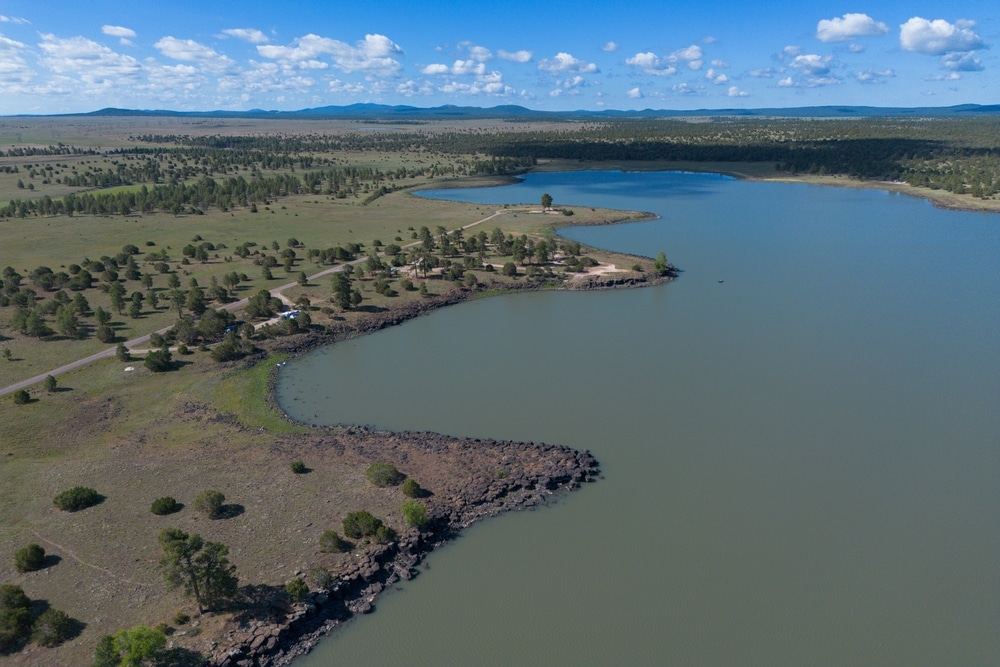
Unlike many of Arizona’s larger reservoirs, Ashurst Lake is a natural lake that has been modified with a small earthen dam to increase its capacity. The lake was named after William H. Ashurst, an early settler in the region who arrived in the 1870s and whose son Henry Fountain Ashurst later became one of Arizona’s first U.S. Senators upon statehood in 1912. The lake has been an important water source for local wildlife and ranching operations throughout its history, and today serves primarily as a recreational destination managed by the U.S. Forest Service as part of the Coconino National Forest.
This modest lake plays a valuable role in Arizona’s water system by supporting local groundwater recharge and providing crucial wildlife habitat in an otherwise arid region. What Ashurst Lake lacks in size, it more than makes up for in natural beauty and the diversity of experiences it offers visitors throughout the year.







Ashurst Lake has established itself as one of northern Arizona’s premier fishing destinations, particularly for rainbow trout. The Arizona Game and Fish Department regularly stocks the lake with rainbow trout during spring and summer months, maintaining a healthy population that draws anglers from across the state. Northern pike and green sunfish were illegally introduced to the lake and are not managed; anglers are asked to keep any they catch.
The eastern shoreline, with its numerous submerged logs and vegetation, provides excellent habitat for pike, especially during spring spawning season. The northern coves offer good shallow-water fishing for trout during cooler morning and evening hours.
Seasonal patterns significantly impact fishing success at Ashurst. Spring (May-June) typically provides the best overall fishing as water temperatures reach ideal ranges and recently stocked trout are actively feeding. Summer fishing remains productive during early morning and evening hours, while midday success rates decline as fish seek deeper, cooler waters. Fall brings another excellent fishing window as water temperatures cool and fish become more active throughout the day. Winter ice fishing is popular when conditions permit safe ice formation, typically from January through February.
Anglers age 10 and older must possess a valid Arizona fishing license. The daily bag limit is four trout, while northern pike and green sunfish have no limit.
Local fishing guides can be arranged through outfitters in Flagstaff, though no permanent guide services operate at the lake itself.
Ashurst Lake accommodates various watercraft but with important limitations. Boats are limited to a single electric motor or a single gasoline engine of 10 horsepower or less, making the lake ideal for fishing boats but unsuitable for high-speed water activities. Electric motors, canoes, kayaks, and stand-up paddleboards are particularly well-suited to the lake’s size and restrictions.
The main boat launch is on the west side of the lake and is open as weather permits.
Navigational hazards include submerged rocks and logs, particularly along the eastern shoreline and in the northern coves. During low water levels, typically late summer through fall, additional hazards emerge throughout the lake.
No boat rentals are available directly at Ashurst Lake, though several outfitters in Flagstaff offer kayak, canoe, and SUP rentals. Ashurst Lake does not feature a marina or fueling station, so boaters must come prepared with all necessary supplies and equipment.
Ashurst Lake offers swimming opportunities, though no officially designated beaches or lifeguards are present. The most popular swimming area is located along the southern shore, where a gradually sloping bottom and clearer water create favorable conditions. This informal beach area includes several picnic tables and a vault toilet but lacks shower facilities or changing rooms.
Water quality is generally suitable for swimming, particularly in early summer. By late July and August, algae blooms can occasionally reduce water clarity and quality. The Arizona Department of Environmental Quality monitors the lake, and visitors should check for any posted advisories, especially following heavy rain events when runoff can temporarily affect water quality.
Beyond swimming, the lake supports numerous water activities with certain limitations. The 10-horsepower motor limit makes Ashurst unsuitable for water skiing or wakeboarding but perfect for paddleboarding, kayaking, and canoeing. The lake’s relatively small size allows paddlers to explore the entire shoreline in a single day, with the northern coves offering particularly scenic routes sheltered from prevailing winds.
Windsurfing and sailing with small craft can be excellent during the reliable afternoon breezes that typically develop, especially in spring and early summer. The open central portion of the lake provides unobstructed runs, while more protected areas around the shoreline offer options when winds intensify.
No specific zones are designated for different water activities, but paddlers typically prefer the sheltered coves along the northern and eastern shores, while swimmers gravitate toward the southern beach area. All water sport enthusiasts should be aware that afternoon thunderstorms can develop quickly during summer monsoon season (July-September), creating dangerous conditions with little warning.

| Category | Details |
|---|---|
| Location | Northern Arizona, ~20-25 miles southeast of Flagstaff |
| Type | Small reservoir/lake |
| Management | Coconino National Forest, U.S. Forest Service |
| Elevation | Approximately 7,000 feet |
| Access | Via Forest Road 82E |
| Surrounding Terrain | Ponderosa pine forest |
| Primary Activities | Fishing, camping, boating, wildlife viewing |
| Fish Species | Rainbow trout (stocked); illegally introduced northern pike and green sunfish |
| Camping | Ashurst Lake and Forked Pine campgrounds on the shore |
| Best Fishing Season | Typically spring through fall |
| Water Source | Snowmelt and rainfall |
| Water Level | Variable depending on seasonal precipitation |
Ashurst Lake encompasses approximately 229 surface acres when at full capacity, though its size fluctuates significantly with seasonal changes and precipitation patterns. The lake is shallow, with an average depth of about 12 feet, and its coves and inlets create habitat for fish and provide secluded spots for anglers and paddlers to explore.
Situated at an elevation of about 7,100 feet, Ashurst Lake’s high-altitude position contributes to its characteristic clear, cool waters even during summer months. The lake’s primary water source is seasonal snowmelt and rainfall, supplemented by small springs in the area. Anderson Mesa, on which the lake sits, is characterized by volcanic geology, with basalt formations and cinder cones visible throughout the surrounding landscape.
Water quality at Ashurst Lake is generally good, with visibility often extending 10-15 feet below the surface in spring months, though summer algae blooms can temporarily reduce clarity. Water temperatures range from near-freezing in winter (the lake often freezes over completely from December through February) to around 70°F (21°C) in the warmest summer months.
The surrounding terrain consists primarily of ponderosa pine forest interspersed with grassy meadows, juniper, and pinyon pine at slightly lower elevations. Anderson Mesa itself is a long, flat volcanic formation that rises dramatically above the surrounding landscape, creating breathtaking viewpoints overlooking the painted desert to the east and the San Francisco Peaks to the north.
Ashurst Lake sits within the larger Little Colorado River basin. The volcanic soil of the region creates interesting geological features, including the permeable basalt that allows water to move between surface and underground systems. This volcanic history is evident in the black basalt rocks that line portions of the shoreline and the cinder cones visible on the horizon. During periods of low water, curious visitors can observe the columnar basalt formations that speak to the fiery origins of this now tranquil landscape.
Ashurst Lake features a modest earthen dam that was completed in 1954. Owned by the Arizona Game and Fish Department, it maintains the lake primarily as a fish and wildlife pond, with recreation as a secondary purpose, rather than for flood control or hydroelectric power.
The dam measures about 12 feet in height and roughly 700 feet in length, with an uncontrolled spillway. Unlike the massive concrete dams that tame larger Arizona rivers, Ashurst Lake’s dam is a simpler structure that works with the natural topography of the land.
Responsibility for the dam rests with its owner, the Arizona Game and Fish Department, with dam-safety oversight from the Arizona Department of Water Resources. Regular inspections and maintenance ensure the continued integrity of this structure, which has withstood decades of seasonal freeze-thaw cycles and occasional monsoon flooding events.
The dam does not generate hydroelectric power, as its primary purpose is simply to increase the lake’s storage capacity and maintain a more consistent water level than the natural basin would otherwise provide. This stability benefits both recreational users and the established ecosystem.
Public access to the dam structure itself is limited for safety reasons, though visitors can easily view it from several vantage points around the lake. During periods of high water, the spillway becomes active.
Ashurst Lake has two developed U.S. Forest Service campgrounds: Ashurst Lake Campground on the west shore and Forked Pine Campground on the east shore. Ashurst Lake Campground offers 25 campsites suitable for both tent and RV camping, though no hookups are available. Each site includes a fire ring and picnic table. The campgrounds provide vault toilets and potable water during the camping season, but no showers.
Some sites can be reserved through Recreation.gov, while others are first-come, first-served. Maximum occupancy is eight people per site, and the camping season typically runs from early May through mid-October, weather permitting, with a 14-day stay limit.
Pets are permitted but must remain leashed at all times, and owners are required to clean up after them. Quiet hours are enforced from 10 PM to 6 AM. Generators may be operated between 8 AM and 8 PM only.
For those seeking a more primitive experience, dispersed camping is permitted in designated areas along Forest Road 82E at least 200 feet from the shoreline. These areas offer no facilities whatsoever, and campers must practice Leave No Trace principles, including proper waste disposal and fire management.
Visitors preferring more comfortable accommodations can find several options within a 30-minute drive:
For visitors seeking RV facilities with full hookups, the closest options are J & H RV Park and Black Bart’s RV Park, both located in Flagstaff approximately 20 miles away. These facilities offer water, electric, and sewer connections, along with amenities like shower facilities, laundry, and WiFi that are unavailable at the lake itself.
Ashurst Lake and the surrounding Anderson Mesa ecosystem support a rich diversity of wildlife that varies with seasonal changes. The lake itself serves as a critical water source in an otherwise relatively dry landscape, attracting numerous species throughout the year.
The riparian and forest areas surrounding the lake feature ponderosa pine as the dominant tree species, interspersed with Gambel oak, juniper, and pinyon pine at slightly lower elevations. Wildflowers abound during the spring and summer months, including vibrant displays of lupine, Indian paintbrush, columbine, and Arizona sunflowers. The shoreline supports cattails, sedges, and various aquatic plants that provide crucial habitat for wildlife.
Birdwatchers will find Ashurst Lake particularly rewarding, with over 200 species documented in the area. Year-round residents include bald eagles, ospreys, great blue herons, and numerous waterfowl species. The lake serves as an important stopover for migratory birds, with spring (April-May) and fall (September-October) bringing dramatic increases in diversity. The western shore near the dam and the northeastern coves offer the best birdwatching opportunities, particularly during early morning hours.
Mammals commonly observed around Ashurst Lake include mule deer, elk, coyotes, gray foxes, and occasional black bears. Smaller mammals such as Abert’s squirrels, ground squirrels, raccoons, and various bat species are abundant. Dawn and dusk provide the best wildlife viewing opportunities for larger mammals, particularly along the eastern shore where forest meets meadow areas.
The lake’s waters and shorelines support diverse reptile and amphibian species, including western terrestrial garter snakes, short-horned lizards, and tiger salamanders. During spring evenings, the chorus of frogs and toads creates a remarkable natural symphony around the shallow coves.
Several sensitive species rely on the Ashurst Lake ecosystem, including northern leopard frogs, northern goshawks, and Mexican spotted owls in the surrounding forest. The Arizona Game and Fish Department and U.S. Forest Service maintain ongoing monitoring programs for these and other species of concern.
Conservation efforts focus on maintaining water quality, preventing the introduction of invasive species, and preserving the integrity of the surrounding forest ecosystem. Visitors will notice boat inspection requirements, periodic controlled burns in the surrounding forest, and restoration projects aimed at enhancing riparian habitat.
Nature enthusiasts can explore the lakeshore and the surrounding mesa, where Passage 30 (Anderson Mesa) of the Arizona Trail offers long views of the surrounding landscape.
Ashurst Lake experiences distinct seasonal changes that significantly impact visitor experiences and available activities. Understanding these patterns is essential for planning an enjoyable visit.
As snow melts and temperatures warm, Ashurst Lake comes alive. Water levels typically reach their annual peak in late May or early June. Daytime temperatures range from 50-75°F (10-24°C), with nighttime temperatures often falling below freezing in April but moderating by June. Spring brings occasional wind events but also spectacular wildflower displays and the year’s best fishing opportunities. Bird migration peaks in May, making this an excellent time for wildlife enthusiasts.
Summer brings the most reliable weather and warmest water temperatures, typically hovering between 65-70°F (18-21°C). Daytime air temperatures average 75-85°F (24-29°C), with cool evenings around 50°F (10°C). The summer monsoon season brings afternoon thunderstorms, particularly from mid-July through August, creating spectacular cloud formations but also dangerous lightning conditions that sometimes force temporary lake closures. Water levels gradually decline throughout summer, and by September, the receding shoreline may impact boat launches.
Fall offers spectacular aspen colors in the surrounding forest, particularly in early October. Temperatures become highly variable, with pleasant days averaging 55-65°F (13-18°C) but increasingly cold nights that can drop well below freezing. Water levels reach their annual low point, exposing more shoreline and occasionally limiting boating access. Fishing improves again as water temperatures cool, and wildlife becomes more active during daylight hours as they prepare for winter.
Winter transforms Ashurst Lake into a frozen landscape. The lake typically freezes completely by late December, remaining ice-covered until March. Daytime temperatures average 30-45°F (-1-7°C), with nights often dropping into single digits or below zero. Snow accumulation varies greatly by year but can reach several feet during heavy winters. Winter activities shift to ice fishing (when ice thickness permits), cross-country skiing, and snowshoeing on surrounding trails. Road access becomes challenging and sometimes impossible without four-wheel drive and high clearance vehicles.
Water levels follow a predictable annual cycle, peaking after spring snowmelt and gradually declining through summer and fall before winter precipitation begins the cycle anew.
Check current day-use and camping requirements with the Coconino National Forest before you visit. Arizona fishing licenses are required for anglers age 10 and older, available online through the Arizona Game and Fish Department or at sporting goods stores in Flagstaff.
The lake is open year-round, 24 hours a day, though winter access is often limited by snow conditions. The main access road (FR 82E) is not plowed during winter months. Seasonal closures may be implemented during extreme fire danger or for resource protection.
No permanent ranger station exists at Ashurst Lake, though Forest Service rangers regularly patrol the area during summer months. The nearest ranger station is the Flagstaff Ranger District Office, located at 5075 N. Highway 89 in Flagstaff, approximately 25 miles from the lake. This office is open Monday through Friday, 8 AM to 4:30 PM, and provides detailed maps, permits, and current conditions information.
No emergency services are stationed at the lake. Cell phone reception is spotty but generally available on the western shore and higher points around the lake (Verizon provides the most reliable coverage). Emergency response comes from Flagstaff with typical response times of 30+ minutes. For emergencies, call 911, but be prepared to move to higher ground for better reception. The nearest medical facilities are in Flagstaff, including Flagstaff Medical Center for emergency care.
Limited accessibility accommodations include one ADA-compliant campsite in the main campground and an accessible vault toilet near the main boat launch. The terrain around much of the lake is rocky and uneven, presenting challenges for visitors with mobility limitations. The main boat launch area offers the most accessible shoreline access.
Potable water is available at the campgrounds during the camping season, but visitors should bring drinking water when the campgrounds are closed. The nearest supplies are available in Flagstaff, with Mountainaire offering a small general store approximately 15 miles west of the lake. No food concessions operate at the lake.
Pack-in, pack-out principles apply throughout the area. Dumpsters are provided at the campground entrance and main boat launch. These are typically serviced weekly during summer months. No recycling facilities exist on-site.
Fire restrictions vary seasonally and can range from Stage 1 (fires permitted only in designated fire rings) to Stage 3 (complete fire bans including charcoal grills). Current fire restriction information is posted at entrance points and available through the Coconino National Forest website or by calling the Flagstaff Ranger District. During unrestricted periods, fires are permitted only in designated fire rings or metal fire pans that prevent ground scarring.
Pets are welcome throughout the Ashurst Lake area but must remain on leashes no longer than 6 feet at all times. Pet waste must be properly disposed of in trash receptacles. Pets are not permitted to disturb wildlife or other visitors.
Ashurst Lake’s central location in northern Arizona makes it an excellent base for exploring numerous nearby attractions:
The vibrant city of Flagstaff lies just 20 miles northwest of Ashurst Lake, offering a charming historic downtown with numerous restaurants, breweries, and shops. Visitors will find all necessary supplies in Flagstaff, including several supermarkets (Safeway, Bashas’, Whole Foods), outdoor retailers (REI, Peace Surplus), and numerous gas stations. Local favorites for dining include Diablo Burger for gourmet burgers using local beef, MartAnne’s for authentic Mexican fare, and Pizzicletta for wood-fired pizzas. The Museum of Northern Arizona provides excellent exhibits on the natural and cultural history of the Colorado Plateau.
The small communities of Mountainaire (15 miles west) and Mormon Lake (15 miles south) offer closer options for basic supplies and casual dining. The Mormon Lake Lodge restaurant serves hearty steakhouse fare in a rustic atmosphere.
Within an hour’s drive of Ashurst Lake, visitors can explore:
The area surrounding Ashurst Lake holds significant cultural importance to several indigenous nations, particularly the Navajo, Hopi, and Western Apache. While no major archaeological sites are open to the public immediately adjacent to the lake, the entire Anderson Mesa contains evidence of ancient habitation dating back thousands of years. Visitors should respect any archaeological remains they encounter and leave artifacts undisturbed, as they are protected by federal law.
Outdoor enthusiasts will appreciate the extensive trail networks accessible from nearby forest roads, including segments of the 800-mile Arizona Trail. The Mogollon Rim, a dramatic 2,000-foot escarpment marking the southern edge of the Colorado Plateau, lies approximately 30 miles south and offers spectacular views and hiking opportunities.
Ashurst Lake offers a perfect microcosm of northern Arizona’s diverse natural beauty—a place where ponderosa forests meet expansive skies, where wildlife thrives, and where visitors can experience the restorative power of nature just a short drive from urban amenities. What sets Ashurst apart from Arizona’s larger, more developed lakes is precisely its modest scale and relative simplicity, providing an intimate connection with the landscape that larger reservoirs often cannot match.
The future of this special place depends on the collective stewardship of all who visit. As climate change brings increasing pressure on water resources throughout the Southwest, preserving the ecological integrity of places like Ashurst Lake becomes ever more crucial. By practicing responsible recreation—minimizing impact, respecting wildlife, and following regulations—visitors contribute to ensuring that future generations will enjoy these same experiences.
Whether you come to Ashurst Lake for the flashing silver of a rainbow trout breaking the surface, the bugling of elk at dawn, or simply the peaceful reflection of ponderosa pines on still waters, you’ll discover a landscape that captures the essence of Arizona’s high country. In a state often defined by its desert imagery, Ashurst Lake reminds us of Arizona’s remarkable ecological diversity and the precious value of its water resources—a blue jewel set within the emerald forest of the Coconino.
We use cookies to improve your experience on our site. By using our site, you consent to cookies.
Manage your cookie preferences below:
Essential cookies enable basic functions and are necessary for the proper function of the website.
Statistics cookies collect information anonymously. This information helps us understand how visitors use our website.
Monetize your website by displaying targeted ads and earning revenue from clicks and impressions.
Google Analytics is a powerful tool that tracks and analyzes website traffic for informed marketing decisions.
Service URL: policies.google.com (opens in a new window)
You can find more information about our Cookie Policy and Privacy Policy.