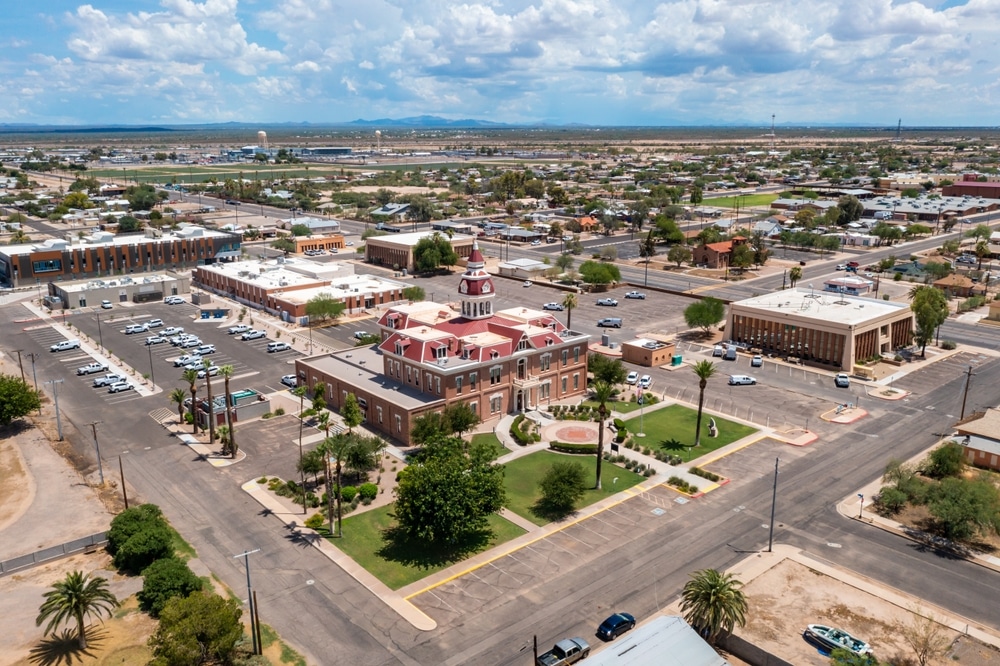
The morning light in Florence carries weight—not the harsh glare of noon, but that particular golden quality that transforms adobe walls and historic facades into something timeless. This is Arizona’s fifth oldest town, where the courthouse square still anchors community life and where 27,000 residents have discovered that history and growth need not be mutually exclusive. As county seat of Pinal County since 1875, Florence wears its heritage with quiet dignity, even as new developments stretch toward the surrounding mountains. The juxtaposition is striking: Victorian-era buildings share streets with modern correctional facilities, while master-planned communities rise from lands where Hohokam Indians once carved elaborate canal systems.
Florence occupies a strategic position 52 miles southeast of Phoenix and 65 miles north of Tucson, making it equidistant from Arizona’s two largest metropolitan areas. This placement along the Highway 60 corridor has shaped its evolution from territorial prison town to modern community, attracting those who appreciate both its accessibility and its independence. The Gila River runs through the northern reaches, though its waters now feed agriculture rather than defining town boundaries. To the east, the Superstition Mountains create a dramatic backdrop, while the Picacho Peak punctuates the southern horizon.

The median home value in Florence has reached $383,068, reflecting both the town’s desirability and its relative affordability compared to metropolitan Phoenix. This price point delivers substantial value: detached houses averaging $446,699 offer space and amenities that would command double in Scottsdale or Chandler. The housing stock tells Florence’s story in architectural chapters—from territorial-era adobes near downtown to contemporary energy-efficient homes in developments like Anthem at Merrill Ranch.
With 86.03% of residents owning their homes—significantly above state averages—Florence neighborhoods radiate stability and pride of ownership. The median construction year of 2004 indicates a community transformed by 21st-century growth while maintaining its historic core. New construction continues at measured pace, with builders offering modern floor plans that respect the desert environment through thoughtful orientation and xeriscaped yards that celebrate rather than fight the landscape.
Rental options, though limited at 13.97% of occupied units, provide alternatives for those testing Florence’s waters before committing. The median rent of $1,247 remains manageable, particularly given the quality of life and space available. With properties spending an average of 70-90 days on market, buyers have time for deliberate decisions rather than the frenzied bidding wars plaguing hotter markets.

Florence’s economy reflects its unique position as both county seat and home to significant state and federal correctional facilities. Public Administration employs 1,155 people, providing stable government positions with comprehensive benefits. The Arizona State Prison Complex-Florence and Eyman, along with federal and private facilities, create an employment ecosystem extending beyond guards to administration, healthcare, medical services, and support staff.
Beyond corrections, Educational Services employ 559 residents, while Professional, Scientific, & Technical Services account for 466 positions. The economy of 5,100 employed residents demonstrates diversification beyond government institutions. The median household income of $76,259 substantially exceeds many rural Arizona communities, reflecting the prevalence of stable, well-compensated positions.
The daytime population swells by over 4,000 due to commuting patterns, as workers travel from surrounding communities for employment in Florence’s institutions. Conversely, many residents commute to Chandler, Mesa, or Phoenix, finding Florence’s quality of life worth the morning drive. With 56.6% of workers both living and working in town, the community maintains an economic self-sufficiency increasingly rare in bedroom communities.

Educational opportunities in Florence blend traditional public schools with modern alternatives. The Florence Unified School District serves the community with a comprehensive K-12 system focused on preparing students for both college and career pathways. The district’s commitment to excellence shows in its investment in technology and programs that rival larger urban districts.
Adult educational attainment reveals interesting patterns: 45.56% hold high school diplomas, while 25.05% have pursued some college. The 11.49% with bachelor’s degrees might seem low compared to metropolitan areas, but this creates opportunity for educated professionals who bring skills the community values. The presence of Central Arizona College’s satellite programs provides accessible higher education without requiring lengthy commutes.
For families with school-age children, the relatively small district size means more personalized attention and community involvement in education. Parents know teachers, administrators know students, and the Friday night football games draw crowds that represent genuine community gatherings rather than mere sporting events. This intimate educational environment appeals to families seeking alternatives to massive urban schools where students become numbers.

Healthcare infrastructure in Florence has evolved to meet growing demand while maintaining small-town accessibility. Local clinics and medical practices handle routine care, with several family physicians and specialists maintaining offices downtown and in newer medical complexes. The proximity to major medical facilities in both Phoenix and Tucson—each roughly an hour away—ensures access to specialized care when needed.
Banner Health and Dignity Health operate facilities within reasonable driving distance, while the correctional facilities maintain medical units that occasionally provide overflow emergency capacity. The town has attracted healthcare providers drawn by the growing population and the opportunity to establish practices without the saturation found in metropolitan areas.
For seniors—a growing demographic given Florence’s appeal to retirees—home health services and assisted living facilities have expanded. The combination of affordable housing, dry climate beneficial for certain health conditions, and proximity to comprehensive medical care makes Florence increasingly attractive for active retirement. Medical transport services connect residents to appointments in larger cities, addressing the transportation challenges that can affect healthcare access.

Florence’s cost of living index at 98.9 sits just below the national average, delivering genuine value in a state where many communities have priced out middle-income families. This near-average index masks significant savings in specific categories: housing costs less than comparable communities closer to Phoenix, while the absence of big-city premiums on services and entertainment stretches budgets further.
Utilities follow Arizona’s seasonal patterns, with summer electricity bills climbing to $200-300 when air conditioning runs continuously, then dropping to $50-100 during the mild winters. Water costs remain reasonable thanks to agricultural water rights and established infrastructure, though conservation remains important in this desert environment. Most residents budget $150-250 monthly for combined utilities outside peak summer months.
Internet service has improved dramatically with population growth, supporting the increasing number of remote workers who’ve discovered Florence. Multiple providers offer speeds suitable for video conferencing and streaming, eliminating the connectivity concerns that once limited rural communities. The median household income of $76,259 goes considerably further here than in metropolitan areas, enabling lifestyles that might be unattainable elsewhere.

Transportation in Florence centers on personal vehicles, with the street grid making navigation intuitive even for newcomers. Highway 79 serves as the main arterial, connecting to US 60 and eventually Interstate 10. These routes provide access to Phoenix Sky Harbor International Airport (52 miles) and Tucson International Airport (65 miles), keeping air travel accessible without airport noise and congestion.
Within Florence, traffic remains minimal even during peak hours. The wide streets, originally designed for horse-drawn carriages, now easily accommodate modern vehicles with ample parking throughout downtown and commercial areas. This ease of movement—where errands can be completed quickly without fighting traffic—represents a quality of life factor that daily shapes residents’ experience.
For those requiring public transportation, options remain limited but functional. Regional shuttles connect to Phoenix and Tucson for medical appointments and airport runs, while local services primarily serve seniors and those with disabilities. The walkable downtown district allows car-free living for those choosing residences near services, though most find personal vehicles essential for full community participation.

Florence’s climate embodies the Sonoran Desert’s extremes and beauty. Summer arrives early and stays late, with temperatures exceeding 100°F from May through September. July and August bring the most intense heat, when afternoon temperatures might reach 115°F, sending residents indoors or to community pools until evening brings relief. Yet the low humidity makes this heat different from Eastern summers—dry, penetrating, but somehow cleaner.
Winter transforms Florence into paradise, with December through February bringing daytime temperatures in the 60s and 70s. These months attract winter visitors and showcase why people endure summer’s intensity. Clear skies dominate—over 300 days of sunshine annually—creating reliable conditions for outdoor activities and solar energy generation. Freezing temperatures occur occasionally but rarely last long enough to damage desert-adapted landscaping.
Monsoon season, roughly July through September, brings drama to Florence skies. Afternoon thunderstorms build over mountains, delivering spectacular lightning shows and brief but intense rainfall. These storms cool evening temperatures and provide most of Florence’s annual 10 inches of precipitation. The desert’s response—sudden wildflower blooms and the perfume of wet creosote—rewards those who’ve learned to appreciate this landscape’s subtle beauty.

Arizona’s tax structure in Florence favors retirees and families alike. The state income tax, ranging from 2.59% to 4.5%, remains competitive, while the absence of tax on Social Security benefits particularly benefits seniors. Property taxes stay remarkably low, with median taxes on mortgaged homes at $2,356 annually—modest considering property values and services provided.
Sales tax in Florence combines state, county, and local rates for approximately 9.5% on most purchases, though groceries remain exempt. Vehicle registration through ADOT requires attention within 30 days of establishing residency, with fees based on vehicle value that decrease annually. The absence of emissions testing in Pinal County simplifies vehicle ownership compared to Maricopa County’s more stringent requirements.
Business-friendly policies attract entrepreneurs, with relatively simple incorporation procedures and reasonable regulatory requirements. The transaction privilege tax system offers certain advantages over traditional sales tax structures, particularly for service businesses. These factors, combined with lower commercial real estate costs, create opportunities for small business establishment and growth.

Life in Florence revolves around authentic community connections and accessible recreation. The historic downtown, with its territorial-era buildings and courthouse square, hosts farmers markets, festivals, and gatherings that draw residents together. The Pinal County Historical Museum chronicles the region’s evolution, while art galleries and antique shops occupy restored storefronts where authentic history trumps tourist kitsch.
Outdoor recreation abounds, with the Picacho Peak State Park nearby offering hiking trails and hosting Arizona’s only Civil War battle reenactment. The Tom Mix monument, marking where the silent film star died in 1940, has become an unlikely pilgrimage site for classic film enthusiasts. Golf courses provide manicured contrast to wild desert, while shooting ranges and off-road vehicle areas cater to those preferring more active pursuits.
The presence of multiple correctional facilities has created an unexpected cultural dimension, with employees from across the country bringing diverse perspectives to this historic town. This mixing of longtime residents, correctional staff, and newcomers seeking affordable Arizona living creates a community more cosmopolitan than its size might suggest.

Starting your Florence journey requires understanding both its historic character and modern evolution. West USA Realty’s local agents know individual neighborhoods and can match properties to specific needs, from historic downtown homes to new construction in master-planned communities. The Town of Florence website provides comprehensive information about utilities, services, and community programs essential for newcomers.
Arizonan.com offers broader context about regional living, helping potential residents understand how Florence fits within Arizona’s diverse community tapestry. The Florence Chamber of Commerce connects newcomers with business and social networks, facilitating integration into community life. Given Florence’s unique character—neither purely rural nor suburban—extended visits during different seasons prove invaluable for confirming fit.
Consider joining community groups or attending town events before committing to relocation. The Saturday farmers market, First Friday art walks, and seasonal festivals provide glimpses into community character that statistics cannot capture. Many successful relocations begin with vacation rentals that allow exploration of neighborhoods and establishment of routines before making permanent moves.

We use cookies to improve your experience on our site. By using our site, you consent to cookies.
Manage your cookie preferences below:
Essential cookies enable basic functions and are necessary for the proper function of the website.
Statistics cookies collect information anonymously. This information helps us understand how visitors use our website.
Monetize your website by displaying targeted ads and earning revenue from clicks and impressions.
Google Analytics is a powerful tool that tracks and analyzes website traffic for informed marketing decisions.
Service URL: policies.google.com (opens in a new window)
You can find more information about our Cookie Policy and Privacy Policy.