The morning sun catches on rusted rails that stretch across the desert floor, their parallel lines cutting through mesquite and prickly pear before disappearing into the shadow of the Superstition Mountains. Here, in the heart of Arizona’s mining country, the Magma Arizona Railroad once connected the isolated copper boomtown of Superior to the outside world. Unlike many of Arizona’s ghost railways that vanished without a trace, the Magma line remains largely in place—steel rails still anchored to wooden ties, a silent sentinel to a transportation era that shaped central Arizona’s development. While the trains no longer run regular service, this remarkable preservation offers a tangible connection to the crucial role railroads played in transforming isolated mineral strikes into viable communities.
Beyond tonnage figures and equipment rosters, the Magma Arizona Railroad represents the stories of the people who built, operated, and depended upon this vital transportation link. From construction workers to locomotive engineers to the passengers who rode the daily trains, thousands of individuals connected their lives and livelihoods to these tracks over its 82-year history.
The workforce of the Magma Arizona Railroad reflected the diverse population of central Arizona. The initial construction crews included significant numbers of Mexican and Mexican-American laborers, many of whom had previously worked on Southern Pacific construction or in nearby mines. These skilled workers, often overlooked in traditional railroad histories, brought crucial expertise in building rail lines through challenging desert environments. Many settled permanently in Superior, establishing families whose descendants remain in the community today.
Once operational, the railroad employed a relatively small workforce compared to major railroads, but one that was significant for the isolated mining community. These employees included engineers, conductors, brakemen, section gangs for track maintenance, and depot staff. Many were multi-generational railroad families, with sons following fathers into railroad service and developing specialized knowledge of the line’s unique characteristics and challenges.
The human element of the Magma Arizona Railroad extended beyond employees to the entire community that depended on this transportation lifeline. For much of Superior’s history, the railroad’s ability to move copper efficiently determined whether mines remained profitable and whether miners remained employed. This created an acute awareness of the railroad’s importance that transcended company boundaries and helped forge a distinctive community identity that continues to honor this transportation heritage decades after the last train ran.
| Aspect | Details |
|---|---|
| Name | Magma Arizona Railroad |
| Established | 1914 |
| Purpose | Built to transport copper ore from the Magma Copper Mine in Superior, Arizona, to a connection with the Southern Pacific Railroad near Magma Junction, Arizona. |
| Length | Approximately 30 miles |
| Terminals | – Superior, Arizona (eastern terminus) |
| – Magma Junction near Apache Junction, Arizona (western terminus, connecting to the Southern Pacific Railroad). | |
| Primary Cargo | Copper ore, concentrates, and smelted copper from the mining operations. |
| Significance | – Played a crucial role in the transportation of copper during the early 20th century, connecting the isolated Magma Mine to nationwide markets. |
| – Supported the growth of Arizona’s copper mining industry, a key driver of the state’s economy. | |
| Route Features | – Traversed rugged terrain, including mountainous regions and desert landscapes. |
| – Known for scenic views and sharp curves along its short route. | |
| Equipment | – Operated with steam locomotives in its early years, later transitioning to diesel-electric locomotives in the 1950s. |
| – Notable for its use of narrow-gauge and standard-gauge locomotives. | |
| Ownership | Originally owned by the Magma Copper Company, which operated the Magma Mine in Superior. |
| Decline | – The closure of the Magma Copper Mine in the 1980s led to a significant decline in traffic. |
| – Operations ceased in 1997 after 82 years of service. | |
| Legacy | – Portions of the line are preserved for historical and tourist purposes. |
| – Some of the former equipment and infrastructure are displayed in museums. | |
| Modern Status | – The dormant line is now owned by Resolution Copper. |
| – Currently inactive, but the route remains historically significant. | |
| Cultural Impact | – Celebrated as a part of Arizona’s mining and railroad heritage. |
| – Locomotives and rolling stock from the Magma Arizona Railroad are preserved at locations like the Arizona Railway Museum. |
The story of the Magma Arizona Railroad begins with copper—the mineral that shaped so much of Arizona’s economic development. In 1914, the newly formed Magma Copper Company faced a critical logistical challenge: how to transport enormous quantities of copper ore from its rich deposits near Superior to processing facilities and markets beyond. The nearest railhead was about 30 miles away at Webster (later renamed Magma), where the Southern Pacific main line provided connections to the national rail network. Between these points lay rugged desert terrain, steep grades, and winding canyons that made conventional wagon transportation prohibitively expensive.
William Boyce Thompson, the visionary mining executive behind Magma Copper, recognized that a dedicated railroad was the only economically viable solution. On October 10, 1914, the Magma Arizona Railroad Company was organized as a wholly-owned subsidiary of the copper operation, with construction beginning almost immediately. The railroad’s sole purpose was utilitarian—to serve the copper industry by connecting the mines to the Southern Pacific interchange—but its impact would extend far beyond ore transportation.
This narrow-gauge line (built to a 36-inch gauge rather than the standard 56.5 inches) came late in Arizona’s railroad-building era. While earlier railroads had been built during the initial mining boom of the 1880s and 1890s, the Magma line demonstrated how specialized transportation remained essential even as automobile transport began changing the American landscape. Its development coincided with Arizona’s early statehood period (having achieved statehood in 1912), when the copper industry emerged as the dominant economic force in the state.
The railroad’s construction reflected several key historical factors that shaped Arizona’s development:
By the time track reached the concentrator near Superior on April 29, 1915, the Magma Arizona Railroad had already become an essential lifeline for what would become one of Arizona’s most productive copper districts.
Unlike many abandoned rail lines that have been scrapped or completely reclaimed by the desert, the Magma Arizona Railroad exists in a remarkable state of preservation. The line ceased regular operations in 1997 after 82 years of nearly continuous service, making it one of Arizona’s longest-operating mining railroads. Since then, various segments of the route have been preserved to different degrees, offering visitors a range of experiences with this historic transportation corridor.
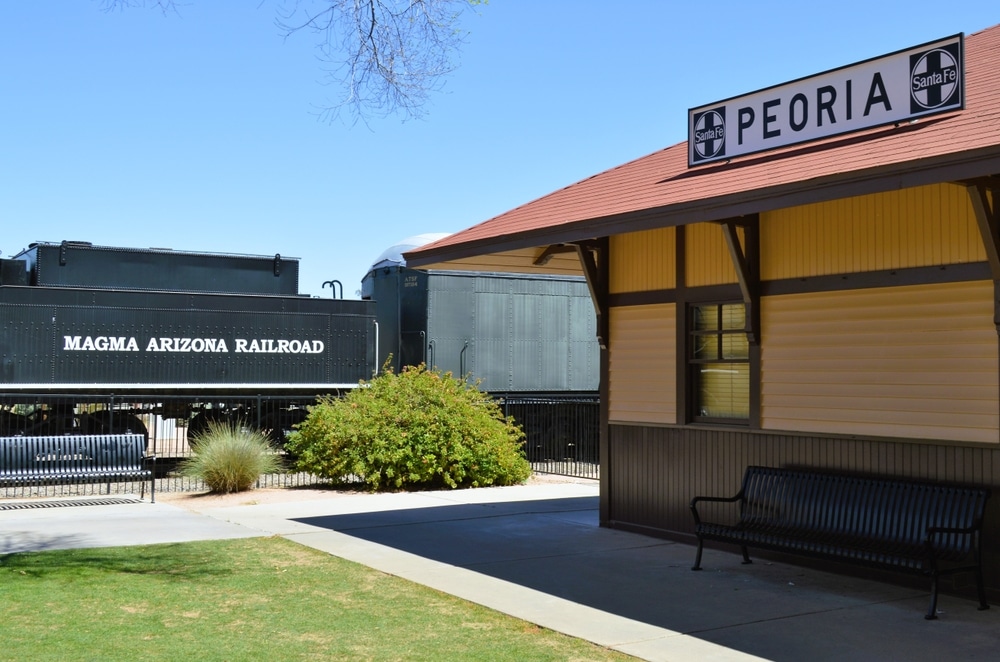
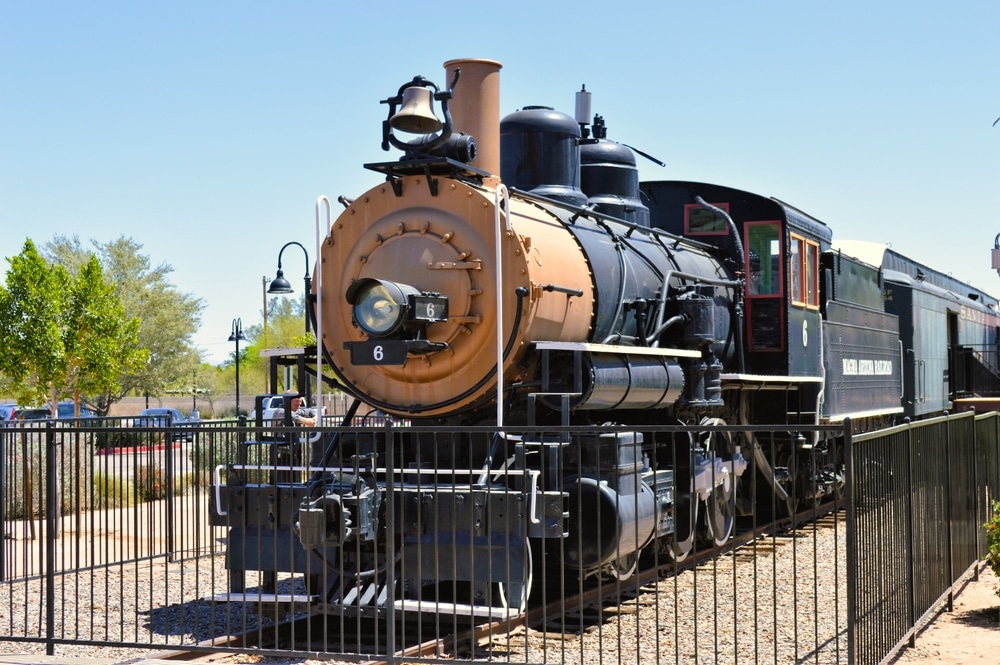
Several of the railroad’s locomotives survive elsewhere. Steam locomotive No. 5, a 1922 2-8-0 and the only new steam engine the railroad ever bought, is displayed at the Galveston Railroad Museum in Texas; Mogul No. 6 is at McCormick-Stillman Railroad Park in Scottsdale; and diesel No. 10 went to the Arizona Railway Museum in Chandler.
Beyond Superior, the tracks of the dormant line remain largely in place, running west from town toward the old Southern Pacific connection at Magma.
Further west, near the community of Queen Valley, evidence of the railroad becomes more fragmented. Portions of the original grade remain visible as linear features cutting across the desert landscape, while occasional rail segments protrude from the sandy soil. At the western terminus near Magma Junction, the interchange yard where narrow-gauge cars transferred their copper cargo to standard-gauge Southern Pacific trains is still discernible.
The line’s remarkable preservation can be attributed to several factors: the relatively recent cessation of operations, the remote desert environment that limits development pressure, community efforts to maintain the railroad’s heritage, and Magma Copper’s (later BHP’s) recognition of the historical value of this transportation asset. This combination of circumstances has created one of Arizona’s most intact ghost railways—a linear historic resource that allows visitors to experience multiple eras of transportation technology within a relatively compact corridor.
Before steel rails connected Superior to the outside world, the region relied on stagecoach and freight wagon service along primitive desert trails. The area that would eventually become Superior first appeared on transportation maps as a stopping point on the Globe-Florence Stage Road, which connected early mining districts with territorial supply centers beginning in the 1870s.
The most significant stagecoach stop near present-day Superior was Pinal, a now-vanished settlement just west of the modern town. Established in the late 1870s during early silver mining activities in the area, Pinal served as an important way station where passengers could find basic accommodations, fresh horses, and meals while traveling between Globe and Florence.
When William Boyce Thompson and other investors began developing copper resources around Superior in the early 1910s, transportation still depended primarily on these wagon and stagecoach routes. Supplies for the growing mining camp arrived via freight wagons from the Southern Pacific station at Webster, while passenger service relied on stagecoaches making the dusty journey from rail connections. These primitive transportation methods severely limited the scale of mining operations, as ore shipments by wagon were prohibitively expensive for all but the highest-grade material.
The transition from stagecoach to railroad transportation represented more than just technological evolution—it enabled a fundamental transformation in the region’s economic scale. While stagecoaches and freight wagons had maintained tenuous connections to outside markets and supplies, the railroad allowed industrial-scale movement of materials that made large-scale copper mining economically viable.
The Magma Arizona Railroad’s construction began in the fall of 1914; crews reached the Southern Pacific connection at Webster in late November. Starting from the Southern Pacific interchange at Webster (later Magma) and from the mining operations at Superior, workers graded the roadbed, built trestles across washes, and laid the distinctive narrow-gauge tracks that would soon carry tons of copper ore to market.
Unlike the transcontinental railroads built with massive federal land grants and foreign labor, the Magma line was constructed primarily with local workers, many of whom were Mexican and Mexican-American laborers with experience in both mining and railroad construction. These skilled workers faced significant challenges, particularly in the rugged terrain of Queen Creek Canyon where the line had to follow the creek’s twisting course while maintaining grades manageable for steam locomotives.
The decision to build to narrow gauge rather than standard gauge reflected both economic pragmatism and engineering necessity. The narrower track width allowed for tighter curves and reduced construction costs in the difficult terrain, while still providing adequate capacity for the mine’s output. This choice placed the Magma Arizona Railroad among the last narrow-gauge lines built in the American West, as most major railroads had standardized their track gauge decades earlier.
Initial construction was completed in just over five months, with track reaching the concentrator near Superior on April 29, 1915, and copper concentrates moving to Webster from May 1. As a common carrier, the railroad also handled local passengers and mail, and around World War I it ran two coaches, one of them a combination baggage car.
As copper production increased, the narrow gauge became obsolete. In April 1922 the company approved a new standard-gauge line built alongside the old one; the narrow gauge carried its last mail, passengers, and freight on April 1, 1923, and standard-gauge cars were soon running through to the smelter at Hayden.
The Great Depression temporarily slowed both mining operations and railroad improvements, but World War II brought renewed demand for copper and corresponding investment in transportation infrastructure. During this period, the railroad gained improved maintenance facilities in Superior, additional rolling stock, and upgrades to bridges and trestles throughout the system.
The most significant technological transition began on August 22, 1958, when the railroad first began using diesel locomotives. Steam lingered for years afterward: Mogul No. 6 retired in 1961, and the Magma Arizona remained one of the last railroads in the country to use steam in freight service.
Throughout its development, the Magma Arizona Railroad maintained its fundamental character as an industrial carrier primarily focused on moving copper ore and supplies. Passenger and mail service, always secondary to the railroad’s primary mission of supporting mining operations, had ended by 1940. This singular focus resulted in a lean, efficient operation that survived economic fluctuations which doomed many contemporary short lines and branch railroads throughout the American West.
The route of the Magma Arizona Railroad creates a distinctive linear corridor across central Arizona’s landscape, connecting the former Southern Pacific main line near present-day Magma Junction to the mining community of Superior. This 30-mile line can still be traced through a combination of physical remains, historical documentation, and modern mapping technologies that reveal how the railroad’s engineers adapted to the challenging topography of the Arizona desert.
Beginning at the western terminus, the railroad originated at a location initially called Webster Station on the Southern Pacific (later renamed Magma to avoid confusion with other similarly named stations). Here, a substantial interchange yard facilitated the transfer of copper ore from narrow-gauge cars to standard-gauge Southern Pacific trains. While most of this interchange infrastructure has been removed, the site remains visible as a distinctive clearing with scattered railroad-related debris approximately half a mile south of present-day Highway 60 near Florence Junction.
From this starting point, the line proceeded eastward across relatively flat desert terrain, following a route roughly parallel to what is now Highway 60 but generally keeping to the south of the modern roadway. This section featured few significant engineering challenges, with minimal cuts and fills required to maintain the gentle grade preferred for efficient operation. Today, much of this western section has been obliterated by agricultural development, though the railroad’s right-of-way remains visible on historical aerial photographs and appears as a linear feature on USGS topographical maps from the mid-20th century.
Approximately 11 miles east of the interchange, the line entered more challenging terrain as it approached the Queen Creek area. Here, the railroad began following the natural drainage of Queen Creek, entering the increasingly confined canyon that would present the route’s most significant engineering challenges. In this section, substantial physical remains of the railroad persist, including intact track, trestles, and evidence of blasting where the rail bed was carved from canyon walls.
The most dramatic portion of the route lies within Queen Creek Canyon, where the tracks navigated tight curves, steep canyon walls, and the creek itself.
Emerging from Queen Creek Canyon, the line curved northward toward Superior, climbing steadily to reach the elevation of the mining community. This final approach to town required several substantial cuts through rocky terrain, which remain visible as distinctive landscape features. The line terminated at the Superior depot, where a small yard with spurs served various mining facilities and loading operations.
Several methods allow modern exploration of this historic transportation corridor:
The most direct connection comes from walking portions of the intact railroad grade, particularly in the Queen Creek Canyon section where substantial infrastructure remains in place. While these expeditions require appropriate permissions and safety precautions, they provide the most tangible experience of the railroad’s engineering and operational challenges.
The Magma Arizona Railroad appears on USGS topographical maps from various periods, allowing comparison of the railroad’s route with natural features and subsequent development. The most useful maps date from the 1940s through 1970s, when the railroad was still active and accurately surveyed.
Both historical and modern aerial photographs reveal the railroad’s distinctive linear signature across the landscape. Digital archives maintained by the USGS and Arizona State University include aerial surveys from the 1930s onward that clearly show the railroad in operation. Modern satellite imagery in services like Google Earth still reveals portions of the grade as vegetation and soil coloration differences, even where tracks have been removed.
Recent LiDAR (Light Detection and Ranging) surveys of portions of central Arizona have created highly detailed topographical models that can detect subtle elevation differences caused by railroad grades, cuts, and fills. These digital elevation models are particularly valuable for identifying sections of the route that have been obscured by vegetation or partial erosion but still maintain their basic physical form.
Unlike many of Arizona’s ghost railroads that disappeared during the Great Depression or following World War II, the Magma Arizona Railroad demonstrated remarkable longevity, operating continuously from 1915 until 1997—a span of 82 years. This extended operational life created a different pattern of decline than seen in railroads abandoned during earlier periods.
The railroad’s fortunes were inextricably linked to the copper industry it served. After World War II, despite periodic fluctuations in copper prices, the mines at Superior maintained sufficient production to justify continued rail service. Passenger and mail service had ended by 1940, but freight service continued, with diesel locomotives taking over from steam after 1958.
The first significant challenge to the railroad’s viability came in the early 1980s when Magma Copper temporarily suspended operations at the Superior East mine due to declining copper prices and increasing production costs. During this period, the railroad reduced its schedule but maintained essential maintenance to ensure the line remained operational for an eventual resumption of mining activities. This flexibility demonstrated the advantages of company ownership, as a common-carrier railroad facing similar traffic declines might have abandoned service entirely.
When mining operations resumed later in the 1980s, the railroad returned to regular service, though with a reduced schedule compared to its peak operations. The acquisition of Magma Copper by BHP in 1996 brought another reassessment of the transportation infrastructure, and the new owner no longer saw a need for rail service.
The final decision to cease railroad operations came in 1997, a year after the BHP purchase, and the line has been dormant since.
Today, the railroad exists in a state of suspended animation—neither fully abandoned nor actively preserved in its entirety. While formal rail operations have ceased, significant physical infrastructure remains, and community memory keeps the railroad’s legacy alive in Superior and surrounding communities. This condition—between operation and complete abandonment—characterizes many industrial heritage resources throughout the American West, where economic change has outpaced formal preservation efforts.
The Magma Arizona Railroad holds significance that extends far beyond its modest 30-mile length, representing important aspects of Arizona’s industrial, technological, and social development. Its unique features have made it an important case study for understanding how specialized transportation systems shaped the development of mining communities throughout the American West.
From an industrial history perspective, the railroad exemplifies the critical relationship between mining and transportation in Arizona’s economic development. Unlike earlier mining booms driven by high-grade silver and gold deposits that could justify expensive wagon transportation, the copper industry required efficient bulk transport to make low-grade but extensive ore deposits economically viable. The Magma line demonstrates how targeted infrastructure investment could transform marginally profitable mineral resources into sustainable industrial operations that supported communities for generations.
Technologically, the railroad represents an important chapter in transportation evolution. As one of the last narrow-gauge lines constructed in the American West, it demonstrates how this specialized technology remained relevant for specific applications even as standard-gauge railroads dominated the national network. The railroad’s transition from steam to diesel power in 1958, documented through photographs, employee accounts, and preserved equipment, provides insights into how remote industrial operations adopted technological innovations while maintaining compatible infrastructure.
For the community of Superior, the railroad represents a crucial element of local identity and historical consciousness. Unlike many mining towns that experienced complete abandonment when mineral resources were exhausted, Superior has maintained continuity of population and a strong connection to its mining heritage. The railroad features prominently in community historical narratives, with former railroad employees and their descendants contributing to ongoing documentation and commemoration efforts.
The preservation of the Magma Arizona Railroad represents a community-driven effort rather than a formal institutional program, with various stakeholders contributing to maintaining different aspects of this linear historic resource. This grassroots approach has created a patchwork of conservation outcomes, with some elements receiving substantial attention while others gradually return to the desert landscape.
The western sections of the route receive virtually no conservation attention. In these areas, the railroad grade gradually erodes or disappears under agricultural development and natural processes, though its alignment remains documented in maps and aerial photographs that preserve the knowledge of its location if not its physical presence.
Perhaps the most significant ongoing preservation activity occurs through community memory and storytelling. In Superior, connections to the railroad remain strong through family histories, with many residents tracing their heritage to railroad workers or miners whose livelihoods depended on the transportation system. These personal connections transform abstract industrial history into living heritage, keeping the railroad’s significance alive in community consciousness decades after the last train ran.
For those interested in experiencing the remains of the Magma Arizona Railroad firsthand, several access points provide opportunities to connect with this transportation heritage while respecting both property rights and the fragile nature of historic resources. Ethical visitation requires attention to legal access, personal safety, and archaeological preservation as visitors explore what remains of this significant narrow-gauge line.
Beyond the depot area, visitation becomes more complex due to mixed land ownership along the former route. Several public viewing areas provide glimpses of the railroad grade without trespassing concerns:
This public road crosses the railroad west of Superior near the site of the old Hewitt Station siding, providing a legal viewing point for the railroad’s alignment.
Photography of visible railroad features is welcomed from public access points and encouraged as a non-invasive documentation method. However, visitors should never collect artifacts, disturb remaining structures, or remove materials even when they appear insignificant. The archaeological integrity of the railroad corridor depends on materials remaining in their original context, where they contribute to understanding historical construction and operational practices.
Safety considerations are particularly important when visiting industrial heritage sites like the Magma Arizona Railroad. Remaining trestles were designed for trains rather than pedestrians and have deteriorated significantly in the decades since abandonment. Similarly, cuts and fills along the grade may be unstable, especially during Arizona’s monsoon season when heavy rains can cause sudden erosion or flash flooding in Queen Creek Canyon. Visitors should remain on established paths, avoid walking on structures, and be particularly cautious near unstable features.
For those unable to visit physically, virtual exploration options include the digital collections maintained by the Arizona Historical Society and the Superior Historical Society, which provide photographs, maps, and documents covering the railroad’s entire operational history. These resources allow appreciation of the Magma Arizona Railroad’s significance without the logistical challenges or potential resource impacts of on-site visitation.
As the afternoon sun casts long shadows across the rails still running along Queen Creek, visitors to the remains of the Magma Arizona Railroad experience a rare direct connection to Arizona’s industrial past. Unlike many ghost railways that exist only in photographs and memories, substantial portions of the Magma line persist as physical reminders of how transportation technology transformed isolated mineral discoveries into communities that have endured for generations.
The story of this specialized railroad transcends mere transportation history—it illustrates fundamental patterns in how the American West developed. The intimate relationship between mining ventures and the infrastructure required to make them economically viable reveals the capital-intensive nature of resource extraction that shaped settlement patterns throughout Arizona and beyond. Where minerals could be efficiently transported to markets, communities flourished; where transportation remained inadequate, even rich deposits might remain untapped or support only brief boom periods.
What distinguishes the Magma Arizona Railroad from many similar industrial operations is its remarkable longevity and the community connections it fostered. While designed for the utilitarian purpose of moving copper ore, the railroad became integrated into Superior’s identity and daily life over its 82-year history. Multiple generations worked its tracks, maintained its specialized equipment, and depended on its reliable operation for their livelihoods. This longevity created deeper community bonds than typically seen with transportation infrastructure, generating the commitment to preservation that has maintained substantial portions of the railroad’s physical presence and documentary record.
Today, as rising copper prices have revitalized mining operations around Superior, the community continues to evolve while maintaining connections to its transportation heritage. Modern mining uses trucks rather than trains to move materials, but the pathways established by the Magma Arizona Railroad still influence movement through this rugged landscape.
For contemporary visitors, the remains of the Magma Arizona Railroad offer something increasingly rare in our rapidly changing landscape—a direct physical connection to industrial technologies that shaped the modern Southwest. Standing beside the tracks, modern observers can appreciate the engineering challenges, human labor, and economic forces that constructed this specialized transportation system.
As Arizona continues to develop and its population increasingly concentrates in metropolitan areas disconnected from the state’s resource extraction history, places like the Magma Arizona Railroad gain importance as reminders of the industrial foundation upon which modern prosperity was built. The copper carried on these rails literally electrified America during the early 20th century, providing essential materials for power transmission lines, telephone systems, and emerging electronics that transformed daily life. This direct connection between remote Arizona mining districts and national development patterns reminds us how seemingly isolated places participated in transformative economic and technological changes.
The ghost of the Magma Arizona Railroad, still visible in steel rails and wooden trestles weathering slowly in the desert sun, offers both specific insights into Arizona’s copper industry and broader perspectives on how transportation infrastructure has repeatedly reshaped human relationships with the challenging landscapes of the American Southwest.
We use cookies to improve your experience on our site. By using our site, you consent to cookies.
Manage your cookie preferences below:
Essential cookies enable basic functions and are necessary for the proper function of the website.
Statistics cookies collect information anonymously. This information helps us understand how visitors use our website.
Monetize your website by displaying targeted ads and earning revenue from clicks and impressions.
Google Analytics is a powerful tool that tracks and analyzes website traffic for informed marketing decisions.
Service URL: policies.google.com (opens in a new window)
You can find more information about our Cookie Policy and Privacy Policy.