The desert wind whispers through the abandoned wooden structures of Vulture City, carrying the ghosts of ambition and forgotten fortunes. Standing amid the sun-bleached ruins, it’s easy to imagine the bustle of miners rushing to their shifts, the clink of glasses in saloons, and the distant thunder of stamp mills crushing ore. Located just 14 miles southwest of present-day Wickenburg in central Arizona, this once-thriving mining settlement now stands as a testament to the boom-and-bust cycle that defined so many Western frontier towns.
Where approximately 5,000 souls once sought their fortunes in the harsh Sonoran Desert, only silent buildings and scattered grave markers remain. Its weathered buildings and the remains of its great mine tell a story of human tenacity in the face of unforgiving elements and economic uncertainty. As we walk through Vulture City today, we tread on ground that witnessed one of Arizona’s most significant gold rushes—a place where pioneer dreams were born, flourished briefly, and ultimately came to rest beneath the watchful eyes of distant vultures circling in the Arizona sky.
The main attraction in Vulture City is its guided walking tour through the carefully restored buildings of the former mining camp. These tours bring the 1800s to life with stories of the miners, prospectors, and infamous outlaws who once roamed the area. Expect to see the assay office, brothel, jail, and blacksmith shop, all staged with original tools and furnishings.
Once the richest gold mine in Arizona, the Vulture Mine was discovered by Henry Wickenburg in 1863. Although it’s no longer operational, you can tour the mine site and see the old headframe, ore carts, and rock piles. Interpretive signs explain the gold extraction process and the dangerous conditions miners faced.
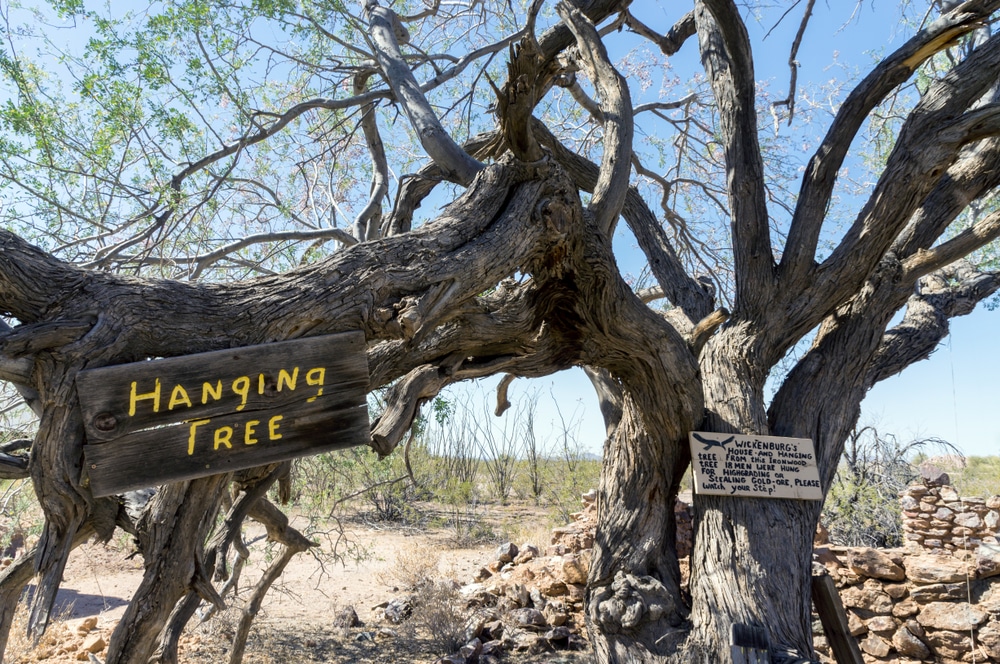
A macabre but fascinating site is the hanging tree, where outlaws were executed for stealing gold ore. Nearby are simple wooden grave markers and burial plots that tell grim stories of frontier justice. The tour guides provide the chilling details of these events, making for an unforgettable historical experience.
Before leaving, stop by the gift shop for souvenirs, local crafts, books on Arizona mining history, and Old West memorabilia. It’s a great place to find unique gifts and support the preservation of the town.

Vulture City hosts special events throughout the year, such as paranormal investigations, Old West reenactments, and haunted night tours. These are especially popular around Halloween. Some events include costumed actors, storytelling, and access to areas not usually open to the public.

Some tours and events offer demonstrations of gold panning, crushing ore, and other historical mining techniques. These interactive experiences are great for kids and adults who want hands-on insight into frontier life.

Vulture City is a photographer’s dream. From sun-bleached wood buildings to rusted machinery and desert backdrops, there are endless photo opportunities. Early morning and golden hour lighting make for especially dramatic shots.

Located in the Sonoran Desert, Vulture City offers beautiful desert views, especially in spring when wildflowers bloom. Watch for wildlife like desert cottontails, lizards, and birds of prey soaring above the buttes.


While Vulture City doesn’t have restaurants on-site, visitors are welcome to bring lunch and enjoy a picnic at designated spots. The peaceful surroundings and rustic atmosphere make it a unique place to dine outdoors.
| Category | Details |
|---|---|
| Name | Vulture City, Arizona |
| Type | Ghost town |
| County | Maricopa County |
| Founded | 1863 (following discovery of Vulture Mine by Henry Wickenburg) |
| Status | Preserved as a tourist destination and historical site |
| Population (Historic) | ~5,000 people at its peak (late 1800s) |
| Population (Current) | None (no residents; maintained for historical tourism) |
| Historical Significance | Home to Vulture Mine, the most productive gold mine in Arizona history |
| Primary Industry | Gold mining |
| Production | Over 340,000 ounces of gold and 260,000 ounces of silver extracted |
| Decline Factors | Mine closure in 1942 by federal order during WWII due to War Production Board regulations |
| Remaining Structures | Assay office, mine shaft, brothel, cookhouse, schoolhouse, hanging tree, and more |
| Preservation Status | Privately owned; tours available to the public |
| Geographic Setting | Located near Wickenburg, Arizona (~14 miles southwest) |
| Access | Reachable via Vulture Mine Road from Wickenburg |
| Elevation | Approx. 2,050 feet (625 meters) |
| Tour Information | Guided tours available; seasonal hours; historical reenactments and events |
| Best For | History buffs, ghost town tourists, photographers, Old West enthusiasts |
Vulture City’s story begins with a stroke of luck and an observant eye. In 1863, Henry Wickenburg, a prospector from Prussia, noticed a quartz outcropping while resting under a tree after being pursued by Apache warriors. Looking up, he spotted vultures circling overhead—an omen that would give the future mine and town their name. Wickenburg’s discovery of gold in this desolate stretch of Arizona Territory would prove to be one of the richest strikes in the region’s history.
The Vulture Mine quickly became the economic powerhouse driving settlement in this part of Arizona. By 1866, a small mining camp had formed around the mine, and within years, it grew into a proper town supporting the extraction operations. The settlement’s growth paralleled Arizona’s broader territorial development, with Vulture City’s gold helping to finance infrastructure and settlement throughout central Arizona.
At its peak in the 1870s and 1880s, Vulture City boasted approximately 5,000 residents, making it one of the largest settlements in the territory at that time. The town featured all the hallmarks of a successful mining community: stamp mills for crushing ore, assay offices, boarding houses, saloons, mercantiles, a school, and even a brothel district discreetly removed from the main residential area.
The mine itself proved extraordinarily productive, yielding some 340,000 ounces of gold and 260,000 ounces of silver between 1863 and 1942. This wealth attracted not just miners but also merchants, service providers, families, and eventually the attention of larger mining companies that sought to industrialize the initially rudimentary operations.
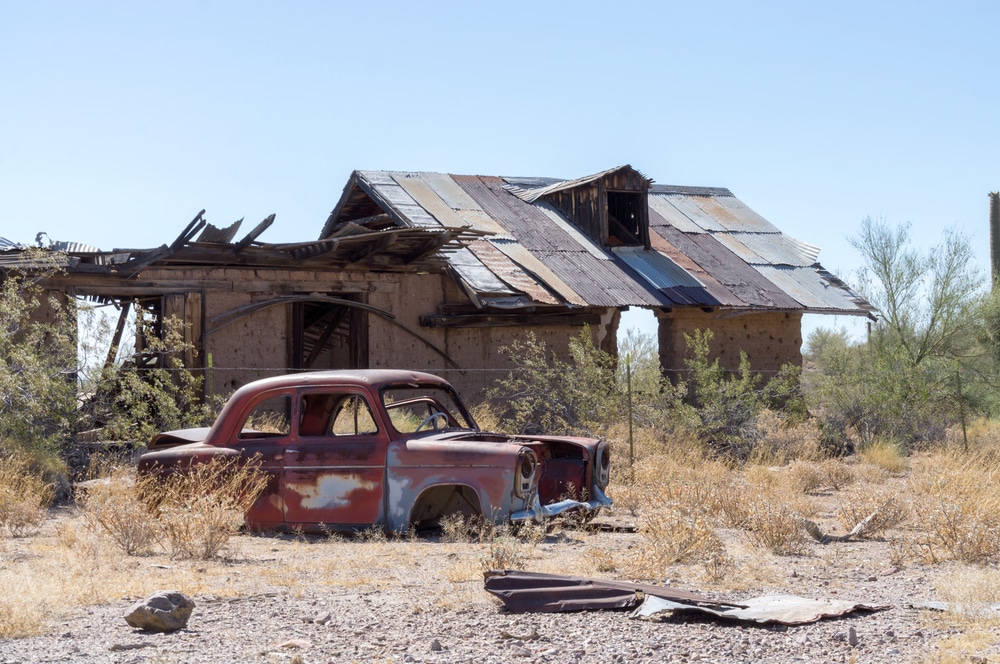
Today, Vulture City stands as one of Arizona’s better-preserved ghost towns, with numerous structures still intact enough to give visitors a sense of the once-thriving community. The Henry Wickenburg cabin—a simple stone structure—remains as a testament to the town’s founder. Nearby, the assay office where miners would bring their ore samples for evaluation still holds its original furnaces and scales.
The imposing remains of the main stamp mill, where ore was crushed to extract gold, dominate the landscape with its multi-level wooden framework. The mill operated day and night during the mine’s heyday, creating a constant thunderous backdrop to town life. Several mine shafts, now safely sealed, dot the surrounding hillsides, with warning signs marking their presence.
The town’s commercial district retains several buildings, including the former general store with its false front architecture typical of Western boom towns. The old powder magazine, built of thick stone to contain accidental explosions, stands apart from other structures for safety reasons. Nearby, the remains of the town jail—nicknamed “the snake pit” due to its reputation for containing rattlesnakes that discouraged escape attempts—offers a glimpse into frontier justice.
Preservation efforts began in earnest in the early 2000s when private owners recognized the historical significance of the site. Today, Vulture City operates as a privately managed historical attraction, with guided and self-guided tours available. Restoration work continues on several buildings, with archaeological surveys ongoing to document the town’s layout and material culture before the harsh desert climate claims more of its remains.
A quarter-mile from the town’s center, on a gentle slope overlooking the settlement, lies the Pioneer Cemetery of Vulture City. This final resting place for the earliest miners and settlers features roughly dug graves, many marked only with wooden crosses that have long since weathered away or simple stone cairns. Established almost immediately after mining operations began in 1863, this cemetery tells the harsh reality of frontier life through its scattered markers.
The oldest identifiable graves date to the mid-1860s, with hand-carved headstones bearing crude inscriptions that speak to the limited resources available. Many markers note deaths from mining accidents—cave-ins, explosions, equipment failures—while others record victims of disease, violence, or the extreme desert heat. A significant number of graves belong to men in their twenties and thirties, reflecting the dangerous nature of mining work and the predominantly male population of early Vulture City.
Today, the pioneer burial ground remains minimally maintained, with desert vegetation reclaiming many of the graves.
Unlike many mining communities that owed their existence directly to railroad expansion, Vulture City developed before rail lines reached central Arizona. The town relied initially on wagon trains and stagecoaches for the transportation of goods, people, and the precious gold being extracted from the mine. The nearest stagecoach station was originally in Wickenburg, requiring a dusty 14-mile journey over rough terrain.
Vulture City’s decline began gradually in the 1890s as the most accessible gold ore bodies became depleted. The mine required increasingly complex and expensive operations to extract diminishing returns. An abrupt acceleration in this decline came in 1896, when the discovery of an extensive operation to “high-grade” ore—workers secretly pocketing high-quality gold—led to a crackdown by the mine owners. According to local legend, 18 men were hanged from a nearby ironwood tree for this theft, though historical records suggest a less dramatic but still significant series of firings and prosecutions.
By the Great Depression, only a handful of determined residents remained, most engaged in small-scale independent mining or caretaking for the property. Mining ended in 1942 when wartime Order L-208 shut down gold mining operations nationwide to redirect resources toward mineral production deemed essential to the war effort. Unlike many mines that reopened after the war, the Vulture Mine never resumed full-scale operations, marking the definitive end of the community.
Vulture City holds a distinctive place in Arizona’s pioneer history as one of the territory’s earliest and richest gold mining operations. The gold extracted from the Vulture Mine contributed significantly to early territorial development, providing capital that helped finance infrastructure and settlement throughout central Arizona. Henry Wickenburg’s discovery effectively opened the central Arizona Territory to Euro-American settlement at a time when mining operations were primarily concentrated in the southern and central highlands.
For local indigenous communities, particularly the Yavapai people whose traditional territories encompassed the Vulture City area, the site represents a complex legacy. The establishment of the mine and subsequent town triggered significant displacement and disruption of traditional lifeways. However, historical records indicate that Yavapai individuals worked periodically in auxiliary roles at the mine, creating economic and cultural intersections that have only recently received scholarly attention.
Vulture City features prominently in regional tourism initiatives focusing on Arizona’s mining heritage and ghost towns. Its relative accessibility from Phoenix (approximately 90 minutes by car) makes it a popular destination for heritage tourism.
Visitors to Vulture City today encounter a site that balances public access with preservation concerns. The main ghost town is operated as a private historical attraction offering guided walking tours; check the current schedule before visiting.
Ethical visitation requires acknowledging that these sites represent not just historical curiosities but the final resting places of real individuals whose lives and labors built Arizona. Visitors are asked to remain on designated paths, refrain from touching or climbing on structures, and never remove artifacts or disturb soil. Photography is permitted and encouraged for personal use, though commercial photography requires special permission.
The Vulture City site faces ongoing preservation challenges from harsh desert conditions, with extreme temperature fluctuations and occasional flash flooding threatening the integrity of remaining structures. Vandalism and unauthorized artifact collection have diminished in recent years but remain concerns.
For those seeking deeper engagement with Vulture City’s history, resources are available through the on-site visitor center. More extensive collections can be accessed through the Arizona Historical Society in Tucson and the Sharlot Hall Museum in Prescott, both of which hold significant materials related to the town’s development and eventual abandonment.
As the sun sets over Vulture City, casting long shadows from the remaining buildings and silent headstones, we are reminded of the ephemeral nature of human endeavor. A town that once hummed with commerce, ambition, and community has returned largely to the desert from which it sprang. Yet in its quiet ruins and weathered grave markers, Vulture City speaks eloquently about the cycles of Western American development—the rush of discovery, the building of community, and the eventual reconciliation with environmental and economic realities.
The pioneers who rest in Vulture City’s cemeteries came seeking individual fortune but created something more lasting in the process—they helped establish the foundations of modern Arizona.
What endures beyond gold figures and population statistics is the human story of adaptation, community-building, and perseverance in an unforgiving landscape.
As contemporary Arizona grapples with questions of sustainable development, water resources, and economic diversification, Vulture City offers a potent reminder of both the possibilities and limitations of communities built around single industries. The ghost town stands as neither a cautionary tale nor a romantic vision, but rather as a nuanced chapter in the ongoing story of the American West—a place where pioneer dreams rest but continue to inform our understanding of human ambition and its complex legacy.
We use cookies to improve your experience on our site. By using our site, you consent to cookies.
Manage your cookie preferences below:
Essential cookies enable basic functions and are necessary for the proper function of the website.
Statistics cookies collect information anonymously. This information helps us understand how visitors use our website.
Monetize your website by displaying targeted ads and earning revenue from clicks and impressions.
Google Analytics is a powerful tool that tracks and analyzes website traffic for informed marketing decisions.
Service URL: policies.google.com (opens in a new window)
You can find more information about our Cookie Policy and Privacy Policy.


